
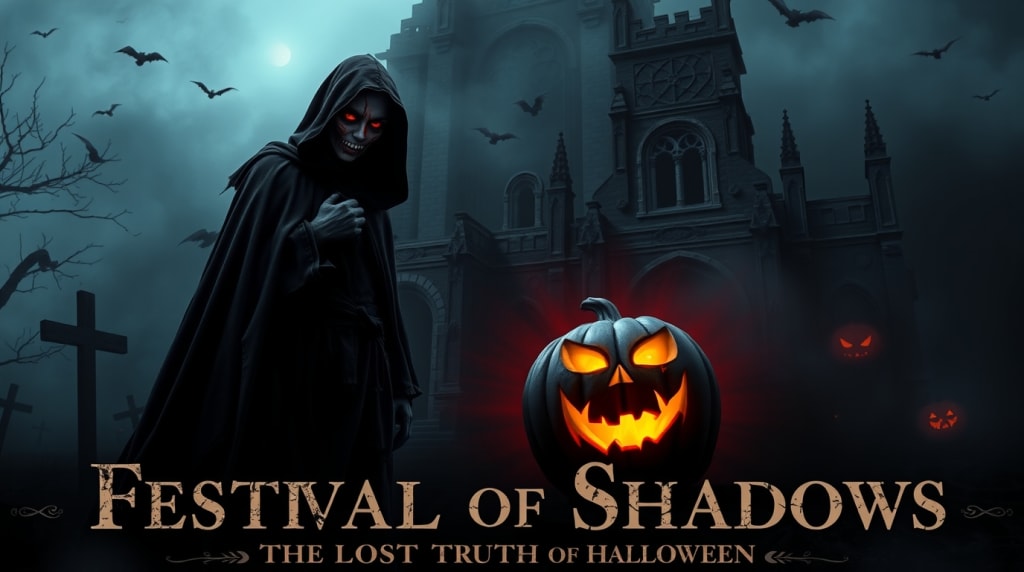
Festival of Shadows: The Lost Truth of Halloween
A Historical Horror Mystery — where fear hides behind every mask
The wind crawled through the hollow streets of Ravenshollow, a forgotten village in Northern England. Every year, as October bled into its final night, the townsfolk lit carved pumpkins, wore masks, and spoke the ancient words—“Trick or Treat.”
But this Halloween felt different.
Something old had awakened.
In the ruins of the village’s church, a local historian named Edward Burke discovered a book bound in cracked leather and sealed with red wax. Its title, barely legible, read:
“The Samhain Chronicle.”
And beneath it, in smudged ink, a warning:
“Halloween was never meant for celebration—it was meant for sacrifice.”
---
The Ancient Beginning
Centuries before Christianity reached the Isles, the land belonged to the Celtic tribes. They celebrated Samhain, the end of the harvest and the beginning of the dark half of the year.
On the night of October 31st, they believed the veil between the living and the dead grew thin. Spirits wandered freely, some benign, some vengeful.
To protect themselves, people lit great bonfires, wore animal skins, and left offerings at their doors — hoping to please the wandering souls.
As generations passed, the word Samhain faded, replaced by All Hallows’ Eve — the night before All Saints’ Day. And from that, Halloween was born.
But the essence remained: a night where the dead could touch the living.
---
The Church’s Silence
When Christianity spread across Europe, the Church saw danger in the old rituals.
To suppress them, Pope Gregory III declared November 1st as All Saints’ Day — to honor the holy, not the haunted.
But the people would not let go.
So the Church tolerated what it could not erase, and Halloween survived — a quiet rebellion hidden behind costumes and laughter.
Old Church records whispered of strange nights:
candles that wouldn’t stay lit, shadows that moved against the wind,
and whispers claiming that Halloween feeds on human fear.
---
A Clash of Faith
Centuries later, scholars from the East examined these customs.
Muslim historians saw in them not faith, but superstition — a human attempt to make sense of the unseen.
They wrote:
> “Man seeks to speak to the dead, forgetting that death has already answered.”
In Islam, remembrance of the dead is through prayer and charity, not masquerades and fear.
The Qur’an warns:
> “Indeed, Satan is your clear enemy—so take him as an enemy.” (Surah Fatir: 6)
And so, while the West turned Halloween into festivity, the East saw it as a mirror — reflecting mankind’s fascination with darkness, and his weakness before it.
---
The Night of Revelation
Edward Burke should have left the book sealed.
He didn’t.
As the clock struck midnight on October 31st, he opened The Samhain Chronicle inside the ancient church.
The wind howled through shattered glass. Candles flickered and died.
The pages turned themselves.
And a low whisper rose from the dark:
> “We are not the spirits you honor—we are the ones you forgot.”
Edward’s scream echoed through Ravenshollow.
By morning, the church stood empty, the book lying open beside the altar.
Across its final page, in blood-red ink, someone—or something—had written:
“Halloween is not a celebration. It is a remembrance.”
---
The Forgotten Truth
Today, Halloween is candy, costumes, laughter, and games.
But beneath the glow of pumpkins lies a shadow older than time.
A night once meant to guard against the dead has become a night that invites them.
The Celts called it Samhain.
The Church renamed it All Hallows’ Eve.
And the world, not knowing what it truly was, called it fun.
Yet every year, as the veil grows thin again,
somewhere — someone still hears the whisper of the old spirits:
“Remember us… or we will remind you.”
---
> “Every festival tells a story — some of joy, others of sorrow.
But Halloween… it tells the story of what happens when humans forget to fear the
About the Creator
Wellova
I am [Wellova], a horror writer who finds fear in silence and shadows. My stories reveal unseen presences, whispers in the dark, and secrets buried deep—reminding readers that fear is never far, sometimes just behind a door left unopened.
One Unchecked Box
"Republished" because it was the only way to add the embed for the newly recorded audio version of this story due to the Top Story badge. Plus it serves as a nice, informal announcement of the podcast's revival for another season (go subscribe!):
By Stephen A. Roddewig6 days ago in Fiction
A quiet reminder
It started with an advert in the back of the Tibley Chapter, the abundantly disappointing local newspaper for the small communities of Tibley, Wrenton and Barkley St Bennett’s. At the time nobody really paid a great deal of attention to it. It was small (at a cost of 25p per word there was a need for economy of communication) and unsurprising but ultimately it was so forgettable everybody did. For the reader’s benefit it is included here:
By Simon Curtis3 days ago in Fiction


Comments
There are no comments for this story
Be the first to respond and start the conversation.