

The Place Where Souls Never Sleep
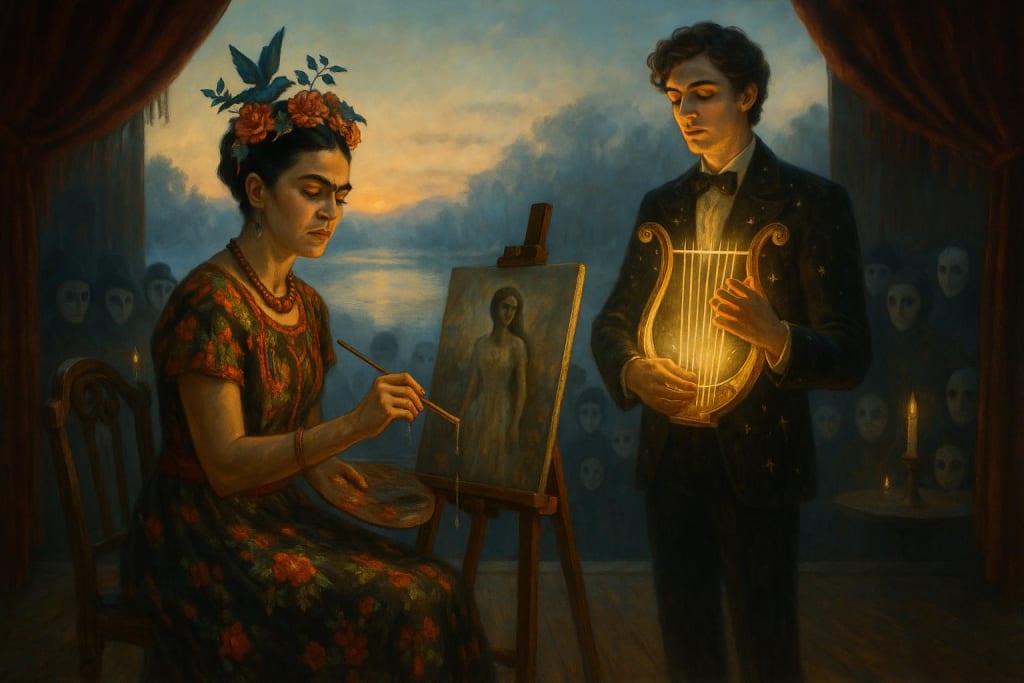
The cabaret floated on the edge of the Styx, between two worlds. Neither on earth, nor in the underworld. A suspended place, where time unravels and artists come to mourn what they never could say in life.
Frida was there.
Her dress, sewn with faded petals, trailed over the damp stones of the stage. Her corset creaked with each movement. Her eyes shone with a light no spotlight could produce.
She dipped her brush into a small vial hanging from her belt.
"A tear for love," she whispered."Another for betrayal."
The audience did not breathe. Waiting souls, some with blurred faces, others masked. All silent.
A chord resounded. Deep. Heavy. Alive.
Frida looked up.
He was there, at the other end of the stage, sitting on a rickety stool. A man with dark curls, dressed in a black suit embroidered with dim stars.
The lyre in his arms pulsed like an ancient heart. His fingers plucked the strings with a violent softness.
Frida stared, intrigued.
"Who do you play for?" she asked."For the one I lost.""You still think she hears you?""All I have left between her and forgetting is this music."
She smiled. It was a joyless smile, the crease of pain become habit.
"I paint for someone too," she said."For Diego?""For myself. For the day I died and no one told me."
The river whispered behind them, like an ancient choir.
Orpheus resumed playing. A slow, haunting melody, full of loops and longing. Frida closed her eyes, then opened another vial.
She painted. The first shapes emerged: a feminine figure, arms reaching toward something slipping away. Perhaps a memory. Perhaps a promise.
Orpheus, eyes lowered, continued to play. But slowly, his chords changed. He followed Frida's rhythm, as if he could hear her pain in her colors.
"Who is she?" he finally asked."A woman I invent each time I suffer. She is all the ones who cannot return. She is you, she is me. She is Eurydice."
He looked up. The name sliced the air like a blade.
"You know her name?""I know all the lost women. Pain teaches us only one thing: the faces we forget too soon."
He approached. Frida didn’t step back.
He offered his lyre. She, her brush.
Their hands touched.
A vibration shook the stage. The painting began to glow. The lyre bled red notes. The audience—the souls, the masks—faded slowly into smoke.
Frida whispered:
"We can’t heal absence. But we can offer it as tribute."
Orpheus murmured:
"What if I turn around again?"
She drew close, so near he saw the pain in her eyes as one looks into an abyss.
"This time," she said, "I’ll stay."
The Painting That Sang
The painting throbbed like an open wound. Colors flowed, slow and alive. Red for loss. Blue for silence. Black for waiting.
Frida and Orpheus worked together in silence.
Each note dictated a shape. Each shape inspired a chord.
The work sprawled across several canvases laid directly on the floor, spiraling around them.
Frida deposited symbols: a wounded deer, a shattered mirror, a sewn heart. Orpheus embedded vibrations: small golden resonances, trapped in pigment.
"Do you believe in what you make?" Frida asked without looking up.
"No. But I believe in what I lose when I don’t."
She nodded.
"I paint because it’s the only way I’ve found to stay."
"Stay where?"
"In the world. In my body. In the eyes of others."
They fell quiet. The river flowed gently. Occasionally a distant voice could be heard, a sigh from a forgotten nymph.
Frida shivered.
"Do you think we can create something that won’t die?"
Orpheus smiled.
"We can try. But we must infuse it with everything we accept to lose."
She nodded again. They continued.
And slowly, something changed.
The painting... began to sing.
A sad melody, but not hopeless. A lullaby for the lost. The song of wounded eternity.
What the Dead Leave Us
The cabaret was empty.
Only the two of them remained, and the painting.
Orpheus set down his lyre. Frida wiped her hands stained with vivid colors.
They sat at the edge of the stage, legs dangling into the void. The Styx shimmered below them, phosphorescent.
"I looked for her everywhere," Orpheus said. "But I no longer recognize her. Maybe I made her up."
"Or maybe you loved her so much she stopped belonging to the world."
"And you, Frida? Do you think we return after death?"
She thought a long time.
"I think we leave fragments. And those fragments haunt the things we loved."
He nodded.
"Then maybe this music, this painting... these are our fragments. Continuing on."
Frida placed her hand on the canvas.
"It will sing as long as someone listens."
And in a breath, she added:
"Don’t turn around again."
Epilogue
The cabaret vanished.
On the shore, only a lone canvas remained, floating lightly above the water.
It sings.
And whoever hears it will never again forget the pain of love.
The End
About the Creator
Alain SUPPINI
I’m Alain — a French critical care anesthesiologist who writes to keep memory alive. Between past and present, medicine and words, I search for what endures.
Keep reading
More stories from Alain SUPPINI and writers in Fiction and other communities.
Mastering French Without Losing Your Sanity: A Realistic Guide for Beginners
Learning French can feel like solving a Rubik’s Cube blindfolded. The tricky pronunciation, the never-ending grammar rules, and the surprising exceptions make it seem impossible. But don’t worry—equipping yourself with key expressions and effective strategies can turn frustration into fluency. Let’s simplify French and make learning enjoyable.
By Alain SUPPINIExclusive • 11 months ago
A Love Forboding
The chipped stone slope caused unbearable footing. I slid, skirting on my heels. I cast my shield, relinquishing my guard to stay upright. Left with my double-edge and a prayer to the maker, I skated toward my objective. The earthly stubble gave way to solid ground. I found myself restored, a trail of dust in my wake.
By James U. Rizzi8 days ago in Fiction
Stories Before a Wedding, or The Little Snow-White
A Royal Wedding the proclamation decreed. The Cursed Prince – now King – Artair had returned at last, and he was to be married. All across the land people rejoiced the upcoming union and rushed to the shops to buy ribbons to decorate their homes or clothing in celebration. As the Prince and his new Consort were to tour the Kingdom on their way to the capital, people lined the streets to meet him and those who travelled with him. At each town and village, the Prince – although he was no doubt tired and wished to see his aging Uncle, his noble and kind regent, as soon as possible – recounted the tale of his being cursed, the woman who had helped to free him, and his future Consort, the one known as Little Snow-White.
By Dionearia Redabout 14 hours ago in Fiction


Comments
There are no comments for this story
Be the first to respond and start the conversation.