
Please note. There are descriptions of religious beliefs and practices contained in HER HANDS. THEY ARE intended for use as setting, cultural context and character development. THEY ARE NOT intended to promote or criticize any religious belief or practice.
HER HANDS
Installment 3
Chapter 2
Scenes 7-9
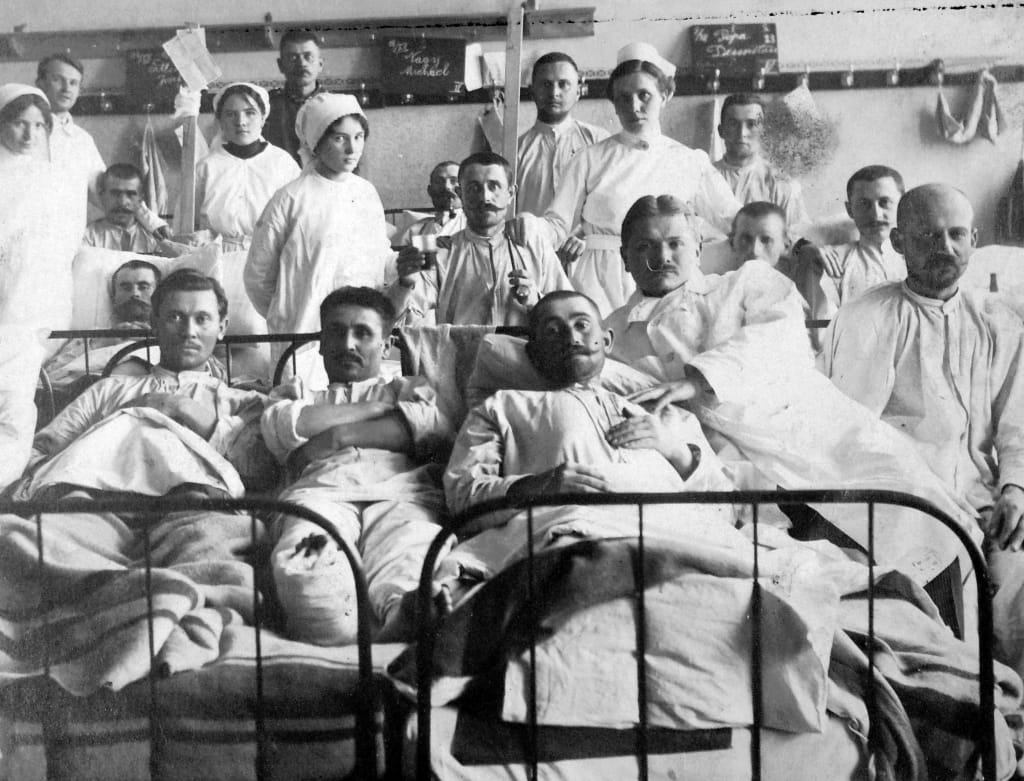
Sarah halted at the entrance to the hall packed with wounded men. Sister Joanna continued a couple more steps before stopping and looking back at her protégé. Sarah paid her no heed. Instead, she took in the enormity of the room and all it contained. She gazed at each person in each cot. She knew the names of each of the men, even those who had just arrived a couple days earlier. Others would find that remarkable. If Sister Joanna had known, she would have attributed Sarah’s ability to identify each of the wounded as the Lord’s providence. Sarah thought none of that, only that she knew each soldier, and that included his name. She knew how each of them had been violated. She knew how each of them responded to her voice, her touch. If she allowed herself, perhaps she also knew how each man would face the next day, the next month, the remainder of his life. But she did not allow that sense to develop to articulable consciousness. In her deep recesses she knew that she would suffer a crushing hell if she entered that realm.
Sarah stood at the entry to the hall and took in the men, as the individuals to whom she was now and always would be connected. She did not smell their urine, their feces, their sweat and fear; she didn’t hear their murmurs, whimpers, pleas, their rattling breaths; she didn’t see their grimaces, contortions, writhing or their placidity. At least not as we would. To Sarah, each of the wounded was much more than their corporeal expressions. She was with each of them at that more profound level. If asked, she would not have been able to explain that compelling grip. It was far beyond empathy. It was what projected her into the hall, alongside Sister Joanna, to begin her ministrations.
“Bonjour, Alphonse, how are you today?”
The twenty year old with bandaged eyes smiled, “I am well, Sarah, thank you. I am glad to be alive this day.”
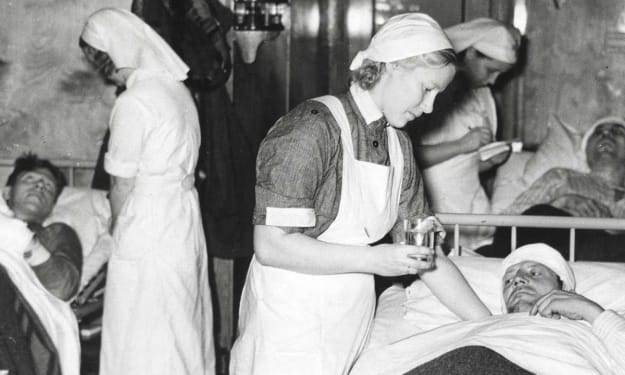
Sarah rested her hands on the young man’s brow, felt his fever. She lifted it from him with her cool palms. If she allowed herself to enter the hell of foresight, she would have said to herself, “He will survive.” Instead she replied, “Yes, it is a good day to be alive.” With that, she removed her hands from the young man’s brow. She offered, “Let me guide you to the latrine.” Alphonse knew from his four days at the hospital that he would return to a clean sheet on his cot, the coolness a relief, particularly since his morphine dosage had been reduced again that morning.
The soldier relieved himself, then waited for Sarah to return for him. As she was tucking in the corners of the new sheet on Alphonse’s cot, Sister Joanna came up beside her and asked, “This one, is he capable of being transported? Perhaps today.”
Sarah felt her breath escape from her. How should she know? And yet she did. Alphonse was blind, certainly, he always would be. And the shards of shrapnel had mostly been removed from his shoulder, with no apparent infection. But what did it mean ‘to be ready to be transported’?
Sarah asked, “Sister, where will he go?”
The nun answered, “I don’t know. Mule wagons will be here after the mid-day meal. Is he ready to leave?”
Sarah again felt her breath escape, “Perhaps.”
The nun fixed her eyes on the young woman’s. Sarah spoke, “Yes, I believe so.”
Sister Joanna nodded and left to tend to the man on the next cot. Over her shoulder she said, “This gentleman has soiled himself.”
Sarah knew that she was being told to fetch a bucket of soapy water, wash cloth and fresh linens for the cot and for the soldier. She also had to guide Alphonse back from the latrine. “Yes, sister.” She hurried off. As she did, she was clear she had given the correct response regarding Alphonse’s transport. Her sureness strengthened her. Some would say she was guided by God’s infinite wisdom. Sarah would not know what to say to that. She only knew what she knew. She would prefer that. What she knew then was that Alphonse was waiting for her at the commode, and his cot neighbor, Jean Claude, needed to have his feces wiped from his groin and the remains of his leg. That was all she needed to know or believe in that moment.
By the noon meal, Sister Joanna and Sarah had identified three other men who could possibly withstand the rigors of travel. Only three out of the nearly fifty who were in their care. The nun grew anxious. Word had reached the hospital that hundreds of men would begin to be delivered that afternoon, wounded from the shelling and fighting the past two days at Ypres. Sarah wanted to know who had made the decision to send so many when there was no room for them. Didn’t they know there was no room? The hospital could not accommodate much more than two hundred wounded, and that was with the corridors and alcoves crammed with bedding.
Rumor reached Sarah that the mule drawn wagons had arrived, twelve in fact, capable of carrying sixty men. The hospital administrator, Mother Superior Clothilde, and an officer whom Sarah had never seen before, moved through the hall, from cot to cot and identified the men who were to leave, maybe forty men when they were done. Sarah shuddered – most of those selected were in no condition to travel, several could barely get up from their cots.
Mother Clothilde instructed Sister Joanna and Sarah, and another pair of attendants, to prepare the men’s wounds and pack their belongings. They were to bring the designated men to the dining hall for a meal before the others. The men would then board the wagons.
Sarah’s head swam. She understood her instructions but did not follow them immediately. Instead, she watched the selection process. She had a fierce desire to run up to the officer and the administrator that this man, then another, were in no condition to travel in open wagons over rutted roads for God knows how long. The pain could crush some of the men. At the same time, she leveled a blinding anger at the head nurse who just followed the men, doing their bidding, as it were. Why did she not intervene? She knows! She knows! There had to be some other way!
“Sarah, we must begin.” Sister Joanna whispered close to the young woman’s ear. Sarah snapped her head at the woman, her eyes blazing but she said nothing. The nun flinched at the ferocity, responded, “It is God’s will.”’
Without reflection, Sarah charged, “No, it is not.” She then collapsed within herself, her angered frustration spent. She surrendered. She would do as she had been told because she could see no other way. She approached the nearest man who had been selected, Jean-Claude, the man whom she had washed up before her meal, lying on his cot, his hands across his chest holding the card the administrator had given him. With no legs he would need to be carried wherever he went.
“Jean Claude, it is time for you to gather your gear.” He had very little; what he was wearing, a spare pair of underwear, his service cap and a cup. Sarah looked at his card: on it was described his regiment, his wounds and his medications and morphine allowance. Sarah saw the card as incomplete. It wasn’t just because there was an empty square – she knew that space would be stamped by some person at some time to designate some thing, most likely something in the nature of being placed somewhere. No, it was the fact that the entire reverse side of the card was blank, unclaimed. She saw the coarse tan surface as important, as available.
Jean-Claude,” she asked, “What town are you from?”
The young man turned his attention to Sarah, answered simply, “Saint-Gilles”.
She asked him to spell it, to be certain. She then asked, “What department?”
“Gard”. He smiled for the first time that day. “It is beautiful. Even this time of year. The sun. Sometimes…” He trailed off. He wouldn’t allow himself the brief pleasure of remembering. Not now.
Sarah took a fountain pen from her apron pocket and wrote “Saint Gilles” and “Dept. Gard” in careful large block letters on the blank side of the card. She showed Jean-Claude what she had written, “Keep this with you, let everyone know this is where you are from.” She nodded sternly. He nodded back. This may help you return home.”
They smiled at her audacity. Sarah then scribbled her initials in the lower right hand corner. “Now it is official, yes?” They laughed together.
Sarah sensed Sister Joanna approaching. She knew this moment had been a luxury, but she felt no shame in taking it or, as she would recall later, giving it. “God speed, Jean-Claude.” She placed her hands on his shoulders.
The young man bowed his head, intoned, “I will always remember you. I will always remember you were there when my fever lifted. It was you…”
Sarah shook her head as he looked up, “No.”
“Aide LaMontaigne.” Sister Joanna was at Sarah’s side. “Is this gentleman ready for transport?”
Sarah didn’t look away from the soldier when she answered, “I believe he is.” She repeated, “God speed, Jean-Claude.” With that she left him for her next charge.
As she headed to the cot of the next wounded man, she committed to memory, Jean-Claude Allembert, Saint Gilles, Department du Gard. She then committed to writing that man and his home in her nearly empty journal, as soon as she could.
“Sister, where are these men heading? They want to know, we should…”
The nun held her hand up, palm facing Sarah, signaling her to silence. She said, “That is not for us to know. We will be told when it is time for us to know.” She lowered her hand slowly, suggesting that Sarah not react rashly.
The young woman watched the hand descend and thought, Who is to know? And who is to determine what shall be known? Witnessing her own impudence, Sarah finished her thought, And don’t tell me it is God or the instruments of God reflecting His infinite wisdom.
Sarah almost spun away from the nun. Instead she gathered herself and calmly approached the cot of the next man holding a card. “Simon, have you packed your belongings?”
Sister Joanna slipped away to prepare another designated man for the imminent journey. Sarah checked the soldier’s meager gear while calculating when the nun was out of earshot. “Can I see the card you’ve been given this morning?” The young man showed it to her. She held out her hand, smiling. He gave it to her.
“How are you feeling, Simon?” He answered that he felt very weak. She knew that there was a great injury to his bowels. He had only just stopped shitting blood the day before. “We’ll have you use the latrine now and right before you board the wagon. And here…” She handed him a snatch of linen cloth and a thin crescent of soap.
He understood her kindness. “Merci, nurse Sarah.”
“Of course.” She had a difficult time receiving his gratitude. She repeated, “Of course.” She braced herself, she knew: he would not survive the journey he was about to embark on. She turned the card over to its blank side. “What town are you from?” He answered. “What department?” He answered. She wrote the information in careful block letters, scribbled her initials in the lower right hand corner. She handed the card back to the young soldier whose bowels had been sewn back inside him the previous week, whose face was yellowish gray. She told him, “This card is important. It will help you get home.”
Simon nodded, his eyes welled with tears. “Yes, home.” He took the card, “Merci.”
Sarah placed her hands on Simon’s chest, above his beating heart, and poured her spirit into him, or so she believed in that instant. “God speed, Simon.” She left her hands there and let him receive her. “God speed.” She needed to leave him, there were the others. She handed him her last swatch of linen cloth and moved on to the next designated man.
***
The barely ambulatory men began their departure from the halls into the broad open day, to the mule drawn wagons, passing those newly arriving in the corridors and the courtyard by wagons and on foot. The incoming men appeared as if out of a mist or up from the soil, appearing in silence, carrying little but themselves or comrades in their arms. They carried the front with them; the blasted mixed scent of cordite and mud, of singed hair and scorched flesh. Their lacerations and punctures were so fresh, they were not yet infected and the absence of that too familiar stench startled Sarah. That reek would be upon them soon enough as the men with limbs sawn off at the field hospitals weren’t far behind, swarming with infection.
The distant thunder of the guns at the front set the cadence for these corporeal specters. The few became many, the many a torrent. Sarah dizzied. She didn’t know the breath it took to manage this all. She didn’t allow herself to look into the men’s faces or survey their wounds; she knew she was not able to. She knew she must set her feet firmly to just handle the terror of the onslaught so she could complete her assigned duties.
There were still so many men remaining in the hospital who needed to be removed. The new arrivals were now collapsing to the ground around her, against walls and wagon wheels. She turned and went back into the hall to assist the next young man depart. In the crowded hallway she passed Sister Joanna guiding blind Marcel out. Sarah had altered Marcel’s card, as she had so many men that day, so all whom he would hereafter encounter would know where his home was, where he needed to eventually arrive. She hadn’t been able to alter many of the men’s cards; she had tried frantically to reach them all, but now there was no time. She prayed for each of them and godspeed the comforts of home await them.
If there was a God in any of this, she called upon Him to be merciful and bring these men to those whom they loved. She didn’t implore Jesus. Her prayer was more a call for Him to do right, befitting His legend. She had no thought she was being impudent, only that she was expressing a just expectation.
She met Sister Joanna’s eyes and was surprised at the fear in them.
“Heaven help us.” The nun whispered.
Sarah nodded. She placed her hand on the woman’s shoulder, then her brow, quieted her clamor for an instant as the nun shut her eyes. Just for an instant, then the two women continued in opposite directions.
“Au revoir, Marcel. Safe return to Nantes.”
The soldier smiled and thanked Sarah.
Sarah returned to one of the few remaining men, but Mother Clothilde, came up to her and commanded, “We must gather those still here into a segregated area. The room off the dining hall should suffice. It will be crowded. Make bedding on the floor with only enough space to pass between. Then gather those who have stayed behind into that room.”
The Chief Administrator provided no opportunity to respond except with obedience. However, Sarah needed to know if she should finish preparing the man beside her and take him to the wagons. Mother Clothilde had observed this young aide’s ministrations throughout the departing process; the scribbled notes, her farewells. There was no time for that. There was a flood of grievously wounded men who would soon be dying of infection, spreading infection if her nurses did not expend every effort preparing the halls, the great rooms and small for the waves of bodies breaking against their walls.
She answered “No. As soon as you have placed the men, join the others in scrubbing down every surface. The room the remaining men are moving into has already been sanitized.” Again, the mother superior’s tone allowed only an obedient response.
“Yes, Mother.” Sarah then turned to the man lying on the on the cot beside the two women and mouthed to the deaf man, “Au revoir, Louis, Godspeed to Calais, to your loved ones.”
The man nodded grimly. Sarah said her small prayer silently, Jesus, please bring Louis home.
The mother superior didn’t move. She expected the girl to immediately begin her new assignment. She watched Sarah place her hands on the man’s eyes, saw the man quieten. There was no time for this. Before she could rebuke the insolent aide, the young woman was gone.
Mother Clothilde watched Sarah gather blankets and linens efficiently, with no wasted motion. She had heard about this young woman. There was something of a buzz going around about her. She had witnessed first hand today what aide LaMontaigne was up to; disregarding procedures that needed to be followed, wasting precious time with what? Writing hometowns on men’s medical cards? With no one having instructed her to do so? And then, just now, lingering after being told clearly what needed to be done! She could be a threat, a danger, a disruption. The mother superior would keep a close watch on the young woman.
About the Creator
Ed Burke
Poet, novelist, lawyer, father, friend. "Her Hands" is a novel in progress about Sarah, a transcendant healer serving during World War I. I will share the scenes taking form, consistently, until her saga is told. Ea/ Ed Burke on facebook


Comments
There are no comments for this story
Be the first to respond and start the conversation.