
It's Just How Things Have To Be
but I still blame you.



Yesterday, I watched a time-lapse video of a sunset. I’ve seen so many real sunsets. The sun sinks farther and farther behind the horizon until it’s gone. Its light lingers for a bit, then fades to night. The video, for some reason- the angle, maybe- made it easier to see the truth, which is, of course, that the sun doesn’t leave us. We’re the ones who turn away, knowing life will be dark and cold without it, but we do it anyway because that's just how it has to be. And here I was blaming the sun all this time.
About the Creator
Keep reading
More stories from Faith M Adam and writers in Fiction and other communities.
Diamonds are forever
Susan sat on the subway bench squeezed between two large people. They weren’t overweight, just tall, overall bigger than average. Susan was tall too, but slight and wispy, kind of like a birch tree. One small birch tree wedged between two big oaks. She accidentally looked directly at the man sitting across from her and quickly darted her eyes elsewhere. He saw her. Dammit. On the New York City subway, one does not look people in the eye. One certainly doesn’t speak to anyone unless asking for directions. Directions are allowed, but only if you don't live there. Sometimes, Susan does not pay attention to these rules.
By Faith M Adam5 years ago in Fiction
Trouble at the Tea Leafing Café
The rain had started right around the time that Annie was buttering her second thick slice of homemade toast for breakfast, and hadn’t paused since. Not that anyone could tell. The windows of the café were fogged over, and with every seat filled with happy customers munching on fresh baked pastries or steaming bowls of the delicious soup of the day, it was hardly surprising. Annie looked around the room, finally taking a moment to breathe after the lunch time rush. Her old life already felt like a bad memory, a part of her history, always, but just that. History.
By Hannah Moore4 days ago in Fiction
“180 Rupees That Killed a Man”
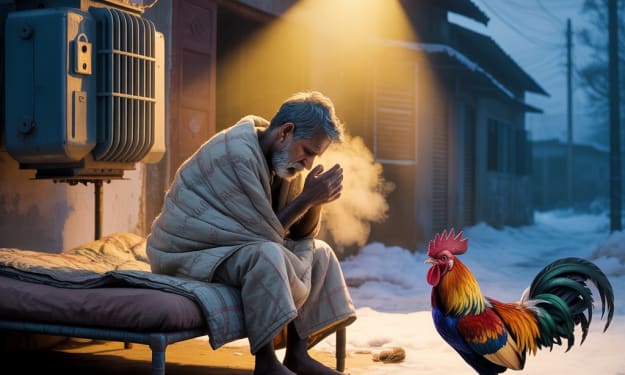
Nobody knew exactly when Master Ilyas came to this neighborhood and when he rented this room, but everyone knew that Master Ilyas was a migrant and belonged to an area in Ambala because he spoke the dialect that is spoken in Ambala. Master Ilyas lived in a rented room and the neighborhood boys would come to him to learn counting, recite multiplication tables, and write on slates. He had a pair of partridges and a purebred rooster. The partridges remained in cages, but the purebred rooster would stand a little distance from the door of his room. Master Ilyas had put a brass anklet on one leg of the rooster and tied a strong string to it, and tied the other end of the string to a nail hammered into the threshold of his room. All the people of the neighborhood respected Master Ilyas and would pass by his door saying 'Assalam-o-Alaikum'. Master Ji also did some other work, but nobody knew what it was. Perhaps he worked as a clerk in the vegetable market, or set up a stall in a distant neighborhood, or worked as a daily wage laborer painting and varnishing in a factory. Nobody knew about him very well, but everyone knew that Master Ilyas's livelihood was just barely sufficient. Actually, Master Sahib was a simple man and did not know how to keep up with the times. For some reason, his face was such that seeing it did not generate a feeling of love or sympathy in people's hearts, and for some reason, his conversation style was such that nobody would believe him. He did not lie. He did not cheat. He did not exaggerate. He did not boast. He did not scare anyone. Because of this People did not believe him. His conversation contained many grammatical and rhetorical errors, and the listener would get frustrated and leave his company. He was so simple and innocent that he didn't seem human. He seemed like a burden on the whole neighborhood and society, and since no one liked to associate with such people, he had no friends. That is why the neighbors respected him and would say "peace be upon you" as they passed his door. One winter evening, the landlord scolded Master Ilyas in harsh words and threatened that if he did not pay the past six months' rent of 180 rupees within three days, he would throw his belongings out. Master Ji was struck dumb with fear because he did not have one hundred and eighty rupees in a lump sum. He only had forty rupees, which he had made fifty by stringing a ten-rupee note with them. Earlier, the landlord used to take forty or fifty rupees and give a future date, but this time he became stubborn and threw the fifty rupees strung on a thread in front of the purebred rooster and said, "Go away! I will not take it. Give me the full one hundred and eighty." When he said this and left, Master Ilyas picked up the fifty rupees from the floor and put them in his waistcoat pocket. Then he went into his room, sat sadly on the cot, and due to severe grief, his voice was choked, and this was the first time someone's voice was choked without crying! Ghagha (choked voice) also means loss of voice in the throat. As promised, the landlord threw his belongings out. He placed Master Sahib's cot behind the two transformer poles and arranged the rest of his belongings around it. He put a new Chinese padlock on the room and rode his scooter home. His house was quite far from this neighborhood, and he used to come monthly to collect the rent for his rooms.
By Muhammad Haris khan about 12 hours ago in Fiction



Comments (4)
Great job and congrats of getting runner up 🥰
So poignant! Sometimes we’re just not ready to accept unconditional warmth, or let light shine on us. Life can be a cycle of seeking and turning away from that sun.
This was a real good one. Great work! Simple, yet elegant.
The title fits the story so well. Leaves me thinking of all the ways I blame something or someone. Well deserved win.