
More Orangutans
When a folk hero comes to visit, the inhabitants of a city-sized, one-way mirror take notice in a surprisingly unsurprised way.

JOHN Chapman rode north on his alpaca.
This was long before he acquired the alias, ‘Appleseed’, mind you. (English puritans would come to bastardize his exploits, associating them with those of copycat New England phil-apple-ists from years later, who sought to piggyback on his fame. They would say he had a horse, not an alpaca. They would say he walked barefoot beside this horse, because he did not wish to harm it. All untrue.)
In truth, John Chapman rode animals. And he wore shoes, too. He did not disapprove of letting an animal transport him in exchange for shelter and food. That was just good bargaining. He did disapprove, however, of rewriting history.
The real Johnny Appleseed, you see, rode his alpaca along the central valley of what would eventually be called California, planting appleseeds in areas that would eventually be suburban streets, with little green signs on their corners that would read “Manzanita” and the like.
He once came upon a city, nestled in the mountains in the northwestern part of the central valley; a city you will find no trace of today, just as you won’t find any trace of the vast river that brimmed the valley at that time, nor the herds of bison that grazed alongside it.
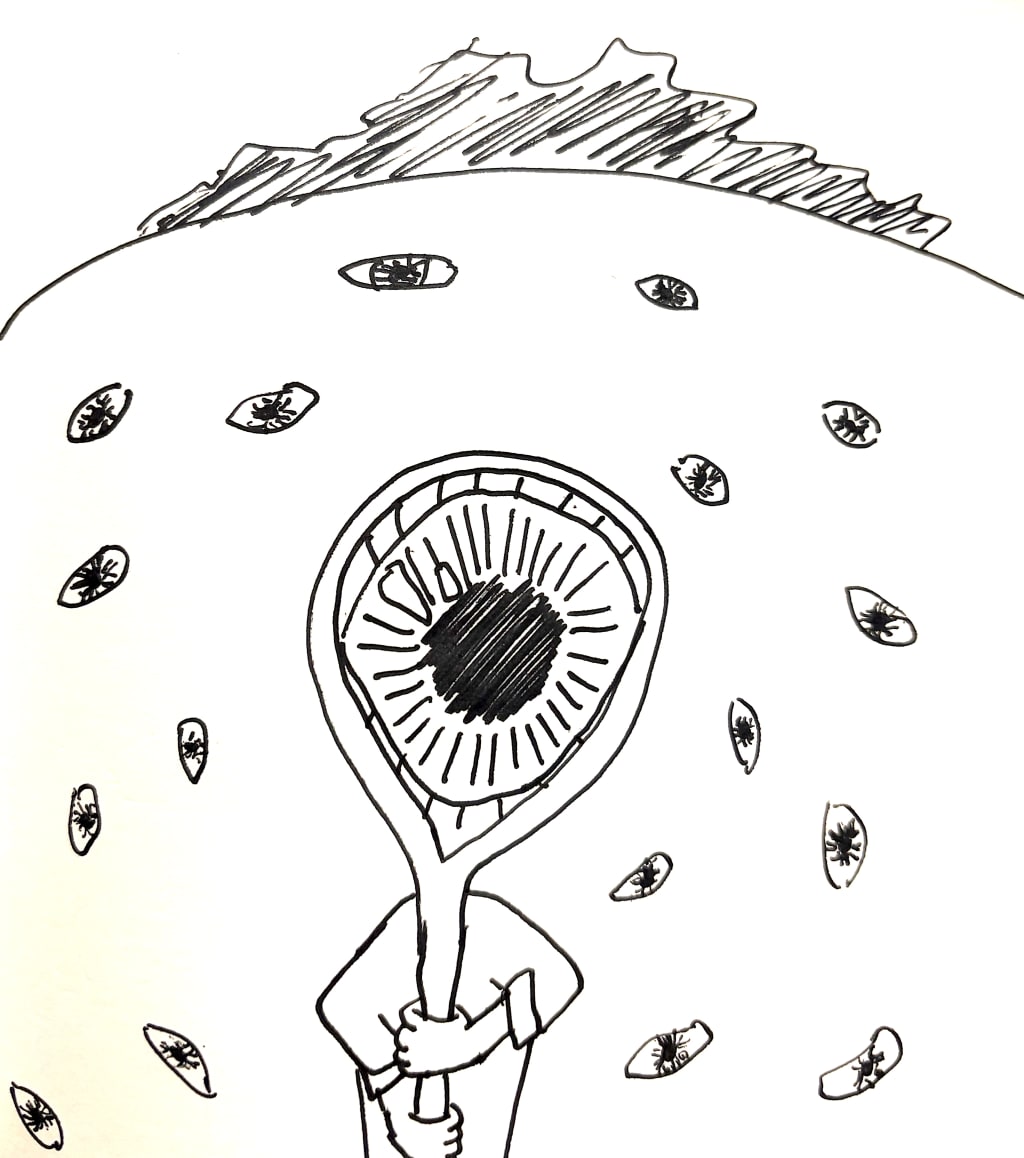
The city was made entirely of translucent glass, and domed entirely by a miles-long bulb of the same. Crowning this bulb was an immense, dark brown cloud, which seemed to lay stagnant, while its cleaner counterparts coasted above it.
John approached the dome, dismounted his alpaca, and touched it.
It was indeed real, and what befuddled him even more, was that it seemed to be reflective on the inside. He had never known a substance to possess this quality— to be transparent from the exterior, like air, yet reflective from the interior, like water.
His alpaca gave him a knowing look, because it suspected what he would do next, before he grabbed his trowel from the saddlebag; before he began digging; before he tunneled twelve feet below the surface, finally reaching the bottom of the dome, and digging toward the surface on the opposite side.
Before John breached the soil again, Ernie heard a sound coming from his backyard.
ERNIE was a citizen of the dome-city. A subject of it, in many ways.
He was a first generation domester, his father liked to say. His father took pride in the fact that he himself had been born outside the dome, that he could now say things like, “you don’t know how good you have it, growing up in this dome.”
His father had been selected decades ago by the founder of the dome-city— a wealthy stranger named Merlin Uncane— who had offered him a wife and a house of his own to come and be a part of his new settlement.
Ernie’s father and mother had no job in the dome. In fact, nobody did. The entire population was, in a word, complacent.
There had never been a crime committed in the dome, though they were all vaguely aware that the dome did have laws to break. Which laws, none could say. They were all quite sure thievery was illegal, but everyone had what they wanted and needed in the dome, so stealing didn’t make sense conceptually.
They were almost certain that murder was illegal, but murder required a lot of work, and the folks in the dome didn’t see each other in person often enough for a motive to accumulate.
Besides, there was always the issue of the sky-mirror.
The sky-mirror, or ‘god replacement’ as Ernie’s father called it, was a design of such ingenious intricacy that anyone, anywhere in the dome, could look up at any time, and see what the other inhabitants were up to. If someone, for example, did decide to steal, he would undoubtedly be perceived by all his fellow domesters, and would have to live thereafter in the shame of it. It simply wasn’t worthwhile.
Ernie’s father called the sky-mirror the ‘god replacement’, because according to him, parents had once told their children that God was watching over them, in order to make them behave properly, even when no one else was around.
“...but ever since the dome,” Ernie’s father would say chummily, “we haven’t really needed God.”
Ernie walked onto the glass parapet that overlooked his backyard. In the sky-mirror, a man created in his image was projected: shabby, unkempt beard, loose shirt, stained breeches. Below this, he saw a portion of his lawn dipping and bulging, as if a ghost were using it as a trampoline.
Suddenly, it opened, pierced by a hand bearing a sharp metal object. Ernie looked up at the sky-mirror, and saw in the reflection that many others were observing it too: each upside-down head above him looked through an otioscope— a sort of two-handed magnifying glass, which served to help the domesters zoom in on interesting things, and speak to one another; and it showed them all sorts of entertaining things in their leisure time.
Ernie had forgotten his own otioscope, and he walked back to get it, all the while keeping an eye, through his glass walls and flooring, on the section of his lawn that appeared to be in labor.
He grabbed the glass shaft of the device and returned. By this time, the hand which had breached through the lawn became an entire torso, topped by a straining face. One after the other, it retrieved its legs from the soil, then fell to its back, exhausted.
Ernie couldn’t blame him. He felt tired just watching. He zoomed in with his otioscope. The man had black hair and leathery brown skin, a shade Ernie had never seen. He noted deep pits in the man’s cheeks, above which his wrinkled eyelids remained shut, as he regained his breath.
Suddenly, the eyes opened. Brown irises. Like his own.
A MASSIVE brown eye glared back at John Chapman from the parapet. He rolled sideways and jumped to his feet, prepared to use his trowel as a weapon.
The cyclops atop this glass parapet had the body of a man, but its entire head was a terrifyingly vivid eyeball, peering down at him through some sort of translucent shepherd's crook.
“Ho there!” he shouted.
In response, the crook was lowered, revealing the unmagnified, and less frightening face of a regular man.
John lowered his trowel, sighing in relief.
The man’s skin was much lighter than he’d seen— silky beige— and smooth like a tooth.
“Ho there?” the porcelain man asked.
“Hello there, I meant to say,” John fibbed.
“Oh.” the man replied, “I’m Ernie.”
“John Chapman,”
“Mm.” Ernie said, “So, what brings you… up here?”
“Oh. I just, um…” He pivoted, saw himself looking back, marveling, for a brief pause, at the reflective clarity of the interior wall, “I just wanted to see how things, were, in here.”
Ernie placed the posterior end of his otioscope on the ground, glanced about for a second, and said, “Things are fine today. How’s the underground?”
John noted the hole he had made in this fellow’s backyard.
“Oh! This is… I am terribly sorry about this. I actually don’t come from ‘the underground’. I was riding north, you see, my alpaca and I. And we simply… I’m sorry. My curiosity is making it difficult to focus. Could you please tell me what it is you're holding?”
“This?” Ernie asked, waving the otioscope, “We use these to look at the sky-mirror, or talk to each other from far away, or sometimes just for entertainment.”
“Entertainment?”
Ernie nodded.
“Could you…” John’s intrigue peeled him from his manners, “I— I promise I will fill in the hole. I’ll plant an apple tree in its place, if you like. But while I have you here, would you mind… showing me how it works?”
Ernie thought for a moment, then shrugged.
“Sure,” he said, “Come on up.”
John gave his clothes a cursory pat, and entered the house. It had no front door. Only an archway.
John took the stairs very cautiously, the glass steps nearly impossible to discern by eyesight.
Eventually, he reached the crux of the staircase, where Ernie stood patiently, wearing that same, disinterested look.
“Okay, here’s how it works,” Ernie said, turning the face-sized loop of the scope toward John, and handing it to him. John held it by the shaft and squinted at it. It currently magnified a bowl of fruit sitting on a table, ten houses away.
“You said I can speak to people with it,” John said.
“Yes. Just point it at someone through the sky mirror.”
John looked up.
It was true. The whole of the city could be seen by looking up. There wasn’t a single person in the dome John could not spy on with perfect clarity.
He directed the otioscope at a woman on the opposite side of the dome. She was wearing an apron, and rolling a ball of dough into a flat circle. He could see every detail perfectly, down to the specks of flour on her knuckles.
“Hello,” he said into the device.
The woman’s otioscope buzzed behind her. She jumped, flinging her dough inadvertently out a window. It frisbee’d perfectly down onto a neighbor boy, who had been playfully running. He began playfully falling, as the dough enwrapped his eyes, and landed, squealing in pain, on his own otioscope.
“What was that sound?” Ernie asked.
“I’m not sure,” John said, “a pigeon, perhaps.”
Ernie did not know what a pigeon was, and believed birds, as a concept, were a myth.
“One more inquiry, if I may,” John said, “You mentioned entertainment…”
“Mm,” Ernie said, “For that, just turn it around, and ask it to show you something.”
John turned the device around.
“Show me an alpaca,” he said.
The image within the loop swirled, becoming a writhing wheel of colors, and exploded into the most vivid image of a field he had ever seen. The individual blades of grass swayed, the sun gleamed off of a spring, and an alpaca grazed serenely in the center of it all.
John was mesmerized.
“Watch this,” Ernie said over his shoulder, “Show me something funny.”
The image swirled again. The alpaca became an orangutan. The orangutan was wearing trousers, unaware of a second orangutan behind it, who snuck up silently, a roguish look on its flat face. This sly intruder waited a moment, then leapt, spooking his trouser-wearing counterpart. The trouser-wearer fled in surprise, flapping his long arms and hooting loudly, before tripping over the pants as they wound about his ankles.
Ernie chuckled, but John burst into raucous laughter, holding his sides, and crying hot tears for a full minute before he could finally catch his breath.
He asked the otioscope to show him more, and it obliged, supplying every image that could ever appeal to Man: encounters with violent sea creatures, beautiful women dancing suggestively, debates where his side won, debates where his side lost, feats of human strength, failures of their stupidity, miracles, the incomprehensible; John felt fear, lust, pride, anger, triumph, hilarity, amazement. He saw orangutans in trousers again. He saw other people reacting to orangutans in trousers.
In the hours that passed, the emotional spark of the images wore down, yet John and Ernie stood right where they had been, like raw nerve endings that had callused over, watching the images roll by.
Finally, John looked at Ernie, saw the same glazed countenance from before.
“Are you hungry?” John asked him.
Ernie thought for a moment, then nodded, “We’ll go to the commissary.”
“Commissary?” John asked. His brain felt sluggish, like it was thinking through mud.
“Food’s there.” Ernie said.
John had further questions, but his brain had yet to reach them. Ernie started walking.
John suddenly remembered his alpaca, whom he had left outside the dome, untied, for hours now.
“Actually, I must go,” he told Ernie hastily, “I need to check on someone.”
Ernie shrugged, and continued walking, his house now in the hands of a stranger.
John shook his head, trying to awaken his brain somewhat, then carefully navigated the stairs back down to the hole in Ernie’s yard, where he made like a worm.
ON the other side, he found his alpaca— about a half-mile in the air, hovering briskly toward the immense, brown cloud that crested the dome.
The cloud seemed to bud outward slightly, like an amoeba searching for bacterial debris.
John had a moment to consider this, before his own body started to lift from the ground, and his trajectory began to align with that of the ill-fated ungulate’s.
He kicked, spinning about in the air. This did as much to stop his momentum as it would if he were free falling.
His body rotated once, giving him a blurred moment to relocate his alpaca: It was now a far dot, approaching the humungous pseudopod of the cloud at rapid speed.
He rotated again, faster. His third and fourth rotations, he spent unconscious, while the fifth was technically not a full rotation, because he found himself suddenly halted in a reclined position.
The thing which had halted him was a pillar coming from the dome, or rather, whatever black magic was being emanated by the pillar. Beside it, an ancient, wizardly looking man stood scowling. He stood on the dome itself, brown wisps curling about his bare, wrinkled feet. His complexion was that of milk, albeit spoiled milk, and his scowl was so spitefully constituted that it seemed to keep his ancient body from collapsing on itself.
“WHO. ARE. YOU.” he rasped. It was a question phrased as an insult.
John sprang awake in time to answer in slurred sounds: “Jah Shapmeh…”
“WHY. ARE. YOU. HERE.”
John waggled his head, snapping himself further into consciousness.
“I’m sorry…” he began, “I saw your d— I assume it’s your dome— that dome down there.”
“THE DOME. AND THE VALLEY. ARE MINE.” the man snarled, “I. AM MERLIN UNCANE.”
The old man breathed crunchily, as though his lungs were frustrated authors, crumpling unsatisfactory pages that read things like “wheeze” and “rattle”, and tossing them to the surface as onomatopoeias.
John froze.
“DID YOU HEAR ME?” Merlin Uncane said, “I AM MERLIN UNCANE! I OWN THIS VALLEY. AND THE CITY WITHIN! YOU. HAVE. TRESPASSED!”
“I’m sorry, Lord Uncane! Please, just allow my alpaca and I to return to the ground, and you’ll have no more problems from us. We’ll leave and—”
“LEAVE? NO—” The words seemed to escape Lord Uncane without his permission, as though his lungs were not just authors, but part-time prison guards, who had taken their eyes off the monosyllables.
“I… shouldn’t... leave?” John asked.
“YOU… SHOULD…” Merlin’s body deflated, and his voice along with it, “You should stay… at least for a little while. Aren’t you interested in what I’ve made here?”
“Of course I am,” John said, “Your tone made me assume you were going to eviscerate me and make me into a part of this cloud if I stayed.”
“This cloud?” Lord Uncane laughed, “This cloud isn’t made of people. It's made of peoples’ minds. Their memories. Their priorities.”
John was silent.
“Whenever my citizens interact with their otioscopes, I retain the information from them. It all ends up here, in the cloud.”
“What information?” John asked, “The conversations they have?”
“Yes, and much more,” Lord Uncane responded, “The otioscopes watch reactions, study faces, find what causes them to wince, smile, etcetera! They can learn a person in a matter of hours, just by tracking how they amuse themselves. For example: I know what you lust after, what views you agree and disagree with, what makes you happy, sad… all from those few hours of interaction.”
“What,” John started, carefully, as though he were climbing a glass staircase, “do you plan on doing with all of this, information?”
“Doing?” Lord Uncane replied, “What do you mean? I'm accumulating it.”
“You don’t have an ultimate plan?”
“Plan?”
“Well, for example, I plant apple trees so that future generations can—”
“Fooey!” Lord Uncane spat, “You plant those trees for recognition! Every time you act humble about it, that’s a protest against your own egotistical nature!”
John fell silent again. He felt undressed.
“Accumulation— that’s what you and I do. I could say that I’m feeding and protecting those people in the dome, but you know, and I know, that they would be happier with the responsibility of looking after themselves! Every time someone tries to better the world, whether its apples or glass cities, they just end up making it more complacent!”
“Well… what exactly are we accumulating then?” John asked.
“Me? Information! Reasons why, when we see proof of ourselves in the mirror down there, we still see ourselves as something different. Something more.”
“And me?”
“You? You’re planting a million little red reminders that you were here. That you were more than that reflection, because your legacy will remain, and you’ll get a little tickle in your grave every time someone says, ‘I wonder who planted all these apple trees’.”
“What is a man supposed to do with his time then?” John asked, “If bettering the world is selfish?”
“If you can’t resolve that question for yourself, John,” Lord Uncane said, “I’ll provide you the second best option: you can go back in the dome, and ask to see more orangutans."
About the Creator
Noah Husband
Hey there,
I'm a cellular biologist by day, and an aspiring author by evening/night/2:00 in the morning when I drink too much coffee.
Sometimes a short story comes out of it, and finds itself here.
Keep reading
More stories from Noah Husband and writers in Fiction and other communities.
A Wall in a House. Runner-Up in If Walls Could Talk.
If walls could talk, this one would ask you for a goddamn cigarette right about now. I’m joking, of course. Even if you could supply me with one, I’ve got no arms to light it with, no mouth to suck in the smoke with, and no lungs to be blackened by it, because in case I wasn’t clear- I’m a goddamn wall!
By Noah Husband3 years ago in Fiction
The Frequency of Solitude
The silence of the Cascade Mountains was not an absence of sound; it was a heavy, living thing. It was the groan of ancient ponderosa pines leaning against the wind, the distant, crystalline shatter of glacial meltwater, and the overwhelming hum of sheer, terrifying vastness.
By Alpha Cortex4 days ago in Fiction



Comments
There are no comments for this story
Be the first to respond and start the conversation.