
Pass it On
"My beat is arts and culture. I’ve never covered crime or murder a minute in my career,” she said. “I figure if anyone can help me get to the bottom of this, it’s you."

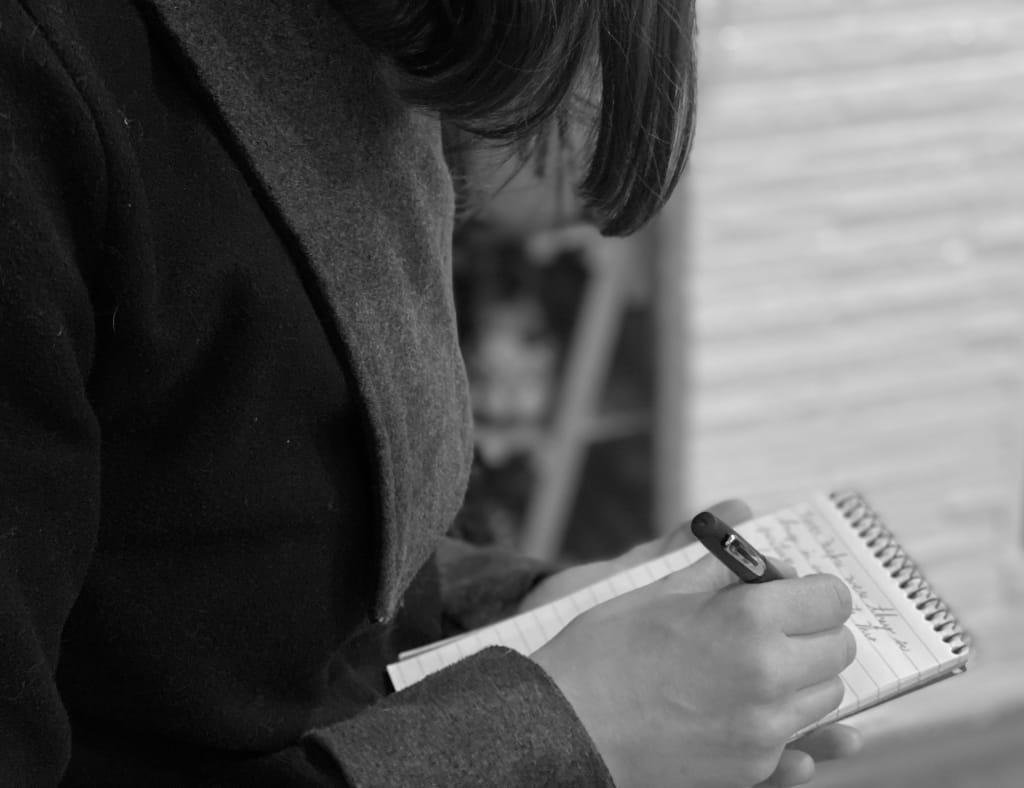
Glancing around the room at the seven faces of the dead on the wall, and the coffee table where cash, a notebook, and a gun lay, Dan briefly thought he’d wandered into some hitman’s apartment rather than his own. He supposed to outside eyes, the dwellings of both killers and those who track them must often look the same.
As he set down the bag of snacks and convenience store sandwiches—the bodega down the street had been the only thing open at two in the morning—he could hear Mary Ann in the shower down the hall and he was glad she’d finally taken a break. Though he had jumped in to take the lead only twelve hours ago, it was on Mary Ann’s doorstep that this story of murder and intrigue first landed one week earlier.
She’d called him yesterday morning, an edgy sound in her voice as she asked him to come over. He remembered the way she’d cautiously held the door half open, as though expecting a wild animal to charge in after him. She showed him into her living room, which doubled as a work space. Piles of paper and takeout containers marked the telltale signs of a reporter on the trail of a major story.
She sat down on the couch and gestured for him to join as she reached under the coffee table and pulled out a paper bag and a little black notebook.
“These appeared a week ago in my mail,” she said, setting them on the table in front of him. “There’s forty thousand dollars in the bag.”
Dan leaned over and saw several stacks of hundred dollar bills. “Where’d it come from?”
“It’s changed a lot of hands, all documented here in the notebook, but as to the original source, I’m still not sure.”
“May I?” Dan reached for the notebook without waiting for an answer. He slid off the elastic band and turned to page one. In a large loopy scrawl was written, Take half and pass it on. Page two had only a name, Stanley Applewood, with an address in Brooklyn. He turned to the next page—another name, another address. Dan saw several obvious tears and wondered if these, too, had been names. Nine pages in he found her, Mary Ann Doyle, with her Newark address. And after her, only one name remained—Julia Loe from Rochester.
“Three days later, I got a call from Adrian Costigni, page eight. He sent me the money, but not before copying the list. He was curious about how the others spent their money and started tracking them down. But what he found instead was a string of murders. They’re all dead. Every single one of them is dead.”
“We made plans to meet later that day, but he never showed. I got anxious. I had to know. So I went to his place in Queens. The door was wide open, keys still in it, and I could tell the place had been ransacked. I called the police and waited outside. He’d been shot in the head.”
Tension engulfed the next few moments as her story sank in.
“I’m out of my depth here, Dan. My beat is arts and culture. I’ve never covered crime or murder a minute in my career,” she said. “I figure if anyone can help me get to the bottom of this, it’s you.”
***
Dan had insisted they move their investigation to his apartment in the city right away, due to the obvious safety concerns of Mary Ann’s place. They set up shop in his living room, occasionally trading theories and sharing information, but for the most part it was quiet work.
As they became acquainted with the details of the seven murders tied to the notebook, a sense of unease crept into their shared silence. Neither talked about the fear they felt, but it was there in their shared glances and desire to keep busy with the task at hand.
After her shower, Mary Ann curled up on the couch with an herbal tea as she watched him plug away. Relieved to hand off the reins to someone else, she drifted off. Dan peaked back at her, eyelids quivering, face calm. He carefully placed a blanket over her and dimmed the lights.
Dan stood in front of the wall of paper they’d built together. The newspaper clippings and written notes were filed from left to right by their corresponding page numbers—from the first recipient to Mary Ann herself. So far they hadn’t discovered any obvious connection between them apart from a general geographic proximity to New York City. Their professions were all different, with incomes ranging all over the socioeconomic ladder.
Not counting the torn pages, if each person had followed the rules and taken only half, that meant the first person—Stanley Applewood—received $10.2 million, making his cut $5.1 million. The first to receive the money, Stanley was also the first to die. He was shot in his apartment just over a year ago.
The media coverage surrounding their deaths made no mention of any mysterious fortune connected to the deceased—with one exception. A 21-year-old grocery clerk from Manhattan had been less than subtle with his spending. Joshua Helton, page five, had apparently blown his cut on a Lamborghini. The article covering his death, headlined “Grocery Clerk in Meatpacking District a Possible Gang Hit”—made much of the fact that he’d recently bought a car beyond his means. Taking into account the fact he lived in a rough neighborhood and also happened to be Black, it seemed to conclude that criminal activity was the only possible answer. Dan sighed and shook his head at the journalistic failings that had cast shade over the young man’s life and death. He planned to write the reporter responsible and demand a correction—if we ever manage to uncover the facts, he mused.
Though the least inconspicuous with his spending, Joshua Helton hadn’t been the only one to start spending the cash before they died. New electronics, cars, houses, and other big ticket items had cropped up here and there as they peered into the seven lives on the wall. Dan looked at each in turn, amazed that his small living room wall could possibly hold seven lives on it. But it didn’t, not really. They were incomplete snapshots. No matter how much research he did, they would always be incomplete.
With this thought in mind, he resigned to put off any further digging until morning. He turned off the lights and retired to his bedroom down the hall.
***
It felt as though his head just hit the pillow when the sound of someone stepping on the creaky floorboard in the hall pulled him from a restless sleep. Dan assumed Mary Ann had woken up, no doubt with a crick in her neck, and figured he’d better make up the pullout couch for her. He wandered down the hall bleary eyed, trying to remember where he kept the spare blankets, and saw a figure too big to be Mary Ann blocking his way at the other end.
The remnants of sleep still weighing down his limbs, it took a moment for alarm to register. The figure raised one massive arm and Dan finally snapped out of it and retreated back toward his room. He’d nearly made it to the door when he heard a loud bang and felt an explosive pain hit his left arm. Without stopping to examine the wound, he slammed the door behind him, locked it, and began sliding his dresser to block the door. His assailant shot through the door at the lock and was kicking against it when Dan finally got the dresser—a heavy, solid oak piece—in place.
The kicking continued, but the dresser held steady—with Dan sitting on the bed and pushing his feet against it for added security. His arm was starting to gush and he reached across the bed to grab a flannel, which he tied above the bullet wound as tight as he could manage. As he did this, the kicking stopped. He strained his ears and after a few seconds heard the footsteps moving back down the hall. For a moment, Dan felt relief before remembering that Mary Ann was still out there.
He sprang up and began working the dresser back out of the way with his back braced against it. As he cleared the door, another shot went off. He stopped moving and froze in place with dread, waiting for the killer to come and finish him off next. If he moved fast, he could probably get the dresser back in front of the door. But how long would that buy him? He stared out his window briefly and considered jumping, but from the twentieth floor, his chances were no better. Before he could decide what to do, a voice called out.
“Dan?”
***
“Are you sure?”
“Of course,” Mary Ann said. “I wouldn’t be standing here if it wasn’t for you.”
“You know that goes both ways,” Dan said. He gave her a squeeze with his good arm and accepted the cash—twenty thousand, the same as the other piles on her coffee table.
She smiled at him and then placed a checkmark next to his name in the list she now kept in the little black notebook—the very same that started it all.
It had taken the cops, with help from a couple in-the-know reporters, six months to solve the case. They’d discovered that the killer was in fact page three in the notebook—or rather, the missing page three. It only took identifying the body and taking a look through his bank records to discover that James Reynolds had been the recipient of about $5.1 million.
What stumped them for quite some time was why James passed the money on at all if he only intended to take it back. A closer look uncovered a trail of unsavory financial decisions that began long before he became a multimillionaire. James Reynolds had a history of getting in debt to the wrong people, and somehow, even an unimaginable sum of money didn’t change that. It wasn’t clear if he had set out to kill everyone else on the list, or if it was a continuation of his poor financial decisions that kept him going. Either way, he’d kept a copy and knew just where to find more money when he wound up in yet another bind.
The investigation had petered out without providing any new leads on the original source of the money. While they were both insatiably curious to get to the bottom of it all, they were content to leave some things a mystery for now.
Without the source of the money, the police had no choice but to treat the notebook as a will, passing what remained of the money to both Mary Ann and Julia Loe, who was quite shocked by the fate she narrowly avoided. What remained was just over one million dollars.
Mary Ann liked to think the notebook owner had set out with good intentions, but she thought she could do better sharing the money equally. She was surprised none of the other recipients had tried to keep more than their fair share, some had even donated portions of their money. It felt like proof that there were still good people out there.
The money was going to a wide range of people, starting with the families of the deceased. Among them was Joshua Helton’s mother, who had written her thanks after their story broke, clearing Joshua’s name.
Mary Ann finished writing in the last of the Moleskine notebooks she bought for each pile. They were small, black, leather bound journals just like hers. On the first page in each, she’d written a single note—Should you find yourself in good fortune, pass it on.
About the Creator
Alyssa Gray
IG: @a.r.gray
TW: @AlyssaRGray
Keep reading
More stories from Alyssa Gray and writers in Fiction and other communities.
The Dust Bunnies are Revolting!
Seeing the loose way people use the word “hate” these days, I guess can say that I hate a lot of things. I hate soggy spinach. I hate dark rooms. I hate visiting relatives I don’t like, just because they’re sick. But nothing, nothing matches the hate I have for dust bunnies. They are vile, evil little things. I will do everything I can to wipe them out.
By Kimberly J Egan4 days ago in Fiction



Comments
There are no comments for this story
Be the first to respond and start the conversation.