
Terms and Conditions Apply
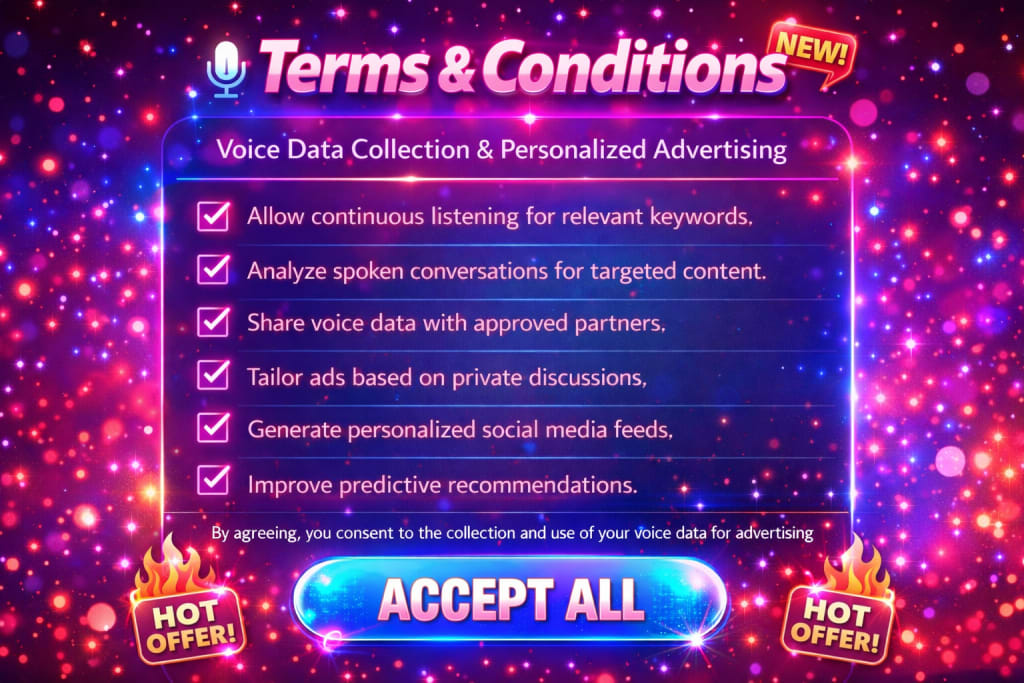
Your phone is listening to you and no one seems to care!

The first time it happened, Mara was cutting limes.
She was in the kitchen at work, the small one behind the café where the air always smelled faintly of citrus cleaner and burnt milk. Her phone lay face-down on the counter beside her apron, silent. She hadn’t touched it in ten minutes, which already felt rebellious.
Jonah stood across from her, counting spoons.
“You ever notice,” he said, “how nobody teaches you how to sharpen knives properly?”
Mara looked up. “You use a stone.”
“Yeah, but nobody explains when you’re done. Like, how sharp is sharp enough?”
She considered the question. The knife slid through the lime too easily, juice spraying her wrist. “When it scares you a little.”
Jonah nodded, satisfied. “That tracks.”
They worked in silence for a moment. Then, without looking at him, Mara said, “I think my phone is listening to me.”
Jonah didn’t pause. “Mm.”
“I mean literally. Not metaphorically. Not, like, data collection vibes. I mean listening.”
He tapped the spoon tray into alignment. “You get the blender blades yet?”
“In the drawer.”
Another lime split open. “I was talking to my sister last night. About hiking boots. I open Instagram this morning and it’s just boots. Boots everywhere. Brands I’ve never heard of. A reel of a guy lacing boots in slow motion like it’s porn.”
“Was it good?” Jonah asked.
“The reel?”
“Yeah.”
She thought about it. “Uncomfortably.”
Jonah smiled. “Algorithm’s on point.”
“That’s not funny.”
“I didn’t say it was funny.” He shrugged. “It’s just how it is now.”
Mara waited. Jonah didn’t elaborate. The fridge hummed. Someone laughed out front.
“So you don’t think that’s weird,” she said.
Jonah wiped the counter. “Define weird.”
She didn’t have an answer that didn’t sound dramatic, so she let it go.
That was the rhythm of things. A question raised. A softer question returned. No answer needed.
⸻
The ads escalated carefully.
They always did.
It wasn’t everything she talked about. Just certain things. Things spoken casually, without intention. A throwaway comment about wanting a new mattress. A joke about sourdough starters. An offhand complaint about her knee.
The next day, mattresses. Starters. Compression sleeves.
The precision was what bothered her. Not the fact of advertising. Advertising had always been there. Billboards, banners, the gentle harassment of pop-ups. This felt… intimate. As if something had leaned closer.
She tested it once.
In her apartment, alone, she said out loud, “I need a left-handed teapot.”
She didn’t search it. Didn’t text it. Didn’t even think about it too hard.
The next morning, there it was. A carousel of asymmetrical spouts and earnest ceramicists explaining ergonomics.
She stared at her phone for a long time.
Then she sent the link to her friend Elise.
Mara: this is new, right
Elise: what
Mara: ads responding to conversations
Elise: oh that
Elise: yeah
Mara: ???
Elise: you’re late to that party
Mara: so you KNOW
Elise: everyone knows
Mara: and we’re just… fine with it?
Elise: fine is a strong word
Elise: but what are you gonna do
That last message arrived with a sponsored post underneath it. Noise-canceling earbuds. Block out the world.
Mara put the phone down.
⸻
At brunch that weekend, she tried again.
There were six of them at the table, menus untouched. Sunlight bounced off glasses. Someone was already complaining about parking.
“So,” Mara said, “doesn’t it bother anyone that our phones are clearly listening to us?”
A brief pause. Just long enough to register, not long enough to threaten.
Her brother Ben sipped his coffee. “I don’t think they’re listening listening.”
“What do you think they’re doing?”
“Predicting,” he said. “Statistical modeling. You say boots because you were already thinking about boots.”
“I wasn’t.”
“You think you weren’t.”
Elise stirred her drink. “Honestly, I like it. Saves time.”
Mara looked at her. “Saves time doing what.”
“Shopping,” Elise said. “Discovering things. It’s efficient.”
Ben nodded. “Yeah. It’s convenience. You trade privacy for convenience. That’s the deal.”
“When did we agree to that deal?” Mara asked.
Ben smiled patiently. “When you clicked ‘Accept All.’”
Someone laughed. The server arrived. Orders were placed. The moment passed.
Mara noticed no one had actually denied it was happening. They just… reframed it. Polished it. Made it small enough to hold without flinching.
That night, she received an ad for a minimalist teapot.
⸻
At work, the café added new signage.
WE VALUE YOUR EXPERIENCE
Underneath, in smaller letters:
Please be mindful of conversations near service areas.
“What does that mean?” Mara asked the manager.
He adjusted the sign. “Just a reminder.”
“A reminder of what.”
“Of the environment,” he said. “People come here to relax.”
“So we’re not supposed to talk?”
“You can talk.”
“But not about…?”
He hesitated. Just for a fraction of a second.
“Anything upsetting,” he said finally.
Mara stared at him. “Like what.”
He smiled. “You know. Stuff.”
She did know. That was the problem.
⸻
The reels grew stranger.
Not darker. Not overtly threatening. Just specific.
A video about knee pain filmed in a kitchen that looked like hers. An ad for a book she’d described to someone but never named. A clip of a woman saying, “You ever feel like something’s paying attention to you?” and then laughing it off.
The comments were full of jokes.
lol same
phones be wild
don’t think about it too hard
Mara started noticing how often people said that.
Don’t think about it too hard.
It’s not that deep.
That’s just how it works.
Normalcy, she realized, was contagious. It didn’t require belief. Just participation.
⸻
She tried to stop.
Not in any dramatic way. She didn’t throw her phone in a river or wrap it in foil. She just… reduced herself. Fewer words. Shorter conversations. Silence where there used to be commentary.
The ads adjusted.
They filled the gaps with guesses.
When she said nothing, they supplied options. When she withheld desire, they suggested it anyway.
It felt less like surveillance and more like anticipation. As if the system was gently impatient.
At dinner with Ben, he noticed her phone was off.
“Battery dead?” he asked.
“No.”
“You good?”
“I’m just… trying something.”
He nodded. Didn’t ask what.
Later that night, she turned the phone back on. Notifications flooded in, relieved. The first ad was for a digital detox app.
She laughed. The sound surprised her.
⸻
The worst part was how quickly she adapted.
That, more than anything, scared her.
She began choosing words carefully, not to hide from the listening, but to manage it. To curate what might come back. If she mentioned stress, she braced for wellness products. If she joked about money, budgeting apps appeared like concerned friends.
She started speaking in bait.
At the café, she told Jonah she needed new running shoes. The ads arrived. He grinned.
“See,” he said. “Manifestation.”
“That’s not what that is.”
“Feels like it,” he said. “Universe listens. Phone listens. Same thing.”
She opened her mouth to argue, then stopped.
Across the counter, a customer was scrolling through her phone, smiling at something only she could see.
Mara cut another lime.
⸻
One evening, she received a notification that wasn’t an ad.
We noticed you haven’t engaged lately. Everything okay?
No logo. No brand name.
Just text.
She stared at it for a long time.
Then she locked her phone and went to bed.
In the morning, the notification was gone. In its place: a cheerful reel about productivity.
She watched it. All the way through.
She didn’t tell anyone.
There didn’t seem to be a point.
⸻
Weeks passed. Months, maybe. Time flattened.
The world didn’t end. No exposé dropped. No collective awakening. Just small adjustments. Policy updates. Better microphones. Softer language.
People joked about it more openly now.
“Careful,” someone would say. “Your phone’s gonna hear you.”
Everyone laughed.
Mara laughed too.
It was easier.
⸻
One afternoon, she sat alone in the café after closing. The lights dimmed automatically. Her phone lay on the counter, awake.
She said, quietly, “I don’t like this.”
The screen lit up.
Not with an ad. Not immediately.
Just a pause.
Then a notification slid into place.
We understand change can be uncomfortable.
She stared at it.
Outside, traffic moved. Inside, the fridge hummed. Everything continued, perfectly normal.
Mara picked up her phone.
She did not reply.
She didn’t need to.
The system already knew.
About the Creator
Jesse Lee
Poems and essays about faith, failure, love, and whatever’s still twitching after the dust settles. Dark humor, emotional shrapnel, occasional clarity, always painfully honest.
Choose Your Own Adventure: St Helena Station
*****Preface***** I have been obsessed with Choose Your Own Adventure stories since I was a kid. I credit them with my love of reading and writing. I've been struggling to get my own kids to embrace words the same way I have but they love video games and our occasional Dungeon's and Dragon's game... which gave me an idea. I'll write an interactive story. So far its working; my middle son loves it and can't wait for the next section to come out.
By Sandor Szabo7 days ago in Fiction
Candy Curse
Easter was always the busiest season for Mathias Grayson, the famed chocolatier of the quaint town of Willowridge. His confections were renowned—velvety truffles, delicate pralines, and his pièce de résistance: intricately molded chocolate Easter eggs filled with hidden surprises. People came from miles around to buy his creations, enchanted by their taste and beauty.
By V-Ink Stories5 days ago in Fiction
📢 Raise Your Voice Thread: 02/05/2026
Our “Raise Your Voice Threads” are hosted most alternating Thursdays at 12PM ET to offer creators more avenues to uncover exceptional stories on Vocal. As we are continuously searching for fresh creators and inspiring stories, this thread provides an opportunity to exchange and discuss the stories that have moved and motivated us on Vocal.
By Raise Your Voice by Vocal6 days ago in Resources



Comments (1)
They don't care because they are already selling all their data to AI. A lot of people lie about it too. It's weird. People constantly complain about privacy but then use AI for everything which is the biggest data harvesting tool available. Everyone keeps feeding the machine and complaining about the monster they're helping to create. Wild times.