

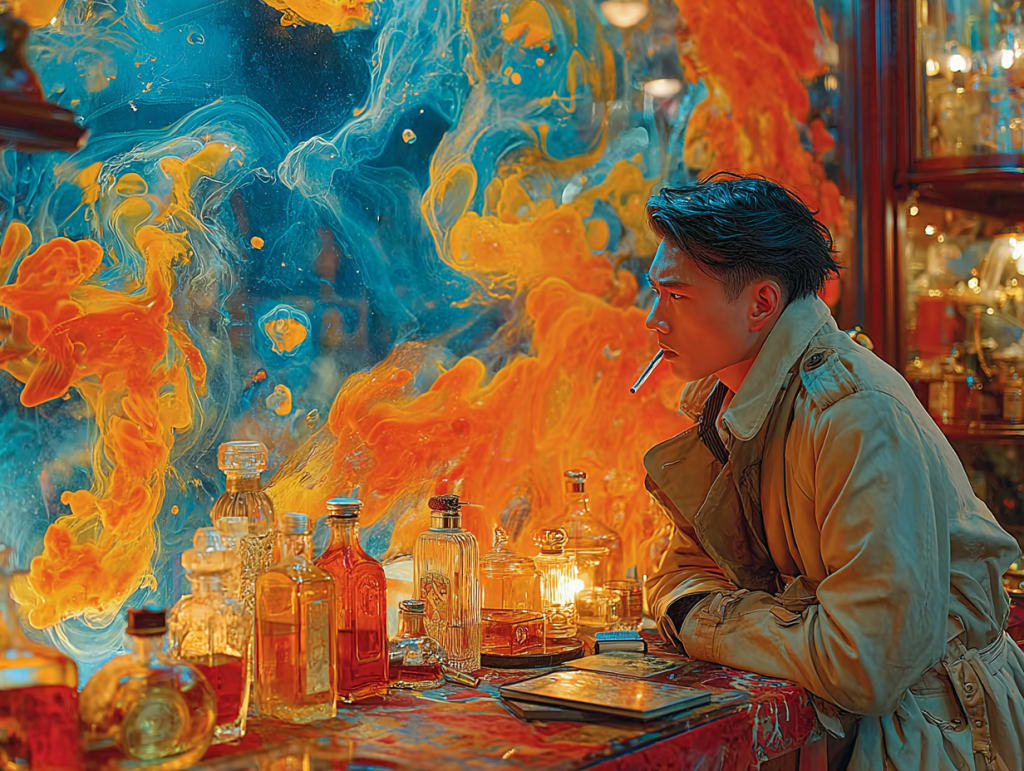
The bell above the door didn’t chime; it gasped, a breathless sound of old brass waking from a century-long nap. Elias stepped out of the relentless, greyscale rain and into the shop. The air inside was dry and smelled of ozone, beeswax, and things that had been forgotten in attics.
Behind the counter sat Madame Vesper. She looked like a woman sketched in charcoal—edges smudged, eyes dark and depthless, her age impossible to determine. She didn't look up from her ledger as Elias approached, his trench coat dripping water onto the dusty floorboards.
"You have brought the payment?" Vesper asked, her voice scraping like dry leaves on pavement.
Elias didn't speak. His hands, shaking with a tremor that had plagued him for three years, reached into his pockets. He laid three objects on the velvet counter, arranging them in a grim triangle.
An old photo. A broken watch. A blue lighter.
"Standard currency for a desperate man," Vesper murmured, finally looking up. Her eyes locked onto the items.
Elias swallowed the lump of razor wire in his throat. "You said if I brought the anchors, you could unravel the knot. You said I could go back to 11:13 PM."
Vesper reached out with a finger, a long, pale talon, and touched the first item: the old photo.
It was a Polaroid, its edges curled and yellowed like a dying leaf. The image was slightly overexposed, washing out the background, but the subject was clear. A woman, Sarah, laughing mid-sentence, her head thrown back. She was sitting in the passenger seat of a car. The flash had caught the sparkle in her eyes—a ghost of joy trapped in chemistry and paper.
"This is the memory," Vesper said. "The ideal. The moment before the world tipped on its axis. You keep this in your wallet, closest to your heart. It burns you, doesn't it?"
"Every day," Elias whispered.
Vesper moved her finger to the second item: the broken watch.
It was a silver wristwatch with a leather strap that had been snapped in half. The crystal face was shattered, a spiderweb of cracks obscuring the dial. But the hands were visible, frozen beneath the jagged glass. They stopped exactly at 11:14.
"And this," Vesper said, her voice dropping an octave, "is the trauma. The impact. The exact second the steering wheel locked and the tires screamed. Metal screaming against the guardrail. This watch stopped, but you... You kept ticking, didn't you, Elias? A machine that functions but no longer lives."
Elias gripped the edge of the counter. "I didn't come here for a lecture. I came for the exchange."
"And finally," Vesper ignored him, tapping the third item: the blue lighter.
It was cheap, translucent plastic, the kind you buy at a gas station for two dollars. It was scuffed, and the fluid level was low, sloshing sluggishly at the bottom.
"The catalyst," she mused. "You dropped it. That's what happened, isn't it? She asked for a light. You fumbled. It fell between the seats. You looked down for two seconds. Just two. When you looked up..."
"Stop," Elias croaked.
"The blue lighter is the guilt," Vesper finished ruthlessly. "It is the smallest thing, yet it carries the heaviest weight. Without this, there is no fire, no crash, no silence."
The shop seemed to stretch, the shadows in the corners lengthening into grasping fingers. Vesper leaned forward. "The ritual is simple, Elias. But the cost is not what you think. To return to 11:13 PM, you must destroy the anchors."
"I'm ready," Elias said. He snatched up the blue lighter. His thumb hovered over the spark wheel.
"Wait." Vesper’s hand shot out, gripping his wrist. Her skin was freezing. "If you burn the photo using the lighter, while the watch bears witness, you do not just erase the accident. You erase the timeline. But nature abhors a vacuum. If you remove the crash, you remove the grief. If you remove the grief, you remove the love that fuels it. You will go back to 11:13, yes. But you will not know her. You will be strangers passing on a highway."
Elias froze. The silence in the shop was heavy, pressing against his eardrums.
"I saved her life?" he asked.
"You save her life," Vesper nodded. "But you lose her history. She will never have met you. You will look at that passenger seat, and it will be empty. You will have never taken the photo. You will have never bought the lighter."
Elias looked down at the trinity of objects.
The broken watch stared back, a mechanical eye blinded by violence. It represented the worst moment of his life, yet it was the only thing that proved he had survived it with her, if only for a second.
The old photo beamed up at him, the laughter silent but deafening. If he did this, that laughter would still exist somewhere in the world, but it would never be directed at him.
He looked at the blue lighter. A cheap piece of plastic that had destroyed his world.
"She lives?" Elias asked, his voice trembling.
"She lives," Vesper confirmed. "But you die to her."
Elias closed his eyes. He thought of the three years of waking up screaming. He thought of the cold side of the bed. He thought of the way her hair smelled like rain and vanilla. He realized that his grief was a selfish monument. He was keeping her dead so he could keep her his.
He opened his eyes. They were dry.
"Do it," he whispered.
He flicked the blue lighter.
It didn't sputter. It roared. The flame wasn't orange; it was a vibrant, supernatural azure, hot enough to blister the air.
He held the flame to the corner of the old photo.
The chemical paper caught instantly. It didn't curl into black ash; it turned into white motes of light. The fire consumed Sarah’s face, her laughter, the car, the sunlight. As the image disintegrated, Elias felt memories being ripped from his mind like pages torn from a book. The first date. The coffee shop. The argument in the rain. The proposal.
Gone. Gone. Gone.
He gasped, falling to his knees. The broken watch on the counter began to vibrate. The sound was a high-pitched shriek of grinding gears. The hands on the dial began to spin backward—11:14, 11:13, 11:12. The glass face healed itself, the cracks sealing up with a snap. The leather strap knits back together.
The world around Elias dissolved into a swirl of grey rain and static. Madame Vesper’s shop fell away.
Elias blinked.
He was sitting in his car. The engine was humming a steady rhythm. The wipers were slapping against the windshield, clearing away the night rain.
He looked at the dashboard clock. 11:13 PM.
He looked to his right. The passenger seat was empty. There was no one there. Just a fast-food wrapper and a map.
A feeling of immense, crushing hollowness expanded in his chest, a void where a person should have been. He felt like he had forgotten something vital, something that defined the very shape of his soul. He patted his pockets.
He found a pack of cigarettes, unopened. He reached for his lighter.
His hand brushed against something in the center console. It was a brand new, cheap blue lighter. He picked it up, staring at it. He didn't know why, but the sight of it made him feel an inexplicable wave of sorrow, a grief so profound it nearly stopped his heart.
He shuddered, a ghost walking over his grave.
"Weird," he muttered.
Elias rolled down the window and tossed the blue lighter out into the dark, wet night. He didn't want it. He didn't know why, but he knew he never wanted to see it again.
He put the car in gear and drove on, alone, into a future that was empty, safe, and completely silent.
Author’s Note
This story was born from the idea that physical objects act as anchors for our psychological states. The old photo represented the idealized memory we cling to, the broken watch symbolized the trauma that freezes us in time, and the blue lighter served as the unexpected catalyst—the small, trivial object that carries the weight of guilt.
I chose the genre of Magical Realism/Noir to give these ordinary items a supernatural weight. The central theme is the "bargain of grief." Elias realizes that his pain is the only thing keeping his connection to Sarah alive. By choosing to save her, he has to sacrifice not just the items, but the memory of the love itself. The ending is meant to be tragic but selfless; he saves her by removing himself from her narrative entirely. The lingering sadness he feels at the end suggests that even when memories are erased, the emotional scar remains on the soul.
About the Creator
Diane Foster
I’m a professional writer, proofreader, and all-round online entrepreneur, UK. I’m married to a rock star who had his long-awaited liver transplant in August 2025.
When not working, you’ll find me with a glass of wine, immersed in poetry.
Keep reading
More stories from Diane Foster and writers in Fiction and other communities.
The Cost of Silence
I wasn't supposed to be there that late. Tuesday nights were Jen's closing shift, but she'd texted me at 7:43 PM. Her kid had a fever. Could I please, please cover? I'd said yes before my brain caught up with my mouth, the way you do when you've been working at the Riverside Animal Shelter for six years and everyone's become family.
By Diane Foster3 months ago in Fiction



Comments
There are no comments for this story
Be the first to respond and start the conversation.