
The Clockmaker’s Curse
In the quiet alleys of Prague, time does not tick forward—it waits to be fed.
The Whispering Castle
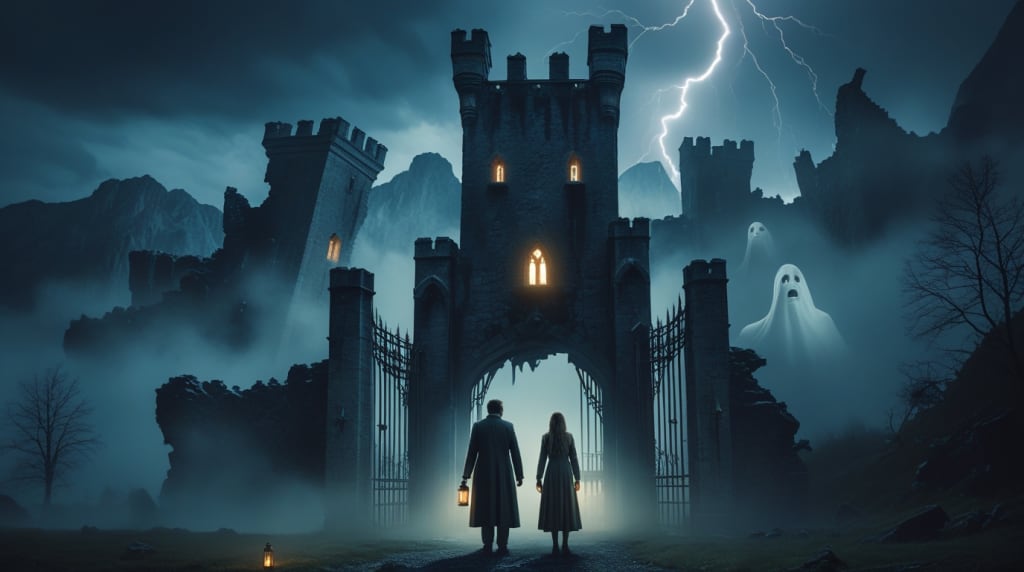
For centuries, the Carpathian Mountains of Transylvania have been shrouded in mist, their jagged peaks hiding legends older than the stones themselves. Among these myths stands Castel Ardelean, a fortress built in the 14th century, long abandoned, yet never truly empty. Locals call it “The Whispering Castle,” for on nights when the moon is shrouded, voices echo through its ruined halls—voices no one dares to follow.
Adrian Petrescu, a historian from Bucharest, had heard these tales since childhood. But unlike the villagers who crossed themselves at the mention of the castle, Adrian believed the whispers were nothing more than the wind. He was a man of logic, raised on facts and reason. When the University funded his research into medieval fortresses, Adrian saw it as his chance to disprove the old superstitions once and for all.
He was not alone. His companions were Dr. Elena Varga, a folklorist obsessed with Transylvanian legends, and Mihai Stoica, a photographer whose fascination with ruins bordered on reckless. Together they drove through winding roads and villages where elders warned them not to continue. “The walls still drink blood,” one old woman whispered as they passed. “And those who enter will not leave the same.”
They laughed politely, but a chill clung to their journey.
The castle emerged at dusk, black stone rising from the mountain like broken teeth. Its towers leaned against the sky, shattered by centuries of storms. Adrian felt a surge of triumph—this was history, not horror. Yet as they crossed the gate, the air thickened, heavy with the stench of damp earth and something metallic…like rust, or dried blood.
Inside, shadows pooled unnaturally. Mihai set up his camera, eager to capture the atmosphere. His flash lit the great hall, revealing faded murals on the walls: battles, coronations, and, curiously, a figure in red robes with no face. Elena traced the paintings with trembling fingers. “This isn’t in any archive,” she whispered. “This figure… it appears again and again.”
That night, they camped in the great hall. The fire crackled, and for a while they spoke of history, politics, anything to fill the silence. But silence had a weight here, pressing in until every flicker of flame cast faces in the smoke. Adrian told himself it was fatigue. Yet when he closed his eyes, he heard them—whispers crawling beneath the stone like worms.
He woke at midnight. The fire had gone out, and Elena was missing. Panic jolted him upright. Mihai stirred, muttering that she had gone to explore the chapel. They followed her trail with lanterns, their footsteps echoing in the vast emptiness. The chapel door groaned open, revealing Elena standing before the altar, frozen.
Carved into the altar’s stone was the faceless figure, larger now, its hands outstretched. Blood seeped from its palms, dripping into a basin below. Elena’s eyes were wide, unblinking. “It’s not a man,” she whispered. “It’s a mouth.”
The whispers swelled, filling the chamber. Mihai snapped a photo, but the flash revealed something the lanterns could not: dozens of pale figures lining the walls, mouths open, whispering, though their bodies remained still.
Adrian grabbed Elena’s arm, dragging her back, but the floor shifted beneath them. The stones pulsed like flesh, and from the cracks seeped a dark liquid. The whispers became screams.
They fled, but Mihai’s scream echoed behind them. Turning back, Adrian saw him suspended in the air, his camera still flashing. A faceless shadow loomed over him, its form shifting, its body made of the same darkness that filled the murals. Mihai’s body withered in seconds, his skin collapsing over brittle bones. His last flash captured the moment—the shadow feeding on him, its faceless void pressed to his skull.
Elena sobbed, pulling Adrian away. They stumbled through endless corridors, yet the castle had changed. Doors led back into the same halls, staircases looped downward into themselves. The architecture had become a maze alive, reshaping with every turn.
They finally collapsed in a chamber Adrian did not recognize. On the walls were names carved into the stone—hundreds, thousands, each etched in blood. Adrian’s lantern flickered, and in its glow he read them: villagers, nobles, scholars. Every person who had entered the castle for centuries. At the end of the list was a new name, fresh and wet: Mihai Stoica.
Elena’s scream pierced the silence. Another name was carving itself into the wall, slowly, as though cut by an invisible knife. Adrian Petrescu.
Adrian’s knees buckled. He clawed at the wall, desperate to erase it, but the stone cut his fingers. Blood smeared across the letters, and the whispering voices roared with hunger. Elena pulled him up, and together they burst through a hidden stairwell that led into the crypt.
Coffins lay open, empty. But the air pulsed with life. At the far end, a throne of bone and iron stood. And there, seated, was the faceless figure from the murals. Its body was robed in centuries of shadow, its head a void.
Elena raised a silver cross, shouting prayers, but the figure simply lifted its hand. The cross melted like wax. The whispers condensed into a single voice, deep and resonant:
“You are history now.”
The castle walls shook. Adrian felt himself dragged forward, his body weightless, his will dissolving. Faces screamed within the throne, souls of the devoured. Elena’s hand slipped from his grasp as darkness swallowed them both.
When villagers passed the mountain weeks later, they noticed new lights in the windows of Castel Ardelean, flickering like candle flames. They said the whispers had grown louder, carrying on the wind for miles.
And in the University archives, months later, a package arrived without sender. Inside was Mihai’s camera. Its final photograph showed a hall filled with faceless shadows—and in the corner, two new figures among them: Adrian and Elena, their mouths open, whispering.
About the Creator
Wellova
I am [Wellova], a horror writer who finds fear in silence and shadows. My stories reveal unseen presences, whispers in the dark, and secrets buried deep—reminding readers that fear is never far, sometimes just behind a door left unopened.
A Love Forboding
The chipped stone slope caused unbearable footing. I slid, skirting on my heels. I cast my shield, relinquishing my guard to stay upright. Left with my double-edge and a prayer to the maker, I skated toward my objective. The earthly stubble gave way to solid ground. I found myself restored, a trail of dust in my wake.
By James U. Rizzi3 days ago in Fiction
Spellslinger
The desert stretches its dry mouth out before me, dust filling my lungs as the light filters from the sky. I can see, just barely, the outlines of the next town on the horizon, and I lean forward and stroke Silas's mane. "Almost there, boy," I whisper, hoping the heat of the bodies I sense with the probing fingers of my magic isn't an illusion. This inhospitable land can do strange things to a person over time, and I've already been on the road for days.
By Raistlin Allen3 days ago in Fiction


Comments
There are no comments for this story
Be the first to respond and start the conversation.