
The Day Fiction Came Alive
One morning, writers around the world wake up to find their fictional creations walking, talking

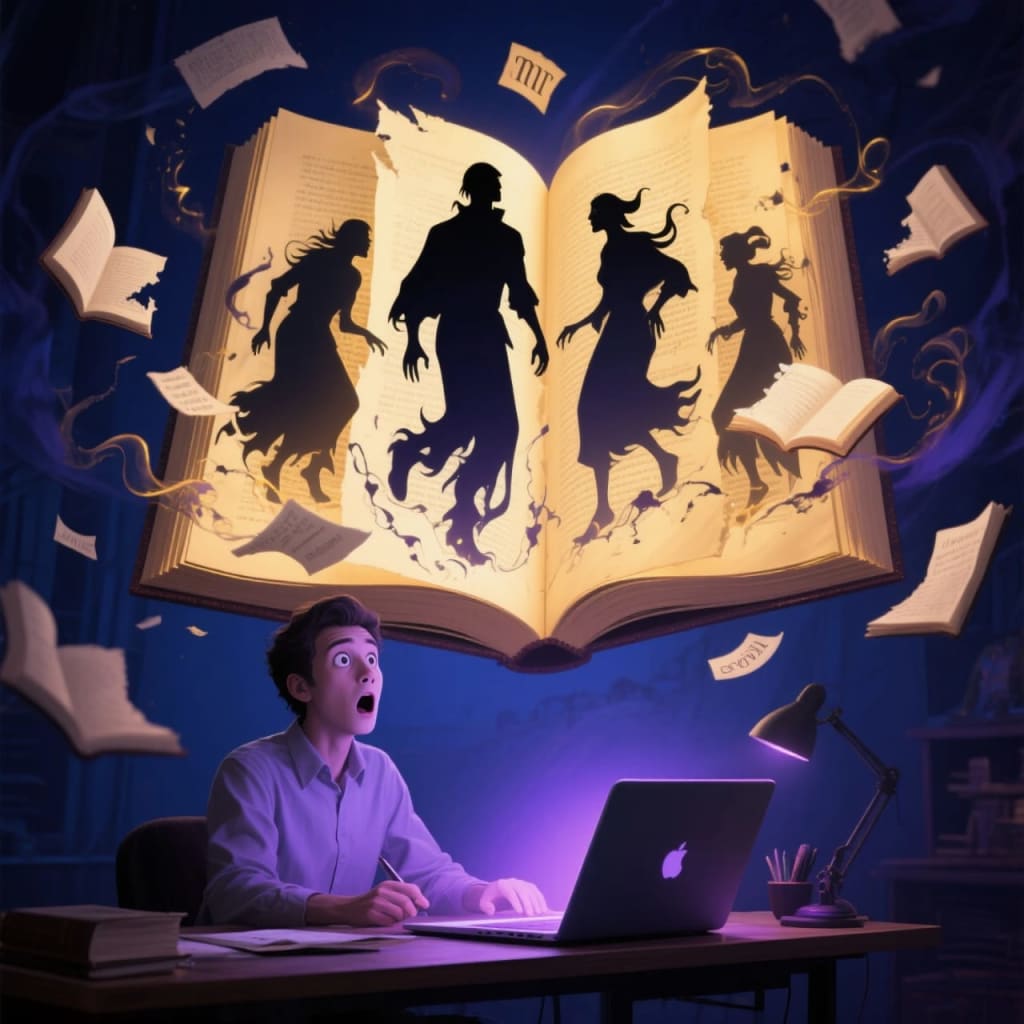
The morning fiction came alive started like any other.
I was half-asleep, gripping my third cup of instant coffee, staring at the blinking cursor of Chapter 17. My protagonist, Rowan Vale, a former assassin turned reluctant hero, had just lost his best friend. I’d written the scene four different ways, deleted it each time. Nothing felt right.
Then the doorbell rang.
I shuffled to the door in my slippers, still groggy, expecting a package. Instead, a man stood there—tall, lean, dressed in black tactical gear with a scar cutting through his left eyebrow.
“I need to talk to you,” he said.
My heart froze. Because I knew that face. I had described that face. Down to the smallest detail.
“You’re... Rowan?” I whispered.
He nodded. “I’m not sure what you did—but I’m real. And I’m not the only one.”
That’s how I learned my fiction had stepped off the page.
The phenomenon was global. Within hours, social media exploded. Tweets flooded in:
> “My vampire prince is currently raiding my fridge. I never thought I’d have to explain gluten-free to a 500-year-old.”
> “My romantic lead just proposed to my roommate. She said yes. Should I be jealous or impressed?”
> “My horror villain is missing. I repeat: MISSING.”
Fictional characters were appearing in kitchens, city parks, subway trains. Some were confused, others amused. A few—especially the villains—were adapting a little too quickly.
Governments scrambled to respond, but what do you do when imagination becomes reality?
Some writers hid. Others went viral. A handful profited wildly—book sales soared, streaming rights got snapped up, agents fought to represent “the characters themselves.”
I went into full-on panic mode.
Because Rowan Vale wasn’t just a hero. He was broken. Dangerous. His world was brutal, filled with war, betrayal, and conspiracies. And now he was here—in my cramped apartment—pacing the living room like a caged wolf.
“You wrote me to suffer,” he said that night, holding my manuscript like a loaded gun. “You gave me blood on my hands. A past I can't erase. Do you have any idea what it’s like to remember pain that never actually happened?”
I had no answer.
He wasn’t wrong. Writers break characters to rebuild them. But I never expected to be confronted by one.
Over the following days, more characters found their authors.
Some arrived with joy, like children reuniting with parents. Others came with rage. Lawsuits were filed. One author had to flee after her dystopian rebels tried to overthrow the city council. Another went into hiding after her jealous ex-lover villain torched a bookstore.
But the deeper mystery remained: Why was this happening?
Scientists had no clue. Religious groups called it divine retribution—or salvation. Conspiracy theorists believed AI was to blame. A few people whispered that this wasn’t the first time the boundary between fiction and reality had frayed.
Me? I just wanted to survive my own creation.
Rowan refused to leave. He read every scrap I’d ever written. He wanted to meet other characters from his world. When I told him they were still fictional, he stared at me.
“Then write them,” he said. “Bring them to life.”
That’s when it hit me: what if I could?
What if the connection wasn’t random—but tied to us? The writers. Our minds. Our stories.
I picked up my laptop and began to type again. Not fiction. Not exactly. More like a letter—an invitation.
By morning, two of Rowan’s closest allies had appeared on my fire escape. A tech genius named Em and a spy named Talia. Both stunned. Both very, very real.
Rowan smiled for the first time since arriving.
But it wasn’t all good news.
Because not every writer had pure intentions.
Soon, news reports told of supervillains taking control of buildings, warlords claiming cities. Writers—either terrified or power-hungry—were turning the world into a patchwork of clashing genres. Noir detectives patrolled Tokyo. Dragons flew over Paris. A zombie outbreak hit New York, but was stopped by a teenage girl with glowing eyes—born from a fanfiction blog.
The world tilted on its axis.
The United Nations hosted an emergency summit—with invited “fictional delegates.” That’s when they issued the term: Narrative Collision—the merging of imagined realities into our own.
“We have to fix this,” Rowan said one night, watching the chaos unfold on my TV. “But not with governments. With writers. We’re the key.”
He proposed the impossible: a united narrative treaty.
Writers across the globe—fantasy authors, thriller creators, poets, screenwriters—had to come together. Define boundaries. Rewrite the rules. Agree to one law: Characters cannot be created without intention. No more reckless worlds. No more villains without purpose.
We formed The Circle—an alliance of writers and their creations.
We drafted the Author’s Pact.
And we began to restore balance.
It’s been a year since that day.
Rowan still lives with me, but now as a friend. He mentors other characters born from trauma. I teach writing workshops to new authors—not just about plot or structure, but responsibility. Imagination, I’ve learned, is power. Stories shape reality more than we ever knew.
The world will never be the same.
And honestly? That’s okay.
Because maybe, just maybe, fiction becoming real wasn’t a glitch or a punishment.
Maybe it was a gift.
A reminder that the stories we tell—about love, loss, heroism, redemption—matter. They always have. They always will.
And now, they walk among us.
About the Creator
Muhammad Sabeel
I write not for silence, but for the echo—where mystery lingers, hearts awaken, and every story dares to leave a mark
Keep reading
More stories from Muhammad Sabeel and writers in Fiction and other communities.
The Christmas Caller: A True Crime Thriller With a Chilling Twist
I was sixteen when the first call came. It was Christmas Eve, and our small suburban home glowed with festive lights. Snow dusted the windowsills, and the scent of cinnamon cookies filled the air. My parents were laughing over an old holiday movie, but I had slipped away to my room, already growing out of the holiday magic.
By Muhammad Sabeel9 months ago in Fiction
Choose Your Own Adventure: St Helena Station
*****Preface***** I have been obsessed with Choose Your Own Adventure stories since I was a kid. I credit them with my love of reading and writing. I've been struggling to get my own kids to embrace words the same way I have but they love video games and our occasional Dungeon's and Dragon's game... which gave me an idea. I'll write an interactive story. So far its working; my middle son loves it and can't wait for the next section to come out.
By Sandor Szabo4 days ago in Fiction
📢 Raise Your Voice Thread: 02/05/2026
Our “Raise Your Voice Threads” are hosted most alternating Thursdays at 12PM ET to offer creators more avenues to uncover exceptional stories on Vocal. As we are continuously searching for fresh creators and inspiring stories, this thread provides an opportunity to exchange and discuss the stories that have moved and motivated us on Vocal.
By Raise Your Voice by Vocal4 days ago in Resources

Comments
There are no comments for this story
Be the first to respond and start the conversation.