
The Elephant and the Ant: Fact-Checking a Legendary Mystery
Exploring the biology of the elephant's trunk and debunking one of the world's most famous childhood myths.

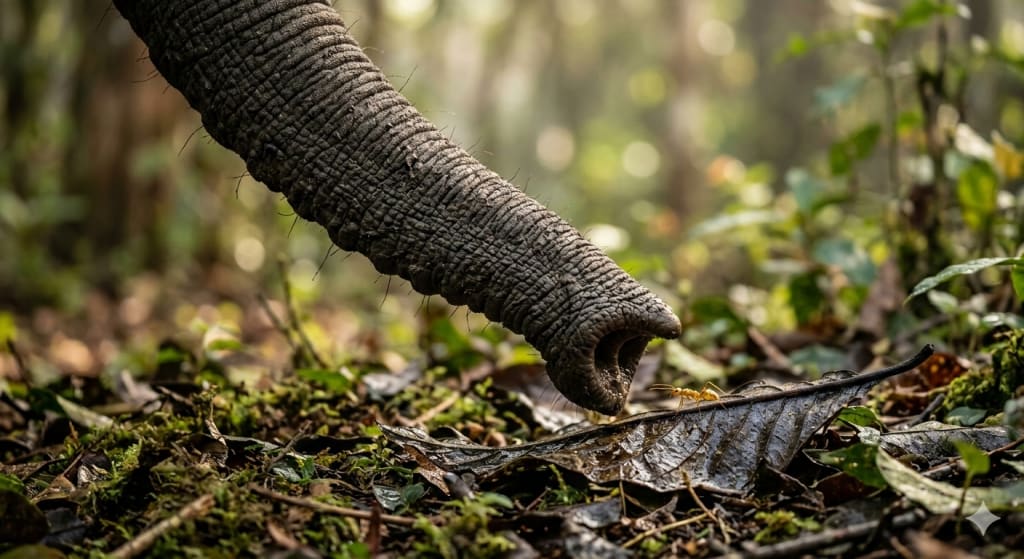
Growing up, our minds are often filled with fascinating stories, old wives' tales, and local legends that we rarely stop to question. One of the most persistent myths many of us heard—whether from an elder's gathering, a village folk tale, or a playground chatter—is the famous claim: "If an ant enters an elephant's trunk, the elephant will die." This sentence has been repeated so many times that it has almost become an accepted truth in our collective consciousness. But when we look at this statement with a logical and scientific lens, the questions begin to arise. Is it even possible for the world’s largest land animal to be defeated by one of its smallest insects?
For a long time, I was among those who believed this. I imagined that perhaps there was a secret, delicate nerve deep inside the trunk that, if bitten by an ant, would cause a fatal reaction or some kind of brain trauma. However, some time ago, I decided to move past the hearsay and conduct proper research. By looking at biological facts and veterinary insights, the real truth finally came to light.
To understand the reality, we first need to understand what an elephant's trunk actually is. It isn't just a long nose. It is a biological masterpiece—a fusion of the upper lip and the nose. The trunk is the elephant's most versatile tool; they use it to breathe, drink water, trumpet for communication, uproot massive trees, and even pick up a single blade of grass with surgical precision.
Most incredibly, an elephant’s trunk contains over 40,000 individual muscles. To put that in perspective, the entire human body has fewer than 700 muscles. This makes the trunk simultaneously incredibly powerful and extremely sensitive. It is lined with thousands of nerve endings that allow the elephant to feel textures and temperatures.
Now, let’s address the core question: Can a common ant or a small insect really kill an elephant by entering its trunk? From a scientific and biological standpoint, there is no evidence to suggest that the mere entry of an ant can cause the death of an elephant.
The elephant’s respiratory system is built to handle such minor intrusions. If an ant or any foreign object enters the trunk and causes irritation, the elephant has a powerful defense mechanism: it can blow air out with immense force. Imagine a sneeze from an animal that can move hundreds of pounds; that force is more than enough to eject a tiny ant like a projectile. Furthermore, elephants often suck up gallons of water and spray it through their trunks to clean them or cool themselves down. Any small insect would likely be flushed out instantly.
However, there is a grain of truth in the myth. Because the trunk is so sensitive and filled with nerve endings, an ant crawling inside can cause significant discomfort and pain. If an ant bites the sensitive inner lining, the elephant may become extremely restless. It might shake its head violently, blow air loudly, or rub its trunk against trees or the ground to stop the irritation. Observing such a distressed, giant animal might have led people in the past to believe the situation was life-threatening or that the elephant was "dying."
In reality, an elephant is one of the strongest and most resilient creatures on Earth. Its immune system and physical structure are not so fragile that a single ant could end its life. Most of these stories stem from "hyperbole"—where a small truth is exaggerated until it becomes a legend. While a severe, untreated infection from a toxic parasite could technically cause health issues, the "instant death by ant" theory is purely fictional.
This myth serves as a reminder to question what we hear. How many things in life do we accept as facts simply because "everyone says so"? What other stories from our childhood turned out to be nothing more than creative imagination?
If you found this investigation into nature’s myths interesting, feel free to like and share this post so others can learn the truth behind the legend of the elephant and the ant!
Disclosure: This article was researched and conceptualized by the author and polished using AI for better structure and clarity.
About the Creator
Pearl
1980 something. we all hung out at Pearl and you and i were nothing special, or so i thought. i mean we all danced, drenched in our own sweat, our own saline solution of fear, too many beers, shots, laughter, tears, fucks in the bathroom and i don't know when we began to be afraid. do you?
By ROCK aka Andrea Polla (Simmons)2 days ago in Fiction




Comments
There are no comments for this story
Be the first to respond and start the conversation.