

Ethan Calloway woke as if he had been pulled violently upward from deep water, his body surfacing before his mind could follow, lungs straining against a pressure that did not exist outside of him yet felt crushingly real. The darkness in his bedroom seemed thicker than usual, less like the natural absence of light and more like something intentional that had gathered in the corners and along the ceiling, watching him struggle. For several long seconds he did not move, did not even blink, because movement would mean confirming that he was awake and he was not entirely sure that waking was safer than remaining where he had just been. His sheets were tangled around his legs, damp with sweat, and the air in the room felt wrong in a way he could not articulate, as if it had been breathed too many times and had nothing left to give him. When he tried to inhale deeply, the breath caught halfway down, splintering into sharp, shallow pulls that made his chest tighten painfully. The red glow of the clock on his nightstand slowly sharpened into focus through the blur at the edges of his vision. 3:17 a.m. The numbers felt accusatory, like witnesses who had seen this happen before and would see it happen again.
The hallway had been more vivid tonight than it had ever been, which frightened him more than the content of the dream itself. He had been standing at one end of it, shoes planted against cold tile that reflected the harsh fluorescent lights overhead in thin, trembling lines. The lockers lining both sides were not merely dented but warped, steel bowed outward in some places and crushed inward in others, as though something large and furious had tried to escape confinement and failed. Water had spread across the floor in a slow, deliberate sheet, not rushing or splashing but advancing with unnerving patience, covering the grout lines between the tiles and swallowing the reflections of the lights above. The air in the hallway had felt heavy and electrically charged, like the moment before a thunderstorm breaks, and at the far end stood the door with the wired-glass window embedded in its upper half. Behind that glass there had been a shape, human in outline but indistinct in detail, standing too still to be accidental. Ethan had known, with the unshakable certainty that only dreams provide, that whoever stood there was looking directly at him.
He squeezed his eyes shut now, as if he could push the image away by force, but the memory persisted with cruel clarity. In the dream he had tried to move forward, to close the distance between himself and the door, yet his feet had felt anchored to the tile as the water crept higher around his ankles. The shape behind the glass had not pounded frantically or screamed; instead, it had lifted a hand slowly and knocked three times against the wired pane, the sound sharp and precise, echoing down the corridor in measured intervals. The knocks had not been desperate. They had been deliberate. As if announcing something. As if counting down. The third knock had reverberated through his bones, and that was when he had woken, heart slamming violently against his ribs, lungs refusing to cooperate.
He pushed himself upright too quickly and the room tilted in response, a wave of dizziness washing over him so strong that he had to grip the edge of his mattress to steady himself. His fingers tingled with pins and needles, a familiar precursor that made dread coil tighter in his stomach because he knew what was coming and knowing never stopped it. His breaths came in uneven bursts, too fast and too shallow to satisfy the body’s demand for oxygen, and with each failed inhale his panic deepened, feeding itself in a vicious cycle. He pressed the heel of his hand against the center of his chest as though he could physically slow his heart by force, but the pounding only seemed to grow louder, filling his ears until it drowned out every other sound in the house.
He knew this sensation intimately, had cataloged it enough times to recognize each stage as it unfolded, yet awareness offered no protection. Panic did not negotiate. It arrived fully formed and seized control of his nervous system as if flipping a switch. His vision narrowed slightly, the corners darkening, and a cold sweat broke along his spine. The rational part of his mind attempted to intervene, reminding him that he was safe in his bedroom, that there was no hallway, no water, no shadowed figure at the end of it. But the rational voice sounded distant and unconvincing compared to the visceral certainty screaming through his body that something was wrong.
Remaining alone in his room felt impossible, so he swung his legs over the side of the bed and stood, ignoring the way his knees wobbled beneath him. The hallway outside his door stretched longer than usual in the dim light, and the resemblance to the one in his dream made his stomach twist violently. He stepped into it anyway, moving quickly but unsteadily, one hand trailing along the wall to anchor himself in something solid and real. His lungs stuttered again, drawing in air that felt thin and insufficient, and the tightness in his chest intensified until he genuinely wondered if he might pass out before reaching his father’s room.
He hated that he still did this, hated the instinct that overrode pride and independence and sent him stumbling down the hallway like a frightened child instead of a seventeen-year-old who was nearly an adult. He was taller than most of the boys in his grade now, broad-shouldered from years of track and weight training, capable of running a mile without breaking stride and strong enough to outlift half the football team. On paper, there was nothing fragile about him. Yet none of that strength mattered when his lungs refused to cooperate and his heart raced as though it were trying to escape his chest. He hated the disconnect between how he appeared and how he felt in moments like this, hated that his body could endure physical strain without complaint but collapsed under the weight of something invisible and internal. The self-reproach only worsened the spiral, feeding the panic with sharp, relentless thoughts about weakness and failure, and by the time he reached his father’s door, his hands were shaking visibly enough that he had to steady one wrist with the other just to knock.
He knocked once, the sound dull and uncertain against the wood, barely audible over the roaring in his ears that seemed to drown out everything else in the world. For a split second he considered turning back, telling himself to handle it alone, but another shallow breath caught painfully in his throat and made the decision for him. He pushed the door open without waiting for a response, the hinges giving a faint, familiar creak as the room beyond came into view. The space was dim, lit only by a thin spill of streetlight filtering through partially closed blinds, casting narrow silver lines across the floor and the edge of the dresser. The air smelled faintly of aftershave and clean cotton. Detective Adrian Calloway lay on his back beneath the covers, one arm resting loosely across his chest, the other angled toward the nightstand where his phone and service weapon sat within easy reach. Even in sleep he looked composed, features settled into the calm neutrality of someone accustomed to resting lightly, someone who had trained himself to surface quickly from unconsciousness if necessary.
Ethan crossed the room in three uneven steps, the carpet muffling the sound of his movement but doing nothing to steady the dizziness that swayed through him. His vision tunneled slightly at the edges, and he focused on the outline of his father’s shoulder as if it were a fixed point in a shifting room. He reached out and gripped that shoulder firmly, fingers curling into the fabric of his T-shirt with more urgency than he intended. “Dad,” he tried to say, but the word fractured in his throat, splintering into a strained, breathless sound that carried more fear than he wanted to reveal. The attempt to speak only made his chest tighten further, and he swallowed hard, fighting for enough air to try again.
Adrian’s eyes opened immediately, the shift from sleep to alertness almost instantaneous, honed by years of abrupt wake-ups and unpredictable emergencies. He took in the scene in a single glance: Ethan’s pallor, the trembling in his hands, the rapid rise and fall of his chest. He sat up without hesitation, all residual drowsiness gone.
“Ethan,” he said, voice low but steady.
“I can’t—” Ethan managed before another shallow breath cut him off.
“You can,” Adrian replied firmly, already moving to sit fully upright and guide Ethan down beside him on the edge of the bed. “You’re breathing. It just feels wrong. Look at me.”
Ethan attempted to comply, but his vision blurred at the edges and his focus wavered. His chest felt constricted, as though a band had been cinched tightly around his ribs. The sensation of suffocation intensified, even though he knew objectively that oxygen was entering his lungs.
Adrian placed one broad, steady hand at the back of Ethan’s head, fingers threading into his hair, and gently guided him forward until Ethan’s forehead rested against his shoulder. His other arm wrapped around Ethan’s upper back, applying firm, grounding pressure. It was not a sentimental embrace. It was containment, stability, something solid to anchor against while the storm inside his son’s nervous system raged.
“I’ve got you,” Adrian murmured close to his ear, voice lowered to a near whisper but unwavering. “Slow it down. In through your nose. Hold it. Out through your mouth. Match me.”
He exaggerated the rhythm of his own breathing, making it slow and deliberate, hoping the physical proximity would allow Ethan’s body to mirror the pattern automatically. The first attempt failed, Ethan’s inhale breaking into a shaky gasp that trembled against Adrian’s shoulder.
“That’s fine,” Adrian said immediately, tightening his grip slightly at the back of Ethan’s head. “Again. Stay with me.”
Ethan clutched at his father’s T-shirt as if it were the only stable object in a tilting world. The warmth beneath his cheek, the steady expansion and contraction of Adrian’s chest, the firm pressure of a hand cradling the base of his skull—all of it provided tangible proof that he was not in the hallway anymore. Gradually, incrementally, his breaths began to lengthen. The suffocating tightness in his chest eased from unbearable to painful to merely uncomfortable. His heart still raced, but the rhythm lost some of its frantic edge.
They remained like that for several long minutes, neither of them speaking, Adrian continuing the quiet cadence of instructions and reassurance while Ethan focused on nothing except matching the breathing pattern pressed steadily against him. Adrian inhaled slowly through his nose, holding the breath just long enough for it to feel deliberate rather than forced, then exhaled in a controlled stream that brushed lightly against Ethan’s hair. The repetition was intentional, rhythmic, something solid to cling to while the chaos in Ethan’s chest gradually lost momentum. Ethan concentrated on the rise and fall beneath his cheek, on the warmth of his father’s body, on the firm hand cradling the back of his head with quiet certainty. The house around them stayed silent, undisturbed by the small crisis unfolding in the dark, its walls and floors offering no sign that anything unusual had occurred. The refrigerator hummed faintly in the kitchen. The old pipes ticked once as they adjusted to the cool air. Otherwise, there was only the sound of breathing—one steady, one slowly finding its way back to steadiness.
When Ethan’s breathing finally settled into something sustainable, deeper and less frantic, Adrian eased back slightly but did not remove his hand from its steady position at the back of his head. He adjusted his grip just enough to study Ethan’s face more clearly, tilting it toward the faint spill of light filtering through the blinds. He examined him the way he examined witnesses and suspects, not with suspicion but with careful attention to detail. He noted the lingering tension in Ethan’s jaw, the faint sheen of sweat along his hairline, the redness around his eyes from the abrupt awakening. Even in the dimness, Adrian could see that the panic had not vanished entirely; it had simply receded to a manageable distance.
“What was it this time?” he asked quietly, his voice low enough to avoid startling him but firm enough to convey that he wanted the answer fully, not in fragments.
Ethan swallowed, his throat still raw from the uneven breathing and the effort it had taken to regain control. He rubbed his palms briefly against his thighs, grounding himself in the physical sensation before speaking. “The hallway,” he said, voice barely above a whisper but steadier than before. “The school one.”
Adrian’s expression sharpened almost imperceptibly, the change subtle enough that someone less familiar with him would not have noticed it. He had heard about this hallway before, in fragments and variations, sometimes described with more detail, sometimes less, but always returning in different forms as though Ethan’s mind could not let it go. The repetition concerned him more than the content itself. Recurring dreams suggested something unresolved, something that continued to press at the edges of consciousness.
“Tell me,” he prompted, keeping his tone neutral and open, resisting the urge to guide the narrative too quickly toward a rational explanation.
Ethan hesitated, not because he had forgotten any part of it but because the clarity frightened him. The images had been sharper tonight, less dreamlike and more tactile, as though he could still feel the cold tile beneath his shoes and the dampness creeping toward him. He closed his eyes briefly, as if replaying it required careful handling. “The lockers were worse,” he said slowly, choosing his words with care so he would not exaggerate or distort what he had seen. “They weren’t just dented. They looked like something had been hitting them from the inside. Like they were trying to get out. And there was water on the floor. It wasn’t flooding all at once. It was moving. Slow. Toward the door.”
“What door?” Adrian asked, his voice steady, though his mind was already mapping the layout of the school in relation to what Ethan described.
“The one at the end,” Ethan replied. “The glass one. The wired glass. The hallway feels longer than it actually is, but I know which one it is.”
Adrian nodded slightly, encouraging him to continue. “And someone was behind it?” he asked, careful not to add emphasis that might suggest confirmation of something supernatural or threatening.
Ethan nodded once, the movement small but certain. “I couldn’t see who. It wasn’t clear. Just… a shape. A person. Standing there. Not moving much. Just watching.” He paused, jaw tightening faintly as he forced himself to recall the sound. “They knocked three times. Not loud. Not pounding. Just three knocks. Even. Like they were counting.”
Adrian exhaled slowly through his nose, thoughtful rather than dismissive, maintaining eye contact so Ethan would not feel brushed aside. He had always approached these conversations carefully, unwilling to validate what he considered magical thinking yet equally unwilling to dismiss his son’s fear outright. Fear ignored had a way of returning sharper. “You were at the station yesterday,” he said evenly, his tone measured and rational. “You walked past the holding corridor when you brought me lunch. You saw the reinforced glass on the doors there. Your brain stores images, especially ones tied to strong emotion. Stress amplifies them. Dreams rearrange what you’ve already seen and attach intensity to it.”
Ethan looked down at his hands, which had finally stopped shaking but still felt faintly unsteady. He flexed his fingers once, as if testing their reliability. “It didn’t feel rearranged,” he murmured. “It didn’t feel like my brain was mixing things up. It felt specific. Like it was showing me something on purpose.”
Adrian’s jaw tightened slightly at that, though his voice remained controlled and even. He understood how convincing dreams could be, how they borrowed the authority of certainty and presented themselves as revelations rather than inventions. “Dreams are not warnings,” he said carefully. “They’re processing. Your mind is very good at finding patterns after the fact and assigning meaning to them. It wants coherence. So when something similar happens later, it feels predictive even if it isn’t.”
Ethan lifted his gaze again, not argumentative but searching. “What if it’s not after the fact?” he asked quietly. “What if it’s before?”
Adrian held his son’s eyes for a long moment before answering, weighing reassurance against honesty. “Then we still handle it the same way,” he said. “With information. With evidence. Not with fear.” He reached up and brushed his thumb lightly along Ethan’s temple, wiping away a lingering trace of sweat. “Your brain is powerful, Ethan. That doesn’t mean it’s prophetic. It means it’s imaginative and stressed and trying to work through things you don’t consciously think about.”
Ethan nodded faintly, though the crease between his brows did not fully smooth. The logic made sense in theory, yet the sensation of standing in that hallway had felt too deliberate to dismiss entirely. Still, exhaustion was pulling at him again, heavy and insistent, and arguing required energy he no longer had.
Adrian watched the internal conflict flicker across his face and softened his tone further. “You’re not crazy,” he added quietly. “And you’re not in danger from a dream. Your body reacted because it believed something was wrong. That doesn’t mean something actually is.”
Ethan did not argue further, but doubt lingered in his eyes in a way that made it clear the conversation had not resolved anything inside him. He understood his father’s logic, respected it even, yet logic did not erase the pattern that had been building in the back of his mind for months. There had been moments before when his dreams had aligned uncomfortably with real events, small incidents that could be explained as coincidence yet felt too pointed to dismiss entirely. A minor fire alarm malfunction at school that he had seen in his sleep days earlier, complete with the flicker of faulty wiring behind a ceiling tile. A broken storefront window downtown that had mirrored an image he could have sworn he had stood in front of during a dream, down to the way the glass had fractured in a spiderweb pattern across the lower right corner. None of it had been dramatic enough to prove anything, and he was self-aware enough to recognize the danger of confirmation bias, yet the repetition of it left a residue of unease that he could not scrub away. It felt less like prophecy and more like standing at the edge of something vast and unseen, aware that the ground beneath him was thinning but unable to identify where it would finally give way.
“I just get this feeling,” Ethan said quietly, lifting his gaze again, forcing himself to meet his father’s eyes despite the vulnerability that came with admitting something so intangible. “Like something is coming. Not small, not random. Something that’s been moving toward us for a while.”
Adrian placed his hand firmly on Ethan’s shoulder, the gesture steady and deliberate, thumb pressing slightly as if to anchor him to the present moment. The contact was grounding, but it was also protective in a way that went beyond reassurance. “Something is always coming,” he replied in a voice that carried the weight of lived experience rather than dismissal. “That’s how time works. That’s how life works. Every day is a step toward something you can’t see yet. That doesn’t make it prophetic. It makes it inevitable in the most ordinary way.”
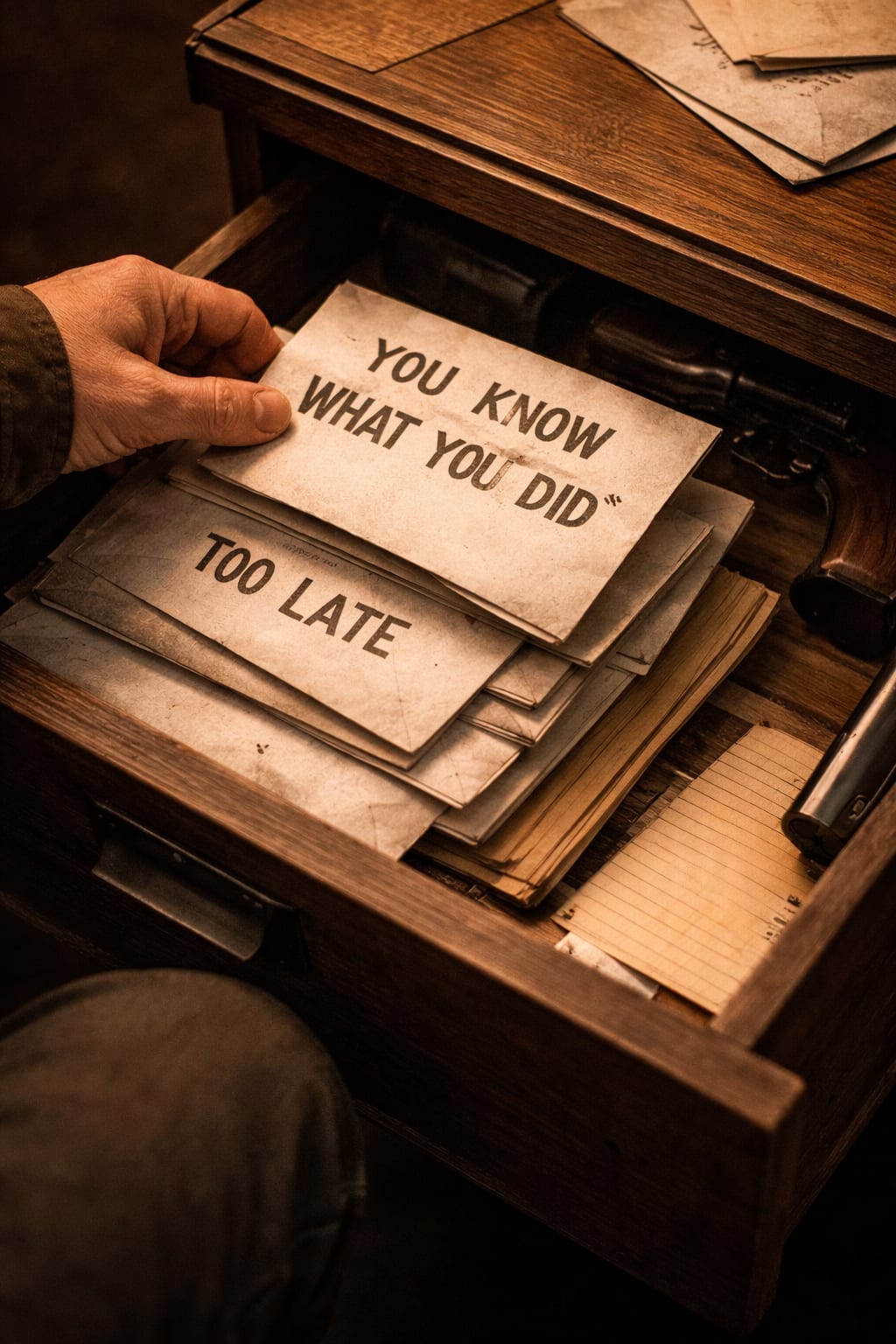
Adrian did not mention the letter that had arrived at the station the previous week, printed neatly on plain white paper and slipped into an unmarked envelope with no return address. It had been devoid of fingerprints, devoid of handwriting, devoid of anything traceable. It contained a single line in precise, impersonal font: You don’t get to walk away. Adrian had read it twice in his office, then once more in the quiet of his patrol car before locking it away in his desk. He had dismissed it outwardly as posturing from someone disgruntled by an old case, someone looking to unsettle him without the courage to do more than that. Threats were an occupational hazard. He had been called worse things to his face in courtrooms and interrogation rooms. He had put men behind bars who had sworn revenge with far more creativity. He had dealt with it before and would deal with it again. Still, the phrasing of that sentence had unsettled him in a way he did not care to examine too closely, because it suggested continuity rather than impulse, a grievance that had not faded with time.
Ethan shifted slightly, fatigue seeping into his limbs now that the adrenaline had drained from his system and left behind a hollowed-out exhaustion. “Have you had any new cases?” he asked, the question tentative but loaded, as if he were stepping carefully across a frozen surface and testing whether it would hold. He did not specify what kind of case he meant, because both of them understood that certain cases lingered longer than others, casting shadows that stretched far beyond official closure.
“My work is not yours to carry,” Adrian said gently but firmly, his tone softening without yielding ground. “You focus on being a student. You focus on your friends, your grades, your future. Leave the rest to me. I chose this job. You didn’t.”
Ethan nodded, though the answer did not fully soothe him. The sense of inevitability from the dream lingered stubbornly at the edges of his thoughts, like a sound too low to hear clearly yet impossible to ignore. He did not press further, partly because he was too tired and partly because he sensed that pushing would only cause his father to withdraw behind a wall of professional detachment that was difficult to breach once fully erected.
“You want to try to sleep again?” Adrian asked after a moment, studying him closely.
After a brief hesitation, Ethan nodded. He did not trust sleep at the moment, but he trusted exhaustion even less, and he knew he would not function the next day if he did not attempt to rest. Adrian rose quietly and retrieved a heavier blanket from the chair in the corner, shaking it out once before draping it over Ethan’s shoulders with a care that felt instinctive rather than deliberate. He returned to sit beside him on the edge of the bed, close enough that their shoulders brushed.
Without comment, Adrian guided Ethan forward once more, his hand settling at the back of his son’s head in that now-familiar hold, fingers spreading slightly to cradle and steady. Ethan leaned into him, forehead resting against his father’s chest, listening to the steady rhythm beneath his ear. The scent of laundry detergent and aftershave was grounding in a way that nothing else could replicate. The weight of the blanket, the warmth of another body nearby, the solidness of a heartbeat that did not race or falter—all of it worked together to convince his nervous system that the threat had receded.
“You’re safe,” Adrian murmured quietly, more to himself than to Ethan, as if repeating the words enough times might solidify them into truth rather than reassurance.
Ethan allowed his eyes to close, focusing on the slow expansion and contraction beneath his cheek. The hallway receded slightly, though it did not disappear entirely. The water still crept forward somewhere in the background of his mind, slow and deliberate. The door still waited at the end of that corridor, the wired glass reflecting light that did not exist in his room. The three knocks still echoed faintly, not frantic but patient, as though whatever stood behind that door understood that time was on its side.
Across town, in a house long since abandoned by its original owners and left to gather dust in the absence of upkeep, a single lamp illuminated a cluttered desk pushed against a peeling wall. The house itself sat at the edge of an older neighborhood where streetlights flickered unreliably and most residents kept to themselves. Its windows were boarded from the inside, allowing only narrow slivers of light to escape into the night. Inside, the air smelled faintly of mildew and paper, the floorboards creaking softly whenever weight shifted across them.
A man sat at the desk in silence, his posture relaxed in a way that suggested patience rather than idleness. Before him lay an open file assembled with meticulous care. Newspaper clippings had been cut cleanly and arranged in chronological order, each article detailing a case investigated by Detective Adrian Calloway over the past fifteen years. Photographs accompanied the clippings, some taken from public archives, others clearly obtained through less official means. Court transcripts were stacked neatly to one side, passages highlighted in yellow where Adrian’s testimony had directly contributed to convictions.
At the center of the arrangement lay a photograph of Adrian Calloway clipped from an article about a particularly high-profile conviction years earlier. In the image, Adrian stood outside the courthouse, expression composed, tie straight, shoulders squared beneath the weight of public scrutiny. The caption praised his persistence and integrity. The man at the desk traced the edge of the photograph thoughtfully with one finger, neither smiling nor frowning, his expression unreadable but intent. He was not in a hurry. He had learned long ago that haste produced mistakes and that mistakes were costly. Patience had served him well before, and it would serve him again. He could wait for the right moment, because anticipation was not a burden to him but a companion.
On a separate corner of the desk sat a smaller stack of papers that had not yet been integrated into the main file. At the top lay a copy of the anonymous letter he had sent to the station, printed in the same clean font, the paper handled carefully to avoid leaving evidence behind. He studied it briefly, then set it aside and reached for another document: a recent school newsletter listing upcoming events, faculty names, and a photograph of the principal standing beside a group of students during a charity drive. The man’s gaze lingered not on the principal but on a familiar surname printed beneath a student achievement announcement.
Calloway.
He leaned back slightly in his chair, the wood creaking under the shift of weight, and folded his hands together. The lamp cast sharp shadows across his face, obscuring details that might have revealed his age or expression more clearly. There was no anger in his posture, no visible agitation. Only calculation.
Back in the quiet bedroom, Adrian remained awake long after Ethan drifted into an uneasy sleep, his gaze fixed on the dark wall opposite the bed as thoughts moved methodically through his mind. He listened to the subtle changes in Ethan’s breathing, attuned to the slightest irregularity, and did not allow himself to fully relax. Unease settled low and persistent in his chest, a sensation he had learned not to ignore entirely. Instinct had kept him alive more than once, and while he did not indulge paranoia, he respected intuition.
He replayed the letter in his mind, considering the wording again. You don’t get to walk away. It implied unfinished business. It implied resentment that had not dissipated with sentencing or time served. He mentally reviewed cases that had ended with particularly vocal defendants, men who had shouted promises of retribution as they were led away in cuffs. Several names surfaced immediately, but most were still incarcerated or under supervision. He would have to check in the morning, quietly, without drawing attention to the inquiry. He did not want the department buzzing with speculation over something that might amount to nothing.
His gaze shifted to the doorway, half expecting to see movement there despite knowing it was irrational. The house was secure. He had checked the locks before bed as he always did. His service weapon remained within reach. Yet security measures did not account for every variable, and that knowledge pressed against him more insistently tonight.
When Ethan finally shifted in his sleep and murmured something indistinct, Adrian tightened his arm slightly in response, a reflexive gesture that blended comfort with vigilance. He had chosen this career long before Ethan had been born. He had accepted the risks knowingly. What he had not fully grasped at the time was how those risks would extend beyond himself, casting long shadows over the people he loved most.
Eventually, when the first faint hint of dawn began to soften the darkness at the edges of the blinds, Adrian eased carefully away from Ethan and stood, moving quietly so as not to wake him. He crossed the room and looked out through the narrow gap in the curtains, scanning the street with practiced eyes. The neighborhood appeared ordinary in the pale early light, cars parked in driveways, no unfamiliar vehicles idling nearby. Nothing overtly suspicious presented itself. Still, he made a mental note to vary his routine over the next few days, to take different routes to work, to pay closer attention to patterns that might otherwise go unnoticed.
Down the street, a car that had been parked beneath a dying tree for most of the night started its engine softly as the sky lightened. The driver did not look toward the Calloway house directly, did not linger long enough to draw attention. He simply merged into the sparse early-morning traffic and drove away at an unremarkable speed, blending seamlessly into the flow of commuters beginning their day. The house receded in his rearview mirror, one of many along the block, indistinguishable to anyone who did not know exactly which one to watch.
Adrian let the curtain fall back into place and stood there for a moment longer, his fingers resting lightly against the fabric as he watched his own faint reflection overlay the quiet street outside. The sky had shifted from deep charcoal to a muted gray-blue, the kind of early light that flattened shadows without fully chasing them away. Porch lights along the block clicked off one by one, and a few distant engines hummed to life as neighbors began the slow transition into morning. A jogger moved steadily along the far sidewalk, breath fogging faintly in the cool air. Everything looked ordinary, undisturbed, as though the night had carried nothing heavier than sleep. The normalcy was almost convincing. Adrian scanned the street one last time out of habit rather than suspicion, committing the parked cars and empty sidewalks to memory before finally stepping away from the window.
He turned back toward the bed and paused, taking in the sight of Ethan sprawled across it at an angle that suggested he had shifted sometime after Adrian moved away. One arm was thrown loosely over the pillow, the other bent near his chest, fingers curled into the sheet as though he had been holding on to something even in sleep. His hair had fallen forward over his forehead, softening his features and making him look younger than he had any right to at seventeen. The tension that had carved faint lines into his brow earlier was gone now, replaced by the unguarded stillness that only came with true exhaustion. In sleep, Ethan looked less like someone bracing for something unseen and more like the kid Adrian remembered from years ago, when scraped knees and math tests had been the height of his worries. Adrian stood there longer than necessary, listening to the steady rise and fall of his son’s breathing, letting the simple, tangible proof of it settle something restless in his own chest.
He crossed the room quietly and sat on the edge of the bed, the mattress dipping slightly beneath his weight. For a moment he did nothing, simply resting his forearms on his thighs and studying Ethan’s face in the growing light. There were faint shadows beneath his eyes, subtle but noticeable if you knew to look for them. Adrian reached out and brushed a few strands of hair back from Ethan’s forehead, the gesture instinctive and careful. Then he placed a firm, warm hand on his son’s shoulder and gave it a gentle shake, not abrupt enough to startle but deliberate enough to break through the depth of sleep. “Ethan,” he said evenly, his voice calm and steady, carrying quiet authority without sharpness. “Come on. It’s morning.” He gave another small squeeze, grounding and present. “You’ve got school. Time to get up.”
About the Creator
Ria
I write historical fiction and mystery/thriller stories.
Keep reading
More stories from writers in Fiction and other communities.
The Salt in her Voice
The myth says mermaids sing to lure sailors to their death. But why? The ocean is huge. Only 5 percent has been discovered by man. Why would a creature of the sea with that much space to roam ever care about the fate of men on ships? The answer, as it turns out, is not a simple one at all. The truth about the myth is older than the tides. Long ago before the first ship ever cut across the surface, the sea made a pact with the sky. The sky would take the souls of the drowned. Anyone who died in storms or any quiet accidents of the deep would have their soul lifted upward to the Heavens while the bodies would remain below, feeding the oceans endless hunger. The greedy sea however wanted more souls than the sky would claim. So it created mermaids. It gave them beautiful voices woven from currents and moonlight. It commanded them to sing. "Bring forth the ones who float where they should sink." it instructed them. So they did. They never killed out of malice but out of obligation. They sung to summon, not to seduce. A mermaid's voice could loosen the tether between the body and soul, making any man step willingly into the water. The sea would take the body and the sky would take the soul. Balance maintained.
By Sara Wilson2 days ago in Fiction
Diaries to Nietzsche
Quotation from Friedrich Nietzsche "He who wrestles long with monsters should beware lest he himself become a monster. And if you gaze long into an abyss, the abyss also gazes into you. Man is not destroyed by suffering, but by the meaning he makes of it."
By LUCCIAN LAYTHa day ago in Critique




Comments
There are no comments for this story
Be the first to respond and start the conversation.