
The Light She Tends
Some Gazes Never Stop.
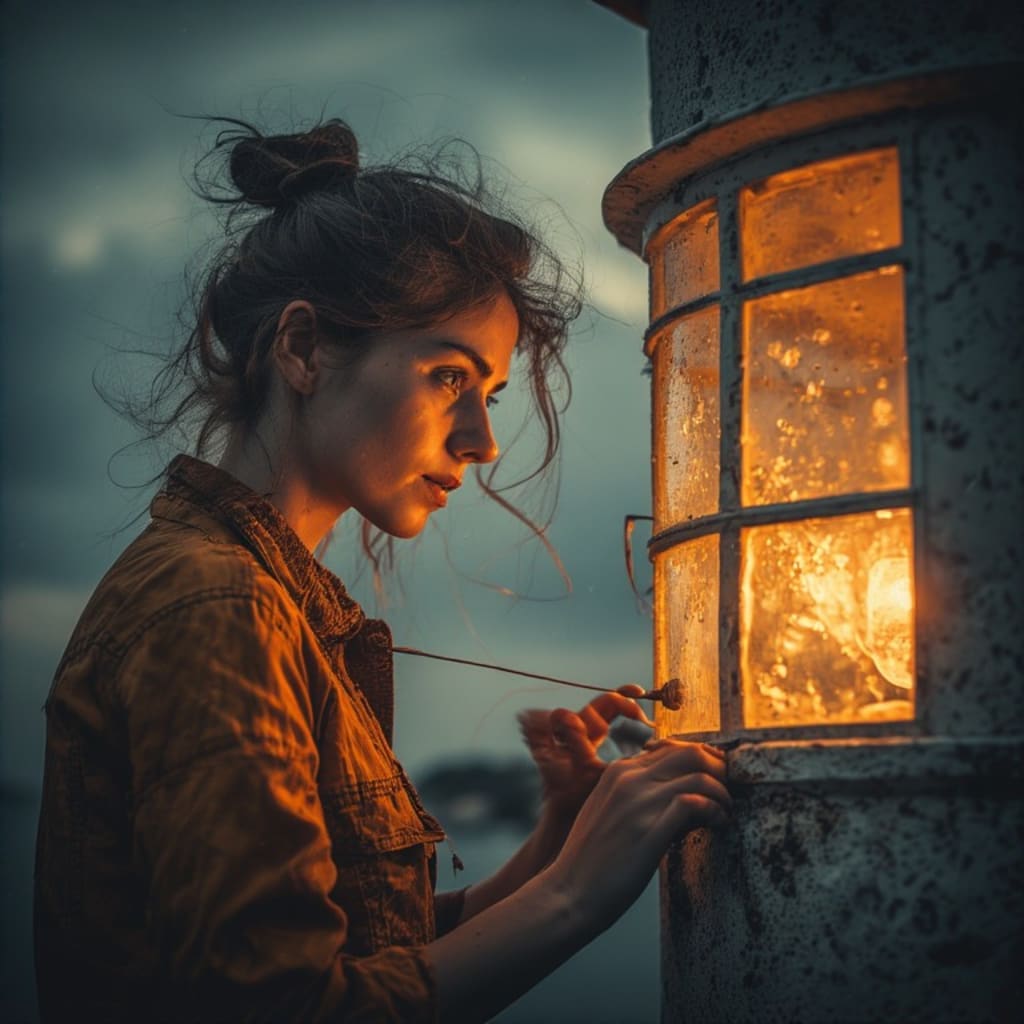
The stone steps of the Veli Rat lighthouse were worn smooth in the centre, a shallow groove carved by a century of keepers’ boots. Petra knew each one by heart—the twelfth step that chirped like a cricket, the twenty-eighth where a seam of quartz caught the sunset and glowed like a vein of gold.
She climbed them every last Friday of the month, rain or wind or the flat, exhausted calm that followed the summer tourists’ departure. She climbed them at the same hour, when the light of the setting sun and the light of the awakening beacon were briefly, equally golden.
In her canvas bag, she carried a soft cloth, a tin of beeswax polish, and a small jar of anchovies she had cured herself.
The lighthouse hadn’t been manned since 2002. The lens turned on its automated axle, the beam swept its scheduled arc, and the government’s digital monitoring system sent hourly affirmations of function to a server in Split. No one needed Petra here. No one had asked her to come.
But her husband, Jakov, had been the last keeper.
He had loved this tower the way other men loved their children or their boats. He had known the precise weight of the mercury bath that floated the lens assembly, the particular groan the outer door made when the humidity rose, the way the Dalmatian sirocco could paint the glass with salt in a matter of hours. He had taught Petra to read the sea’s moods by the quality of the reflected light.
“The lens doesn’t just throw light outward,” he used to say, his rag moving in slow, patient circles. “It receives it, too. Everything that touches the glass leaves something behind.”
He had been gone five years now. Lost in a November gale, his fishing boat foundered on rocks a mile from the very light he had tended. They had recovered the boat, tangled in its own nets. They had not recovered Jakov.
The first time Petra climbed the stairs, it had been grief that drove her—a raw, animal need to be somewhere he had been, to touch surfaces his hands had touched. She had expected to cry. She had expected to feel his absence like a physical wound.
She had not expected to find the porthole fogged from the inside.
It was the small window on the seaward side, set into the thick stone of the stairwell. Not part of the main lantern assembly, not subject to the temperature swings of the glass above. A window that should have been clear, or dust-streaked, or cobwebbed.
Instead, it was opaque, beaded with condensation, as though someone had been standing close to it, breathing against the cold pane.
Petra had stood very still. The lighthouse hummed around her—the quiet machinery, the wind, the distant complaint of gulls. She had touched the glass, and her fingertips had come away wet.
She had not told anyone about this. What was there to tell? That a window in an unheated building had fogged? That her imagination, raw with loss, had manufactured a sign?
But the next month, when she climbed again, the porthole was clear. She had almost convinced herself it had been nothing. A trick of temperature. The residue of an autumn storm.
Then she had opened her canvas bag, taken out her cloth and polish, and begun to clean the main lens as Jakov had taught her.
The glass was cold, smooth, indifferent. She worked in silence, the ritual of it steadying her hands. And when she finished, wiping the last smear of beeswax from the brass housing, she had turned to leave and seen the porthole again.
Fogged. Dense and intimate, a small cloud pressed against the stone.
She did not check it that day. She did not check it the next month, or the month after. She cleaned the lens, she repacked her bag, and she descended the worn stone steps without looking at the window. It became part of the ritual—the looking away. The not-knowing.
But she always knew. The fog was there, waiting behind her back, patient as a tide.
Tonight the sirocco was building. Petra could feel it in the ache of her knee, in the way the lighthouse stairs seemed to exhale dampness. The wind would arrive fully by midnight, flinging salt spray against the tower’s seaward face.
She paused on the twenty-eighth step, touching the quartz vein. Jakov had called it his luck stone. He had proposed to her on this step, forty-two years ago, his hands rough from polishing the lens, his eyes the same grey-green as the winter Adriatic.
“You’ll be a lighthouse keeper’s wife,” he had said. “It’s not a glamorous life.”
“It’s your life,” she had answered. “That’s enough.”
She had been nineteen. She had not understood then what it meant to wait for a man who was married to a light.
At the top of the stairs, the main chamber opened around her—a cathedral of glass and brass, the great Fresnel lens rotating in its silent, stately dance. The mechanism hummed, the beam swept, and the small porthole on the far wall was, as always, clear.
She set down her bag. She removed her shoes, the same habit of reverence Jakov had observed. She took out the soft cloth and the tin of beeswax, and she began.
The lens was made of crystal, not glass. Jakov had told her this so many times she could recite the specifications: 1.8 meters in diameter, 592 separate prisms, each one cut and ground by hand in Paris in 1849. He had treated each prism as a living thing, worthy of address.
“Good evening, old friend,” she whispered now, her cloth moving in slow spirals. “The sardines are running late this year. The tourists were fewer than expected. The bakery in Božava closed—you remember the one with the walnut bread. I bought the last loaf.”
The beam swept past her, impersonal, ancient.
“I dreamed of you last week,” she continued, her voice steady. “We were in the vegetable garden. You were complaining about the rabbits. You always complained about the rabbits, but you never did anything about them. You liked them, I think. Their small, foolish faces.”
Her cloth traced the curve of a prism, lifting a month’s accumulation of dust and salt. The brass beneath gleamed like old gold.
“The window was fogged again last month. I didn’t look. I never look.”
She paused, her reflection fractured across a hundred crystal facets—a woman of sixty-seven, grey-haired and straight-backed, her face mapped with the lines of salt wind and sun.
“But I felt it. The warmth. The breath.”
The lens turned. The beam swept. The sea growled against the rocks below.
She finished the cleaning in silence, her movements sure and practised. Then she sat on the wooden stool Jakov had kept for his rest periods, and she opened the jar of anchovies.
They were her own cure, this year’s catch, silvery fillets suspended in amber oil. She had brought them, as she always did, as an offering. Not for Jakov—she did not believe, had never believed, that his spirit lingered here. Jakov had been a practical man, his faith measured in well-spliced ropes and properly maintained machinery. He had not expected an afterlife. He had only expected the light to turn, night after night, until it didn’t.
No, the anchovies were for her. For the ritual of bringing something of her life to this place, some small production of her hands to set beside his monument. She ate one slowly, the salt blooming on her tongue, and watched the light.
The sirocco struck the tower full force at 8:47 PM. Petra felt it in the stone beneath her feet, a deep vibration like a cello’s lowest string. Rain lashed the lantern glass, and the beam fractured through the water into a thousand smaller lights.
She should leave. The stairs would be treacherous, and the drive back to her cottage on the mainland required two ferry crossings. But she did not rise.
Instead she turned slowly to look at the porthole.
It was fogged.
Not the faint haze of temperature differential, not the transient breath of a passing storm. It was dense, milky, absolute—as though the window had become a cataract, a blind eye turned inward.
And there was something else. A pressure in the air, subtle but unmistakable. The sense of a presence occupying the same space but not the same moment, like the negative shape left after a photograph is taken.
Petra stood. Her knees complained; she ignored them. She walked toward the porthole, her bare feet silent on the cold stone, and she stopped an arm’s length away.
She did not touch the glass. She had never touched it, not since that first day. But she leaned closer, close enough to feel the chill that radiated from the fogged surface, and she spoke.
“Are you waiting for him too?”
The fog did not shift. The pressure did not ease. But something—some quality of the silence—changed. Deepened. Became attentive.
“He’s not coming back,” Petra said. “You must know that. He kept his watch. He kept it faithfully. And then the sea took him, the way it takes everything, eventually.”
The beam swept. The rain hammered. The lighthouse hummed its mechanical song.
“But you stay,” she said. “You breathe against the glass. You wait.”
She had never spoken to it before. In five years, she had acknowledged the fogged window only by her refusal to acknowledge it. Now the words came easily, unstoppable, like water finding its level.
“I thought, at first, that it was him. Some part of him that couldn’t leave. But it’s not, is it? He never would have hidden behind glass. He would have met me at the door.”
The fog seemed to pulse, very faintly, as though in answer.
“You’re the lens,” Petra said. “The glass itself. Everything that touched it, everything that looked through it—all those years of ships and storms and keepers and stars. You remember. You hold it all.”
She did touch it then. Her fingertips pressed against the cold, fogged pane, and she felt—not warmth, but something like recognition. The pressure of a gaze returned.
“I bring him here,” she said. “Every month. I bring his hands, his habits, his voice in my mouth. I feed you with his memory. And you give me back—this.”
She withdrew her hand. Her fingertips were wet.
“Is it enough?” she asked. “Is this what a light requires? Not just mercury and electricity, but attention? Devotion?”
The fog did not clear. It did not thin. But the pressure in the air shifted, becoming less expectant, more resigned. As though the question had been asked before, and the answer was not new.
Petra returned to her bag. She packed the cloth and the polish, sealed the jar of anchovies, and slipped her feet into her shoes. She did not look back at the porthole.
At the top of the stairs, she paused with her hand on the cold iron rail.
“I’ll come next month,” she said. “And the month after. As long as I’m able. That’s the ritual, isn’t it? Not the cleaning. Not the offerings. Just the coming. The not-forgetting.”
She descended, and the lighthouse turned its beam behind her, and the small porthole remained fogged against the storm.
On the mainland, the ferryman who had known Petra for thirty years saw her drive onto his boat and said nothing. Her face was calm, her hands steady on the wheel. She looked, as she always did on these nights, like a woman who had completed a necessary task.
But as she drove off the ramp onto the dark road to her cottage, he thought—not for the first time—that there was something in her eyes that had not been there before Jakov died. Something that had not been there last year, or the year before. A quiet accommodation, as though she had made peace with a presence she could not name.
The light of Veli Rat swept its arc behind her, steady and certain, a gesture of attention directed at an empty sea. And somewhere in the tower, against a small pane of salt-etched glass, a patient warmth continued to breathe.
About the Creator
Keep reading
More stories from Anna Soldenhoff and writers in Fiction and other communities.
The Day The Angels Quit
The sky rained feathers the day the angels decided to quit. It wasn’t gradual, like a fading light or a whisper slipping into wind. It was sudden, vast, final. At 4:17 p.m. Zagreb time, the clouds opened — not with thunder, not with fire, but with a hush. A hush so deep it silenced traffic, halted footsteps, and left a little girl holding her mother’s hand at the tram station, blinking at the first white feather that drifted down onto her outstretched palm.
By Anna Soldenhoff3 months ago in Fiction
The Lesions of Devotion
Every day I set myself down on the freshly cut lawn and strip myself bare. I take my guitar and finger the frets and pick at the strings, listening for dissonance. My life is dissonance. I twist the tuning pegs until each string sounds bright. Then I kneel, calves pointing behind me, kneecaps facing forward. All exposed to the breeze. I close my eyes and play the melody.
By Paul Stewart7 days ago in Fiction
Every Sunday at 4:17
Every Sunday at 4:17 p.m., Eleanor brushes her husband’s hair. The nurses know not to interrupt. They used to ask why that time. They don’t anymore. Hospitals teach people the mathematics of grief. After a while, no one questions the arithmetic.
By Edward Smitha day ago in Fiction
The Saddest Thing - The Billionaires Who Rule America Aren't Even Enjoying Themselves
This single post says more about our ruling class than a thousand policy papers. The saddest thing about today's system is that the men robbing the rest of us - sabotaging our economic prospects, our pensions, our access to affordable healthcare - are not even happy.
By Scott Christenson🌴6 days ago in The Swamp


Comments
There are no comments for this story
Be the first to respond and start the conversation.