
The Oracle of Broken Things
Where shattered relics whisper forgotten truths
In a forgotten quarter of the city, tucked behind alleys too narrow for cars and lit only by flickering lamps, there stood a peculiar little shop with a sign so faded it could barely be read. Those who did read it found three words painted in cracked, flaking gold:
The Oracle of Broken Things.
Most people passed by, barely giving it a second glance. To them, it was just another curiosity in a city brimming with antique stores and dusty thrift shops. But for those who dared to step inside, the Oracle offered something far stranger than bargain-priced porcelain or chipped teacups. It offered answers.
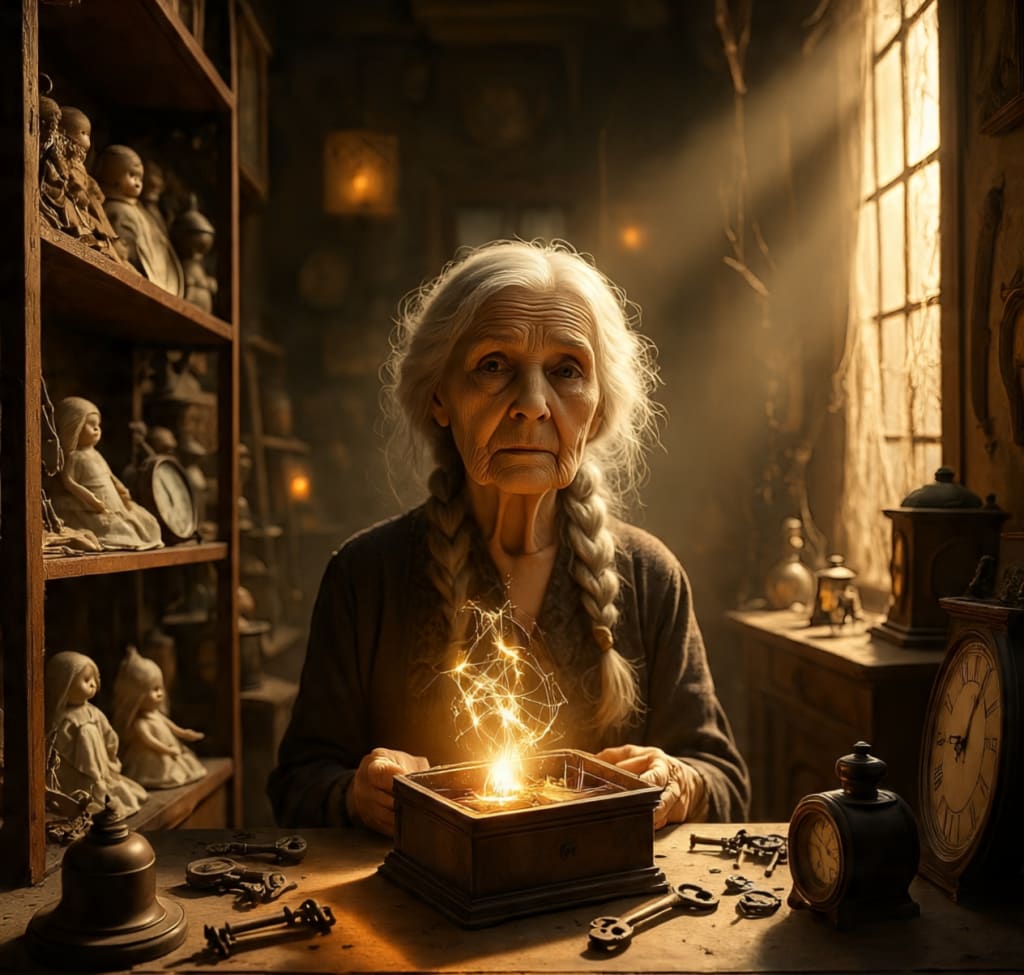
The shopkeeper was an elderly woman named Mirna, who seemed as ageless as the cracked walls and ancient oak shelves around her. Her hair, white as winter fog, hung in a loose braid over her shoulder, and her eyes shimmered with a peculiar mix of sadness and certainty. She spoke softly, but every word felt deliberate, as if weighed before being shared.
The shop itself was an organized chaos of relics: broken clocks, single gloves, shattered mirrors, porcelain dolls missing limbs, rusted keys with no locks. Each object had a story, Mirna claimed. And more curiously, each object could speak—if you listened carefully enough.
People didn’t come for the objects themselves. They came for what they revealed.
One evening, a young woman named Clara pushed open the heavy wooden door. The bell above jingled, its sound sharp against the musty quiet inside. Clara’s eyes were red; she had been crying. She hesitated, unsure if she should be there, but something about the shop drew her in.
Mirna greeted her with a gentle nod, as though she had been expecting Clara all along.
“How can I help you?” Mirna asked, her voice like the soft creak of old floorboards.
Clara looked around at the shelves, unsure how to explain. “I… I lost something important,” she whispered. “And I don’t know where to look.”
Mirna studied her silently, then gestured toward a cracked porcelain music box on the counter. Its lid was chipped, and the ballerina inside had lost one arm. “Hold this,” Mirna instructed.
Clara picked it up gently. It felt strangely warm, as though it had been sitting in sunlight rather than the dim interior of the shop. Mirna closed her eyes, and after a moment of silence, spoke.
“You’ve been searching in the wrong places,” Mirna murmured. “What you’ve lost isn’t gone—it’s hidden behind what you refuse to face.”
Clara swallowed hard, her heart pounding. She knew immediately what Mirna meant: the letters she had never opened, left by her estranged mother before she died. Clara had told herself for years that they didn’t matter, that nothing in them could change what had happened between them. Yet here she was, standing in a dusty shop, clutching a broken music box, wishing for something—anything—to bridge that emptiness.
Mirna opened her eyes, fixing Clara with a gaze that seemed to see through her. “Sometimes broken things show us what whole things cannot,” she said softly.
Clara nodded, tears brimming again, but this time they felt different—like rain after a long drought.
---
News of the Oracle spread quietly, like ivy creeping along stone walls. A man came in search of forgiveness for a betrayal he couldn’t take back. A woman came to ask whether the child she had given up years ago ever thought of her. A boy came carrying the pieces of a shattered toy, wanting to know if his parents would stop fighting.
Each left with more than they brought: not always the answers they wanted, but always the truths they needed.
The shop changed people. Or maybe it reminded them they could change themselves.
---
One stormy night, a stranger entered. He wore a long coat, dripping from the rain, and his face was hidden beneath the brim of a hat. In his hand, he carried a small, broken compass.
Mirna regarded him silently as he placed the compass on the counter. “What do you wish to know?” she asked.
“Where I belong,” the man replied, his voice low and weary.
Mirna rested her hand lightly on the compass, and for a long while, the only sounds were the ticking of broken clocks and the sigh of wind through the cracks in the door. Finally, she spoke.
“You’ve wandered so far, searching for a place,” she said. “But the place you seek isn’t marked on any map. It’s not a where—it’s a who. You belong where your heart is willing to stay.”
The man lifted his gaze slowly, and in the lamplight, there was a flicker of hope—small, but unmistakable.
---
Years passed, but the Oracle of Broken Things endured. Mirna grew older still, yet never seemed to age. And the broken relics kept whispering their truths to those brave enough to listen.
In a world obsessed with perfection and newness, the little shop remained a quiet rebellion: a reminder that broken things—and broken people—still had stories worth telling.
And sometimes, in those stories, they found themselves whole again.
About the Creator
Mati Henry
Storyteller. Dream weaver. Truth seeker. I write to explore worlds both real and imagined—capturing emotion, sparking thought, and inspiring change. Follow me for stories that stay with you long after the last word.
Keep reading
More stories from Mati Henry and writers in Fiction and other communities.
A Love Forboding
The chipped stone slope caused unbearable footing. I slid, skirting on my heels. I cast my shield, relinquishing my guard to stay upright. Left with my double-edge and a prayer to the maker, I skated toward my objective. The earthly stubble gave way to solid ground. I found myself restored, a trail of dust in my wake.
By James U. Rizzi8 days ago in Fiction
Cabin Fever Because of Snow, Sleet, and Freezing Rain That Turned to Icy Roads
What Is Cabin Fever? The short answer is that cabin fever is restlessness from being in a confined area. Cabin fever is the distressing irritability or restlessness experienced when a person or group is stuck at an isolated location or in confined quarters for an extended time. Research shows that prolonged cold, gray skies, and being stuck indoors can trigger mood shifts similar to “winter blues.”
By Margaret Minnicks7 days ago in Humans


Comments
There are no comments for this story
Be the first to respond and start the conversation.