
The Sound the Sky Was Making
Expansion Project

The sky had been humming for three days.
Not loudly. Not enough to interrupt conversation. Just a low, steady vibration, like an appliance left running in another room. You couldn’t hear it so much as feel it—behind the teeth, in the bones of the wrists.
By the second day, everyone agreed it was probably construction.
“Expansion project,” Mrs. Kline said, watering her lawn as if the grass might escape without supervision. “They’ve been meaning to update the grid.”
No one asked which grid.
By the third day, birds had stopped landing.
They hovered above rooftops, then adjusted midair. A few tried to land and veered off sharply at the last second, as if something invisible blocked them. It looked almost polite. Like they were apologizing.
“Migration pattern,” someone said at the coffee shop.
“Unseasonably early.”
The barista’s hands shook slightly while she poured. The foam collapsed too quickly in every cup. She apologized for that too.
No one mentioned the way the windows vibrated at night.
No one mentioned the way the dogs wouldn’t sleep.
The sky had changed color sometime after dusk on Tuesday. Not dramatically. Just a fraction wrong. Too matte. Like a painted ceiling trying to pass as atmosphere.
People squinted at it and nodded.
“Wildfires somewhere,” they decided.
There was no smoke.
At 9:17 a.m. on Wednesday, the first crack appeared.
It wasn’t thunder. It wasn’t lightning. It wasn’t an explosion. It was the sound of something enormous splitting slowly.
Everyone looked up at the exact same time.
Across the horizon, a hairline fracture ran from east to west. Thin. Pale. Like a scratch in glass.
Then it stopped.
The sky did not fall.
The crack did not widen.
The humming continued.
Someone clapped.
“I guess they fixed it.”
A few people laughed. It wasn’t a good laugh, but it was serviceable. It did the job.
Traffic resumed.
The hum didn’t soothe.
It tightened things.
Conversations shortened.
Patience thinned.
Minor inconveniences felt deliberate. Personal.
People snapped faster.
Apologized less.
At work, Nathan refreshed his inbox seventeen times in an hour.
The fracture was visible through the office windows now, a faint white seam holding the day together. When the light hit it right, it shimmered.
“Do you see that?” he asked quietly.
His coworker didn’t look up from her screen.
“See what?”
He turned back to the window.
It was still there.
“Nothing,” he said.
At noon, a piece of it fell.
Not large. Not dramatic.
A flake the size of a dinner plate detached and drifted down, slow as ash. It dissolved before touching the ground.
People paused.
A woman shielded her coffee.
A man adjusted his tie.
“Pollen,” someone said.
“It’s been bad this year.”
Everyone agreed.
By Thursday, the fracture had multiplied.
Thin lines webbed across the sky in geometric patterns.
Clean angles. Too symmetrical to be weather.
They looked deliberate.
The humming deepened.
Children began drawing it in crayon without being told. Houses. Trees. And above them, the sky stitched together with white lines.
Parents took the drawings away.
“That’s not what it looks like.”
“Throw that away.”
That night, the news addressed it.
The anchor smiled.
“There have been reports of atmospheric anomalies visible across several regions. Experts assure us this is a harmless optical phenomenon caused by upper-layer refraction shifts.”
The graphic behind her showed a perfectly blue sky.
The fracture flickered faintly across the studio lights, visible only if you weren’t looking directly at it.
“Nothing to worry about,” she said.
The hum rattled the microphone.
On Friday morning, the grocery store ceiling began to shed dust.
Not chunks. Just fine, consistent particles drifting down like snowfall. They tasted metallic.
Shoppers brushed it off their shoulders.
“Renovations,” the manager explained over the intercom. “We appreciate your patience.”
No one asked why the ceiling lights flickered in rhythm with the sky’s vibration.
At checkout, the cashier’s hands trembled.
“You doing okay?” Nathan asked.
She smiled too wide.
“Everything’s normal.”
Behind her, the sky fractured again.
By Saturday, the first scream happened.
It wasn’t about the sky.
It was about a parking space.
Two drivers exited their cars simultaneously, one mid-sentence on a cell phone.
The anger redirected mid-word. The argument shifted targets without pause, pivoting from the person on the line to the stranger in front of him in seconds.
The other was already swinging.
Striking the man without hesitation.
The fracture widened enough to show darkness behind it. Not night. Not clouds. Just absence.
The darkness pulsed once.
Neither driver looked up.
Security was called.
Security laughed and left.
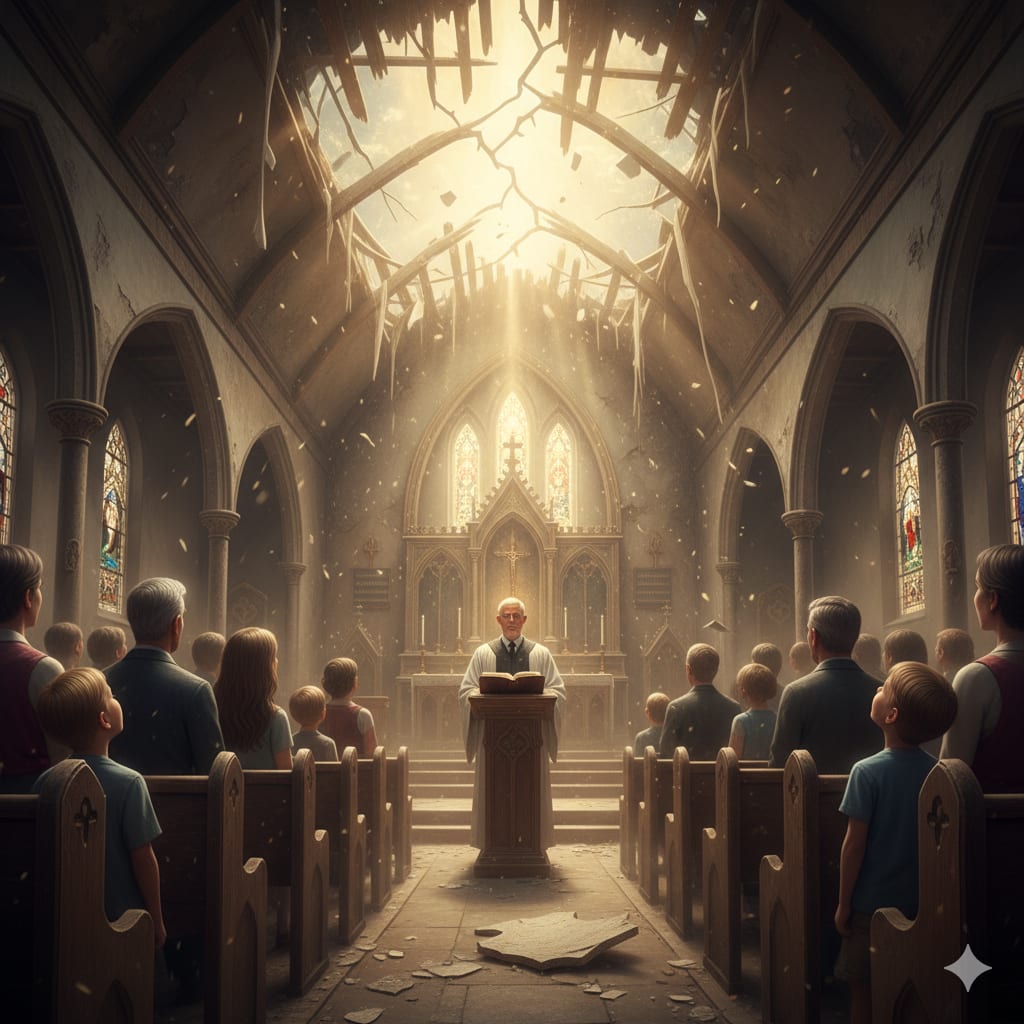
Sunday morning, the church roof split.
A clean line down the center aisle. Sunlight poured through, filtered through the fractured sky above. It made the dust glow.
The pastor did not pause the sermon.
“We are tested in uncertain times,” he said calmly, stepping around a fallen beam. “Faith is the discipline of staying steady.”
Dust drifted down like snow.
A piece of ceiling landed three pews back.
No one moved.
Children stared upward, mouths open.
Parents forced their children’s faces downward, like a deadbolt sliding into place.
“Eyes forward.”
On Monday, the crack reached the sun.
It split cleanly through it, dividing the light into two mismatched halves. The temperature dropped sharply.
People put on sweaters.
Weather apps updated automatically.
“Unexpected cold front.”
Nathan stood outside during his lunch break and watched the split light cast double shadows.
Every object had two outlines now.
He held up his hand. Two hands looked back.
The hum intensified, vibrating behind his eyes.
He felt the hum inside his ribs, syncing with his pulse.
The fracture shuddered.
A flake drifted down and didn’t dissolve this time.
It landed in his palm.
Cold. Smooth. Artificial.
He waited for it to dissolve.
It didn’t.
A woman next to him scrolled her phone, thumbs moving quickly.
“Do you see this?” he asked her.
She glanced at his hand, at the fragment, then at the sky, her jaw tightening.
“See what?” she said through gritted teeth, already turning away.
No one was reacting.
The hum intensified.
The fracture overhead shuddered, and for a split second the entire sky peeled back—like wallpaper torn from a wall—revealing black infrastructure behind it. Latticed beams. Mechanical movement. Something vast and constructed.
Then it snapped shut.
Seamless.
Blue.
Perfect.
People gasped softly.
Then:
“Glitch.”
“Satellites.”
“Government testing.”
“Nothing unusual.”
A man laughed too loudly.
Nathan closed his hand around the fragment.
It cut into his skin.
It was real.
He waited.
For someone to break.
For someone to say it.
For someone to look up and refuse.
Instead, traffic lights changed.
A dog barked at nothing.
A bus drove past with an advertisement that read:
STAY CALM. STAY CONNECTED.
The hum reached a frequency that made his vision blur.
Another flake fell.
And another.
They stayed.
They gathered on rooftops—
on cars, on shoulders, in hair.
Fragments accumulated like winter had arrived early.
They fell on people.
Landing in open mouths.
Dissolving slowly on the tongue.
Metallic. Bitter.
People coughed and cleared their throats with an irritation like a splinter under a fingernail or a mosquito buzzing in a dark room.
“Must be seasonal," someone muttered.
Animosity crystallized in midair.
Nathan felt something inside him split.
Not fear.
Not panic.
Recognition.
The wrongness wasn’t the fracture.
Not the hum.
Not the machinery behind the sky.
It was the agreement.
The quiet, practiced choreography of not naming it.
The collective refusal to disturb the surface.
A child across the street locked eyes with Nathan later that afternoon.
She pointed upward.
Her mother gripped her wrist, seizing it too tightly.
“Don’t look at that,” she scolded.
As if the sky might notice being noticed.
“Don't stare," she snapped.
The hum grew louder.
The sun flickered.
The fracture widened.
And the entire city continued as if everything were exactly as it had always been.
Nathan opened his mouth.
He felt the word forming.
Something simple.
Obvious.
Dangerous.
He swallowed it.
It burned going down.
Above him, the sky split again.
And something on the other side leaned closer.
Temperaments flared without clear provocation.
Doors slammed harder.
Eye contact shortened.
The hum settled deeper into the city.
White fragments continued to fall.
People brushed them away irritably.
And yet no one said anything.
By Tuesday, the sky was perfectly blue.
He no longer saw the fracture.
Or maybe he had stopped looking.
About the Creator
Tifani Power
I write from the places most people avoid. Drawn to moments that shape us, break us, remake us, and who we become in between—the inner wars we fight. My work is grounded in lived truth, built on depth, atmosphere, and emotional precision...
Keep reading
More stories from Tifani Power and writers in Fiction and other communities.
Made for Love
2086 — Tokiton, Eurasia. I open my eyes for the very first time. I take a look around. I can assume I am at a laboratory — pale white walls, big screens emitting blue light while displaying codes all over, at least five holo-boards with calculations written on them. And many, many silvery robot arms like a spider queen hovering above my face. What's a spider?
By Carolina Drouvenabout 4 hours ago in Fiction
'Till Death We Do Art
There would be nothing divine in this world without art. Nature may surpass the divine to all intents and purposes, but like everything it absorbs and is absorbed by, it remains here, stuck on the surface of this world, ever-present, physically bound to the universe.
By Avocado Nunzella BSc (Psych) -- M.A.P about 16 hours ago in Art



Comments
There are no comments for this story
Be the first to respond and start the conversation.