
The Unfinished Class
A philosophical clash between belief, logic, and the truth we fear to face.

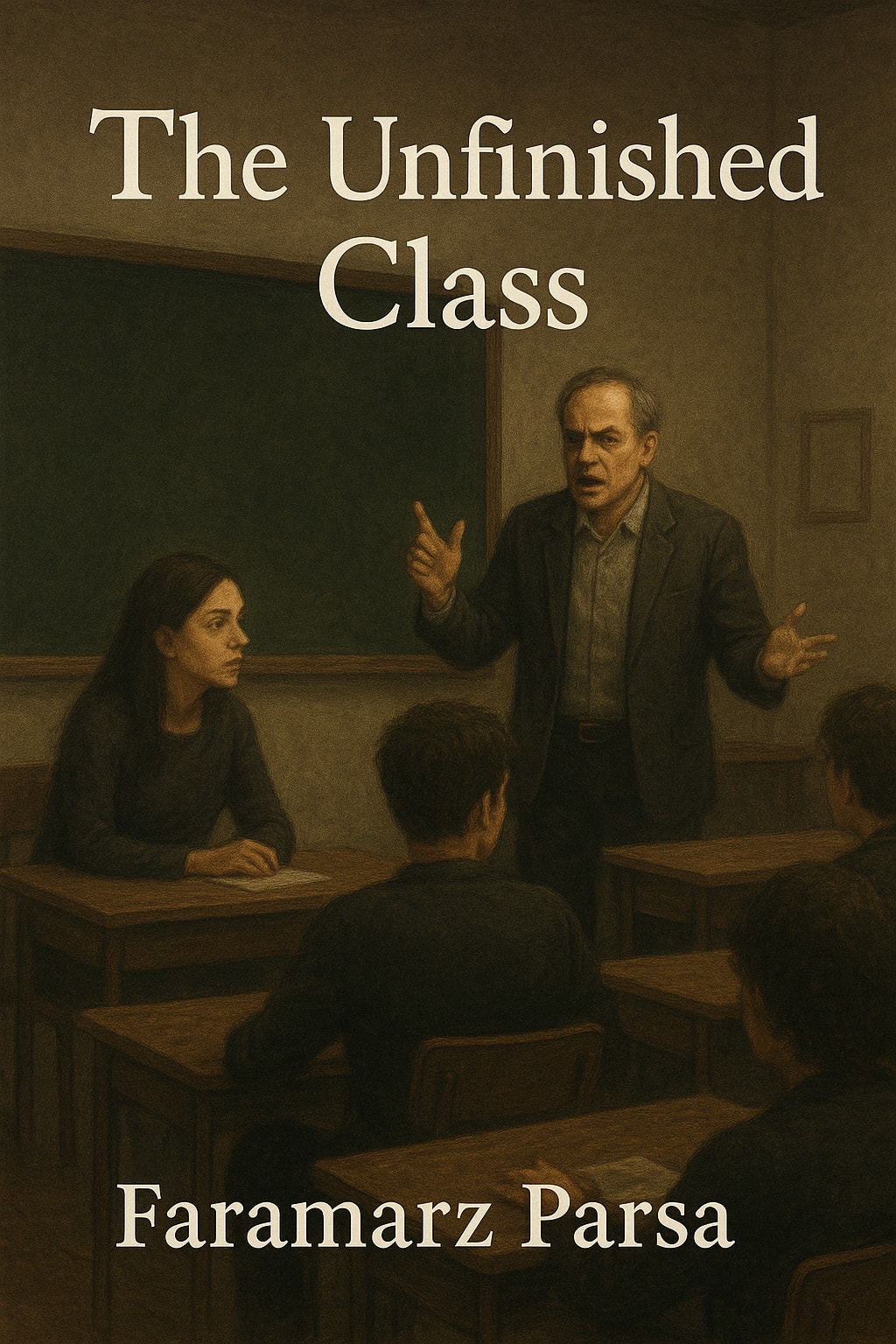
In a classroom filled with restless students, a bold question disrupts the lesson:
Does the soul truly exist—or is it only a belief shaped by religion?
As tensions rise, science and faith collide. One student challenges centuries of spiritual tradition, arguing that the soul may be nothing more than a human concept created to give meaning to life and death.
The Unfinished Class explores a powerful philosophical conflict between logic, belief, and the mysteries we fear to confront.
A thought-provoking story about truth, doubt, and the human need for meaning.
“The Unfinished Class”
by Faramarz Parsa
Chapter 1: The Last Question
The students’ whispers filled the classroom like waves.
Professor Namdar, famous more for his presence than his books, knocked firmly on the desk:
“Please, silence the class.”
Everyone quieted down, except for a girl whose question seemed stuck in her throat.
“Professor… if we say the soul dies with the body, does that mean we challenge religion?”
Some sighed; a few smiled nervously. No one dared speak.
Professor Namdar leaned slightly:
“Your question is not simple. Religion has relied on the concept of the soul for thousands of years. So if someone says the soul doesn’t exist, yes… it may shake the foundations of beliefs. But science is responsible for truth, not preserving beliefs.”
The class remained silent.
A boy from the back, Arad, stood. His steps were firm, as if he had found the answer:
“Professor, Jesus returned after death. Both the Quran and the Bible mention resurrection. If the soul doesn’t exist, how could that happen? Isn’t the soul separating from the body and returning?”
The professor turned to Arad, the one who had started the debate.
Arad calmly stood, opened his bag, but took out a notebook, not a book, not a reference—just a blank page.
“The soul,” he said, “is something we humans created out of fear of death.”
The class shifted uneasily. The professor gestured for silence.
Arad stepped forward:
“From the first day we understood death, we sought a reason to accept it. So we created something called ‘the soul’… something to reassure us that we don’t completely die. Science hasn’t measured it. No one has seen it. No record exists of it returning to the body.”
A boy in the back whispered, “But religion says…”
Arad interrupted:
“Yes, religion says so. But religion is not science. It’s narrative; stories humans told thousands of years ago about what they could not understand. Today, we know brain death, oxygen deprivation, the end of neural activity. When the brain stops, awareness stops.”
Arad paused:
“If the soul were real… every living being would have it. But we only speak of the human soul. Why? Because humans wrote the story, not nature.”
The professor leaned forward slightly:
“So, Arad… you are saying the soul is a belief, not a fact?”
“Yes, professor. A mental construct. A psychological safeguard. Something to face death with.”
The girl in the front asked softly:
“But if it doesn’t exist… does everything lose meaning?”
Arad sat on the bench, his voice quieter:
“Maybe meaning lies in life itself, not what comes after. We have complicated the world because we fear the simplicity of death.”
The classroom fell silent. Only the wind moved the curtains.
Professor Namdar, for the first time that semester, had no answers.
He sighed deeply. And then said:
“Sometimes a simple question shakes the entire history of human belief.”
The bell rang. No one moved.
The class… remained unfinished.
Chapter 2: The Silent Witnesses
The night was colder. Students left the classroom, but their minds stayed with Arad;
as if someone had said something dangerous.
Professor Namdar was the last to leave. The door closed softly behind him.
Arad remained alone. His notebook opened to the blank page, the only image of death he could picture.
A voice came from behind: “Arad… still searching for an answer?”
He turned. Mina, the girl who asked if the soul dies with the body, approached.
“I don’t want an answer, I want the truth.”
“Truth is not always an answer; sometimes it is the beginning of trouble.”
Mina sat. Arad stared at the blank page.
“You said the soul is a human construct… but what is this consciousness I have now?”
Arad smiled, a practiced, heavy smile.
“Consciousness is a product of the brain, not separate from it. Like a flame from friction between two sticks. Remove the sticks, and the fire goes out. The brain stops, awareness stops.”
Mina whispered:
“So after death… we become nothing?”
“More accurately,” he said, “we cease to exist as someone. The body returns to nature.”
Suddenly, Professor Namdar returned.
“You are still here?” he asked.
Arad remained silent. The professor walked slowly to the front.
“Tonight, we explore something humans have always been drawn to and scared of: the soul.”
Chapter 3: Hall 3 and the Edge of Truth
The library was silent. The three sat. Professor Namdar explained:
“There are three kinds of truth:
Scientific truth—what can be measured and observed.
Experiential truth—what humans experience, even if science cannot prove it.
Belief truth—what humans create to give meaning.”
He continued:
“The soul has no scientific evidence. Yet, people report experiences. And as a belief, it is created to help humans cope with mortality.”
Mina asked:
“So, the soul exists or not?”
“The dangerous question,” said the professor.
“Sometimes the answer is neither simple nor comforting.”
Arad closed his notebook. For a moment, he doubted what he believed.
Professor Namdar said:
“Religion created the soul. Maybe. But not from lies—from human need. And even if the soul is only a belief, it is powerful because it shapes how we face death.”
Mina smiled—not happily, but with the calm of discovery:
“The soul may be just a belief, but the awareness of life and death is real.”
By Faramarz Parsa
About the Creator
Ebrahim Parsa
⸻
Faramarz (Ebrahim) Parsa writes stories for children and adults — tales born from silence, memory, and the light of imagination inspired by Persian roots.
Keep reading
More stories from Ebrahim Parsa and writers in Fiction and other communities.
Dead and Wearing Green
She was wearing that green dress when I first saw her, five years ago to the day. Flowing meadow fabric draped over long legs, thick auburn hair flowing down her back. That smile. Of course, she is still beautiful now. But now she is no longer alive.
By Karen Cave7 days ago in Fiction
What the Moon-Eyed People Left Behind
The story goes that before the Cherokee came to the Appalachian Mountains; there lived a race of pale people who could only see at night. They had large, round eyes sensitive to daylight, and they built stone walls and earthworks across the valleys. When the Cherokee arrived, they drove the Moon-Eyed People west, and that was that. The pale night-dwellers vanished, and the Cherokee claimed the land.
By Tim Carmichaela day ago in Fiction



Comments
There are no comments for this story
Be the first to respond and start the conversation.