
When Powers of Sun Magnified
We waited for it—for this


After childhood years spent listening to these stories at the feet of Nana Belle, great aunts and great uncles, this part (my part) became both easy and hard. Easy when you grow up to become a writer. Hard knowing the oral traditions steeped in a history vast enough to eclipse the oldest mariner’s voyage are in danger of being lost simply because no one sits still to listen anymore.
I’ve shared the clearest of my memories. May the Ancestors, I pray, be pleased with me…
May 17, 1803: - Laughter died at the hands of the lecherous and lash in a long-ago time. You would do well to remember that la isla de las Bermudas (the island of Bermuda) garnered omnipotence from the sea in ways varied and inexplicable.
The unseen. Ever present and iron-weighty in salted heaviness. It shipwrecked countless sailors, drove men to mistresses, thwarted best-laid plans for stock inventory making mockery of the slave masters though we dared not let mirth alight our faces.
Sweat-soaked humid summer days and frigid dampness ‘through to your bones’ winter nights spent in repair for a stronger house, better crop yields, or larger sea catch would be welcome if it benefitted us and brought security to our families.
It was not. And it did not.
Between the Smith and Butterfield Estates in Devonshire and Paget parishes, we gathered firewood away from brackish marshes, slow-smoked red snapper over low fires, and tended tobacco, banana, onion, and arrowroot crops. In between, we mended clothes and fishing nets alongside endless other chores in utter silence through countless phases of moon and seasons.
It remains unknown exactly who started it. But start it did.
A simple signal for “drink,” and “come.” Words like “hurt” and “sleep” grew a complex language of hand signs from the desperation of necessity to speak to one another. Because after the near-successful slave rebellion of 1689, the “massas” took to cutting out our tongues.
Other-worldly gurgled screeches behind the chicken coop on a crude table unfit for purpose were by design.
To petrify the rest of us.
To abolish such notions as “escape” or “freedom.” But you can bet, in secrecy, we developed sign language for those words too.
After 250 years plus, in conditions a dog would die in, our vocal cords dried up from disuse. The ‘cutting practice’ became less widespread with concern over infection rates, labor days lost, or death by choking. Accrued costs the English colonists were loathe to absorb. But the damage had long been done. Upon never hearing spoken language and being sequestered from the white world until of age to work, children emitted guttural sounds at best. Soon after, they picked up hand gestures as right as rain.
No official record exists, yet the reasons are clear. More slaves perished from heat at summer solstice than any other time of year. Thus, two "rest days" protected white colonial “investments” since a sick or dead slave couldn’t work well enough.
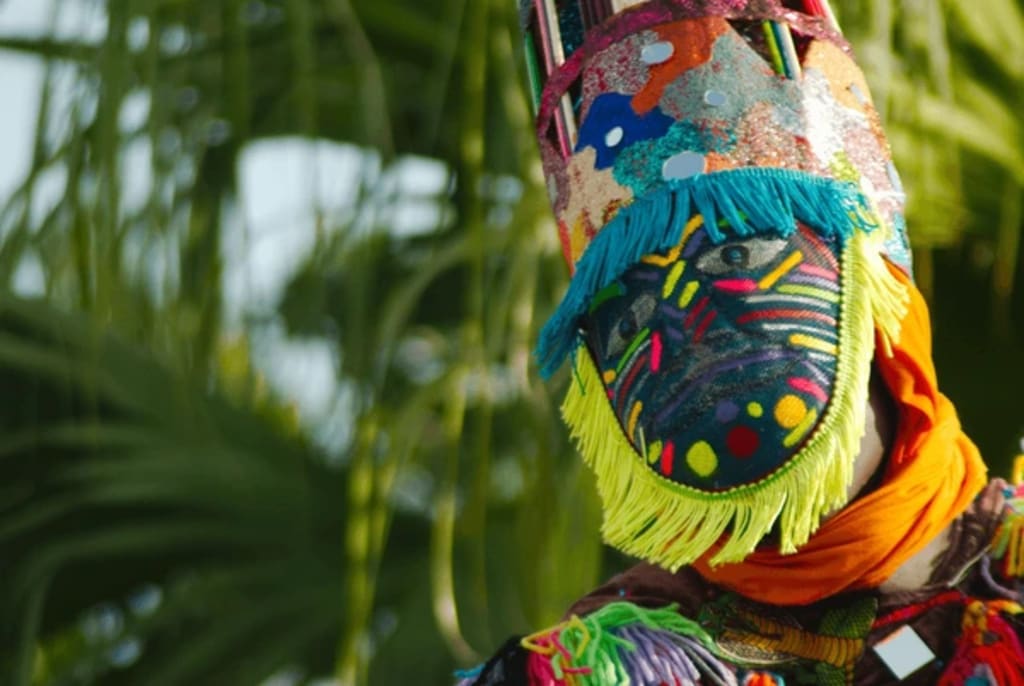
Lengthened “fiyah heat days” birthed the Gombey dancers, a spirit tradition that drew mystic ocean magic starting hours before sunrise. Safe in anonymity, they re-enacted the horrors forced upon the enslaved by brutal taskmasters with kaleidoscope leaps and footwork to drums and whistles in sporadic locations infusing terror across the isles. Not a soul could comprehend how they danced all day long without collapse beneath the oppressive and relentless sun.
Circa 1805: - A distant family relation known only as “Tan” crept away for a swim underneath night’s cloak one solstice eve and chanced upon them. Camouflaged amid spice trees, he later returned to “tell” of Gombey preparations at Devonshire Bay near the water’s edge, his hands a lightning flurry...
“Gallons of seawater collected and stored in doubled bladders of fish and fowl, calabash and crude tar-lined sacks…stored inside drums, under dress garments, headdress the height of a man…covered bodies head to foot...low incessant splashes to summon spirits of the dead and the unborn…glints of sharpened axes and arrows against reefs.”
Silent skyward pleas made pre-dawn air thick with yearning over injustice and every other indignity human beings can suffer when enduring relentless tragedy.
Turtles, crabs, stingrays, cahows, and terns alongside assorted marine creatures would encircle and weave through the Gombeys, mirrors on dark capes reflecting moonlight, at various depths of the shore. Surely a fisherman’s dream catch, but no harm befell any creature. Perhaps each life knew instinctively of sanctuary, an energy lending spirit to rituals that freedom cried for…soundless. All bore witness until time eclipsed to crescendo. A haunted silence breathed from seagrass beds until at last, the first faded pink dots appeared on the horizon and the energetic display ebbed to thwart discovery. A practice seldom witnessed and subsequently never held in the same location.
No one knew what to say to Tan.
But two things happened after that curious rite. Our people learned well to keep secrets. And on summer solstice day and the next, miraculous events unfolded that shook the white population to its hardhearted core.
Mothers cuddled and cooed before the surprised eyes of children enrapt by blissful sound.
Brothers shouted news and greetings to siblings across the onion fields, embracing in teary-cheeked rapture. Words, a broken mix of Bantu, Wolof, Creole, Portuguese, Spanish, or English, provided a living testament to the countless exchange of hands and the brutality of chattel slavery.
Widowed ones in headscarves and wide-brimmed straw hats would rail nigh the entire day with packets of smelling salts in segregated slave church cemeteries. The scent of smothered grief for husband fishermen lost at sea without a body to bury drenched nostrils for miles. Broken-hearted shrieks caused even the starlings to cease their customary song. It seemed as if they too honored such sorrow.
A shadowy pallor cast wary over otherwise mouthy captors. During this exuberant freedom of speech when every enslaved African could pray, hum, or sing around bewildered white households whose occupants remained unable to extinguish a voice without killing the body that bore it.
Above the multitude of conversations that moved everyone but slave masters to compassion, arose other pursuits. Primal urges that cruel punishment of neither stockade nor whip could deter.
Husbands loved wives in ardent fervor whispering assured longings with a tenderness that permeated day into night, embracing toiled ebony limbs sinewy and sore.
Secret crushes discovered anonymous sunshine dandelion bouquets left. Lemongrass sachets. Sometimes fragrant multi-colored hibiscus or rose in the hope that shyness could pierce through filtering back to its senders. Romance warmed the coolest hearts to action at the one opportunity for relationship redemption.
Love, a flame unfurled, drove some to voice their dedication to this or that young beauty without relent—songs of raw emotive request. Metaphor-laden entreaties promising solace. Heaven. A love that should seek eternity on the longest day of the year saw recipients bask in conversations suggesting cherry blossoms and turtle dove softness against the realities of laborious birth-to-death captivity.
Love unrequited panged a mournful rhythm as morn droned to eve and desperation crept into words for life’s one chance at bliss, uncertain as it was. Potential lovers cast monologued persuasion extolling the virtues of themselves and their Beloveds even after their throats surrendered to hoarseness brought on by sheer exhaustion.
Yet still they spoke.
Entreated.
With everything left inside them over days, nights, weeks, and parish borders. As one by one, the enchantments wore thin. As silences crept into completeness on cooler autumn winds and a distant promise of the following year, holding all the words they could not yet say.

Author’s Note:
Although this is a work of fiction, Bermuda did become the first English colony to bring enslaved Blacks to its shores to dive for pearls in 1616. Due to its geographical isolation, punishments and restrictions for the enslaved were severe.
Gombey is a Bantu word meaning “rhythm” or “drum” and to this day, the Gombeys reenact the stories of horrendous treatment by slave masters of a bygone era through dance.
About the Creator
Reader insights
Outstanding
Excellent work. Looking forward to reading more!
Top insights
Heartfelt and relatable
The story invoked strong personal emotions
On-point and relevant
Writing reflected the title & theme
Excellent storytelling
Original narrative & well developed characters
Expert insights and opinions
Arguments were carefully researched and presented
Compelling and original writing
Creative use of language & vocab
Masterful proofreading
Zero grammar & spelling mistakes
Eye opening
Niche topic & fresh perspectives
Easy to read and follow
Well-structured & engaging content
Keep reading
More stories from The Dani Writer and writers in Fiction and other communities.
The Lesions of Devotion
Every day I set myself down on the freshly cut lawn and strip myself bare. I take my guitar and finger the frets and pick at the strings, listening for dissonance. My life is dissonance. I twist the tuning pegs until each string sounds bright. Then I kneel, calves pointing behind me, kneecaps facing forward. All exposed to the breeze. I close my eyes and play the melody.
By Paul Stewarta day ago in Fiction


Comments (16)
This horror helped create the wealth of Regency England. Extraordinary story; extraordinary writing! Congratulations, Dani! Richly deserved!
Wow. This is incredible work.
Wooohooooo congratulations on your win! 🎉💖🎊🎉💖🎊
Incredible story telling! You really brought the historical context to life! Double congrats on Top Story and Runner Up!!
Although the Caribbean Islands are close, we barely know the true stories of our fore-people. We were taught the white man's history in school books. We had to grow up and find out the truth for ourselves. You brought out the painful truth of your island suffering, a bit wrapped in fiction, but truth nonetheless. Congrats.
The power behind the silence is what people often overlook. This was an amazing historical fiction piece. I love it when a story is steeped just enough in truth. That's what makes a story powerful and meaningful. And this is one of those. Good job Dani.
I like that
AMAZING! IT MIGHT BE FICTION BUT I PRESUME IT TO BE TRUE FOR SOMEONE! THE TRAIL OF TEARS HERE IN AMERICA WAS ABSOLUTELY HORRIFYING!
This comment has been deleted
What a painful historical piece! What humans did, and ,do to other humans is heartbreaking. The secret language and dances - the horror - and the people smiled and sang, to stay sane, to keep their humanity, to keep their souls safe from the monsters who cruelly enslaved them. The dances of all ethnic groups tell stories. You depicted the history of your background beautifully and poignantly in your Top Story! 🎉🥳🎉🥳🎉🥳🎉🥳
They are gone, my heart-Sister!
Superb work as always!! FLAWLESS ❤️ Congrats! 🎉🎊
Back to say congratulations on your Top Story! 🎉💖🎊🎉💖🎊
I had to check the community it was published in to determine whether this was a factual account. Very powerful writing. Congrats on top story!
Truly amazing read! It felt so real, and incredibly emotional! Very well deserved top story, congrats! Good luck with the challenge, I won't be surprised to see this on the leader board!
I am humbled by these unstoppable spirits and your skill. ✍️✍️✍️
Gosh your story broke my heart and made me so emotional! It's just so devastating and it must have been so difficult for you to write a story on this topic. I wish you all the best for the challenge!