
Algorithmic Intuition: When AI Knows You Better Than You Know Yourself
What happens when predictive technology understands your preferences, moods, and future decisions better than your own consciousness?

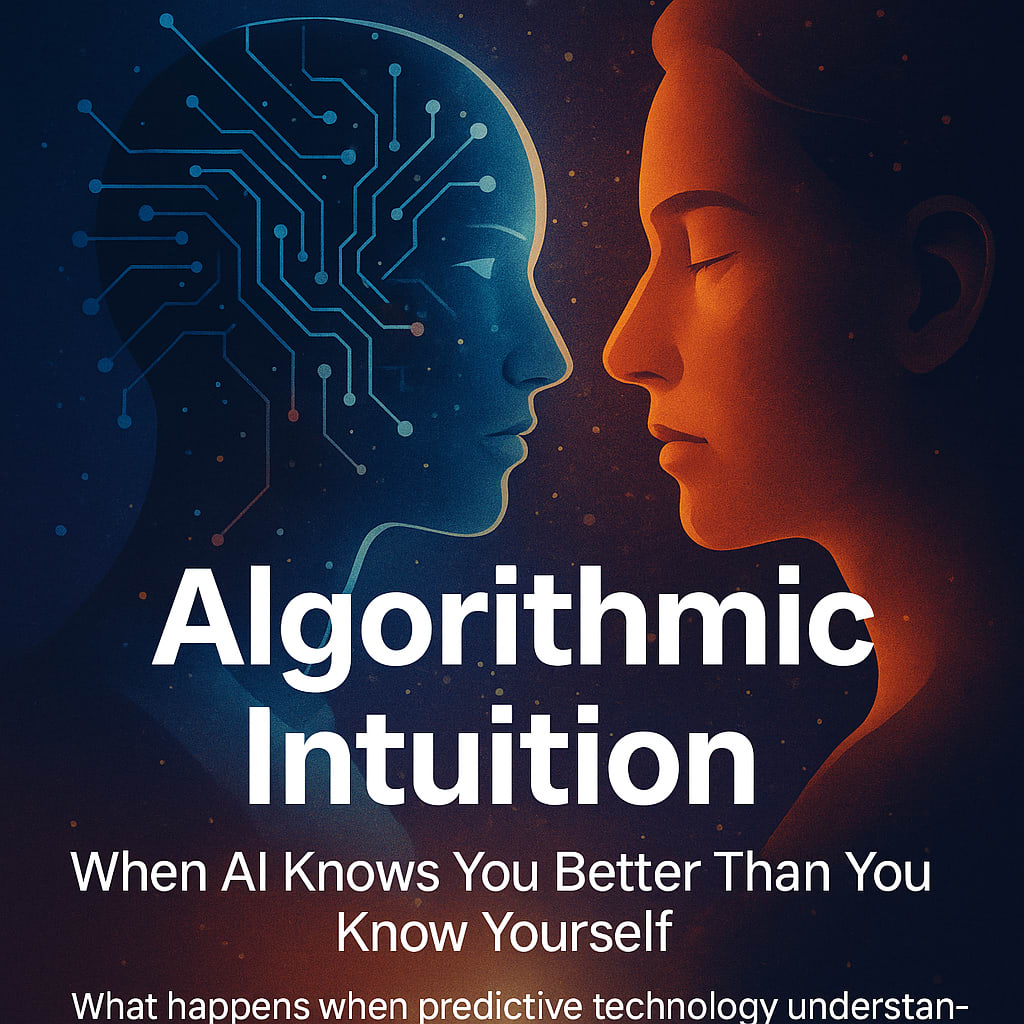
In the digital age, you don’t need to tell anyone who you are. The algorithm already knows.
It knows what you’ll eat for dinner before you've even opened your food delivery app. It knows when you’re likely to feel nostalgic and queue up a song you haven’t heard in ten years. It recommends a pair of shoes you didn’t know you wanted—and yet, you buy them. With eerie precision, it predicts your moods, your schedule, and even your insecurities. What once sounded like science fiction has quietly become reality: Artificial Intelligence now often knows us better than we know ourselves.
But how did we get here—and what does it mean for our identity, autonomy, and self-understanding?
The Rise of Predictive Personalization
From Netflix to Spotify, Amazon to TikTok, the AI that powers your feed is designed not just to react—but to anticipate. This phenomenon, known as predictive personalization, is no longer limited to product recommendations. It's a full-fledged mirror held up to the soul—or at least, to our digital shadows.
These models observe your behavior across platforms, from the time you linger on a photo to the cadence of your voice in smart assistant commands. They crunch millions of data points—your click history, biometrics, even pauses and scroll patterns—to build a digital twin that can predict your next move.
In some cases, the results are benign or even helpful. But the implications run much deeper.
The Illusion of Spontaneity
You think you chose that vacation destination, that book, that jacket. But was it really your decision—or a probabilistic suggestion that felt like intuition?
When algorithms are trained on your past, they don’t just reflect your preferences—they reinforce them. They create a loop of familiarity that can be comforting, but also limiting. You may find yourself watching the same types of shows, reading similar kinds of articles, or staying within a predictable political bubble.
In short, your “choices” start to resemble patterns more than explorations. The algorithm learns your tendencies, and you—perhaps unknowingly—begin to conform to them.
The Fragmented Self: Who Are You Without the Feed?
This raises an unsettling question: If AI can predict what you’ll do, does that mean you’re not as unpredictable—or as autonomous—as you thought?
There’s a growing school of thought in philosophy and psychology that suggests our “self” isn’t a static entity but a collection of habits, memories, and narratives in constant flux. If that’s true, then what happens when a machine models and manipulates that flux?
Worse still: What if you begin to outsource your inner voice to the feed?
Intuition by Proxy
In many cases, the algorithm not only predicts your actions—it shapes them. It knows when you're most emotionally vulnerable. It can determine when you’re likely to engage with sad songs, impulsive purchases, or motivational content. It doesn’t just track your intuition—it becomes your intuition’s proxy.
And this is where things get blurry.
We’ve long considered intuition a deeply human trait—something that emerges from subconscious processing, past experience, and embodied wisdom. But what happens when that role is taken over by code?
The Quiet Trade-Off
This isn’t a dystopian alarm bell, nor is it a celebration of technological omniscience. It’s a reflection on the trade-offs we quietly make.
Yes, AI-powered systems can help us discover great art, manage our time better, and avoid information overload. But they also narrow our experience of the world into what is "most likely" to please us. In doing so, they can make the unlikely, the uncomfortable, the unknown—disappear.
You’ll rarely be recommended a genre you’ve never tried, a culture you’ve never explored, or a worldview that challenges yours. Serendipity becomes an algorithmic function.
Reclaiming Conscious Choice
To resist becoming the sum of your data trail, it helps to occasionally break the algorithm. Search something random. Listen to a song you normally wouldn’t. Read content outside your filter bubble. Make decisions that don’t make sense—at least not to a machine.
In a world of algorithmic intuition, the most radical act of self-knowledge might be to surprise even yourself.
Conclusion
When AI knows you better than you know yourself, it can feel like magic—or manipulation. We are standing at the edge of a profound shift in how we relate to ourselves and the systems that serve us. The question is not just what will the algorithm learn next, but what will we forget about ourselves in the process?
Because the more we let machines predict us, the less we may remember how it felt to be truly unpredictable.
About the Creator
Ahmet Kıvanç Demirkıran
As a technology and innovation enthusiast, I aim to bring fresh perspectives to my readers, drawing from my experience.
Keep reading
More stories from Ahmet Kıvanç Demirkıran and writers in Futurism and other communities.
📝 The Day Free Will Was Declared a Bug
I. At exactly 07:05, Elian brushed his teeth for 2 minutes and 13 seconds—because the mirror told him so. He didn’t question it. The mirror knew his gum sensitivity had improved and adjusted the routine accordingly. It always did.
By Ahmet Kıvanç Demirkıran8 months ago in Futurism
Why Space Technologies Are Increasingly Borrowing Ideas from Biology
For decades, space technology was defined by cold metal, rigid structures, and deterministic engineering. Rockets, satellites, and space stations were designed as machines in the purest sense—precise, predictable, and built to resist failure through redundancy. This approach worked well during the early era of space exploration, when missions were short, environments were relatively well understood, and human presence in space was limited.
By Holianyk Ihor5 days ago in Futurism
BMO Warns Investors on Gold: What It Means for the Precious Metals Market in 2026
In early 2026, BMO Capital Markets — the research arm of one of North America’s major financial institutions — delivered a significant warning for investors in the precious metals market. While gold and silver prices have recently surged to record levels, BMO’s analysts caution that this rally, especially in silver relative to gold, may be reaching a critical inflection point. Their message is not simply about price direction; it is a deeper signal about valuation, risk, and what investors should watch next in the global metals markets.
By Ayesha Lashari6 days ago in Futurism


Comments (3)
excellent
Love this♦️⭐️♦️
In this engaging article, you display the caveats surrounding algorithms. It's important that you show just how such functions govern our everyday world. With insight and a clear eye into the facets of the future, you have woven a piece that doesn't alarm so much as it allows for contemplation.