
Australia Meat Market: Production Dynamics, Consumer Preferences & Export Demand
How evolving production dynamics, shifting consumer preferences and robust export demand are shaping Australia’s meat market
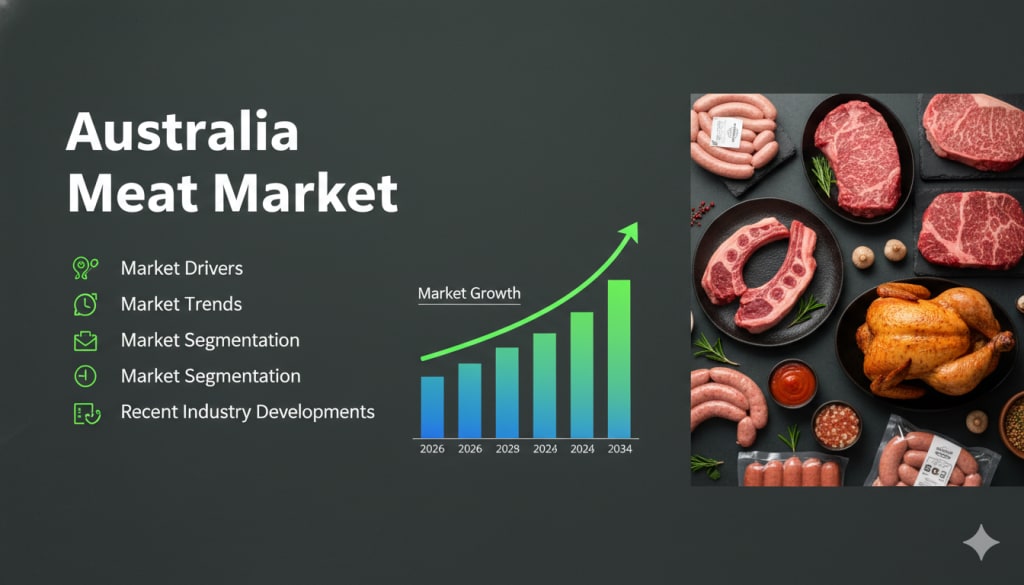
According to IMARC Group, the Australia meat market was valued at USD 29.15 Billion in 2025 and is projected to reach USD 34.39 Billion by 2034, growing at a compound annual growth rate (CAGR) of 1.85% during 2026–2034. While growth remains moderate, the sector holds strategic importance within the national economy of Australia. Meat production—spanning beef, lamb, pork and poultry—continues to serve both domestic consumption and strong international export markets. The industry is navigating evolving consumer preferences, sustainability pressures and productivity challenges while maintaining its position as a key contributor to rural employment and global food supply chains.
Why Should Smart Buyers and Investors Know About the Australia Meat Market?
Stable Core Demand
Meat remains a fundamental dietary component domestically and globally, ensuring baseline consumption stability.
Strong Export Revenue Potential
International trade remains a critical growth pillar, supporting foreign exchange earnings and industry scale.
Efficiency and Productivity Improvements
Technology-driven productivity gains offer margin expansion opportunities even within moderate growth conditions.
Sustainability-Driven Innovation
Environmental initiatives and animal welfare compliance can enhance brand value and export competitiveness.
Strategic Role in National Agriculture
The meat industry contributes significantly to rural employment, agribusiness value chains and economic diversification.
Recent Trends & Developments in the Australia Meat Market
July 2025:
Export volumes of premium beef strengthened as demand increased from key Asian markets.
March 2025:
Producers invested in methane-reduction feed additives to align with emissions reduction targets.
October 2024:
Retailers expanded premium and value-added meat product lines to meet evolving consumer preferences.
The Australia meat market represents a mature yet strategically significant segment of the national food economy. Supported by IMARC’s steady growth projections, the industry continues to balance domestic consumption, export performance and evolving sustainability expectations. While growth rates remain moderate, ongoing investments in production efficiency, traceability and value-added processing are strengthening long-term competitiveness. As global protein demand evolves and environmental accountability increases, Australia’s meat sector is positioned to adapt through innovation and operational modernization. For investors, agribusiness stakeholders and food industry participants, the market offers a stable yet forward-looking platform anchored in export strength, productivity gains and responsible production practices.
Australia Meat Market Vision 2050
1. Sustainable and Climate-Resilient Livestock Systems
By 2050, livestock production is expected to incorporate advanced methane mitigation techniques, regenerative grazing practices and improved land management to reduce environmental impact.
2. Digital Traceability and Supply Chain Transparency
Blockchain and digital tracking systems will enable end-to-end traceability, strengthening consumer trust and export compliance.
3. Integration With Alternative Protein Markets
While traditional meat will remain dominant, the industry may coexist with plant-based and cultured protein segments, diversifying protein supply portfolios.
4. Advanced Processing and Automation
Automation in meat processing facilities will enhance efficiency, hygiene standards and workforce productivity.
5. Strengthened Export Diversification
Australia may expand export destinations and develop new trade agreements to reduce reliance on a limited number of markets.
What Are the Key Growth Drivers in the Australia Meat Market?
Robust Export Demand
Australia remains a major exporter of beef and lamb to global markets, particularly across Asia and the Middle East. Strong trade relationships and high standards of food safety and traceability support consistent export volumes. International demand for premium, grass-fed and hormone-free meat products continues to bolster industry resilience.
Stable Domestic Consumption Patterns
Despite changing dietary trends, meat remains a staple in Australian households. Poultry consumption has grown steadily due to affordability and perceived health benefits, while premium beef and lamb continue to command strong demand in retail and foodservice channels.
Advances in Production Efficiency
Technological improvements in livestock management, genetics and feed optimization are enhancing productivity and yield. Digital farm management systems and supply chain traceability tools are supporting operational efficiency and compliance with international quality standards.
Growing Focus on Sustainability and Animal Welfare
Environmental considerations and animal welfare standards are shaping production practices. Producers are investing in sustainable grazing systems, methane-reduction strategies and improved livestock health management to align with ESG expectations and export requirements.
Expansion of Value-Added Processing
Beyond raw meat exports, the industry is investing in processed and packaged meat products that command higher margins. Branding, portioning and ready-to-cook innovations are enhancing domestic and international market appeal.
About the Creator
Keep reading
More stories from Shrestha Roy and writers in Futurism and other communities.
Australia Natural Gas Market: Domestic Demand, LNG Exports & Infrastructure Development
According to IMARC Group, the Australia natural gas market reached a value of USD 34.46 Billion in 2025 and is projected to expand significantly to USD 73.82 Billion by 2034, exhibiting a robust compound annual growth rate (CAGR) of 8.83% during 2026–2034. This strong growth trajectory highlights natural gas’s dual role within Australia’s energy landscape—as both a critical domestic fuel source and a globally traded commodity. While renewable energy continues to expand, natural gas remains central to electricity generation, industrial production and export revenue generation. Supported by infrastructure investments and expanding liquefied natural gas (LNG) capabilities, the sector is reinforcing Australia’s position as a key energy supplier within the Asia-Pacific region and across Australia.
By Shrestha Royabout 14 hours ago in Futurism
Saudi Arabia Power Tools Market: Construction Boom, Cordless Innovation & Smart Tool Adoption, Market Expansion
According to IMARC Group's latest research publication, Saudi Arabia power tools market size reached USD 361.2 Million in 2025. The market is projected to reach USD 487.6 Million by 2034, exhibiting a growth rate of 3.39% during 2026-2034.
By Kishan Kumarabout 6 hours ago in Futurism
Unexpected Properties of Dark Matter Revealed in 2026
For decades, dark matter has remained one of the most persistent enigmas in modern astrophysics. Invisible to telescopes and undetectable through direct electromagnetic interaction, it nonetheless shapes the Universe on the largest scales. Galaxies rotate faster than their visible mass allows, galaxy clusters remain gravitationally bound, and the cosmic web itself depends on an unseen framework. Until recently, dark matter was largely treated as a silent, passive component—cold, inert, and interacting only through gravity. However, research published and analyzed in 2026 significantly challenged this simplified view.
By Holianyk Ihor3 days ago in Futurism


Comments
There are no comments for this story
Be the first to respond and start the conversation.