
Australia Steel Market: Production Dynamics, Demand Trends & Sustainability Initiatives
How shifting production dynamics, evolving demand trends and increasing sustainability initiatives are shaping Australia’s steel market
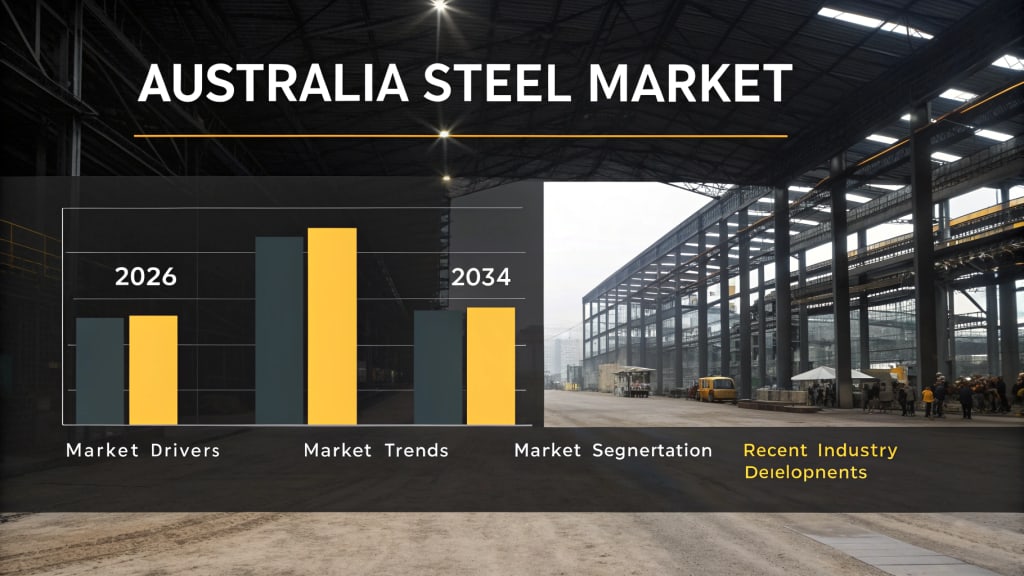
According to IMARC Group, the Australia steel market reached USD 20.1 Billion in 2025 and is projected to expand to USD 26.2 Billion by 2034, exhibiting a compound annual growth rate (CAGR) of 2.91% during 2026–2034. This steady growth trajectory reflects structural demand from infrastructure, construction and mining sectors across Australia. Steel remains a foundational industrial material supporting transportation networks, renewable energy projects, manufacturing facilities and urban development. As global supply chains evolve and sustainability standards tighten, Australia’s steel industry is navigating production modernization, demand shifts and decarbonization pressures.
Why Should Smart Buyers and Investors Know About the Australia Steel Market?
Stable Long-Term Industrial Demand
Steel remains indispensable for infrastructure, manufacturing and resource sectors.
Alignment With Energy Transition
Renewable energy and grid modernization projects support sustained consumption.
Sustainability Transformation Opportunity
Green steel initiatives create competitive advantages and ESG-aligned investment opportunities.
Export Market Resilience
Strong trade links with Asian economies diversify revenue streams.
Technological Modernization Potential
Automation and advanced metallurgy enhance productivity and profitability.
Recent Trends & Developments in the Australia Steel Market
July 2025:
Producers increased investment in low-emission steel technologies aligned with decarbonization targets.
April 2025:
Infrastructure contracts boosted domestic steel orders for renewable and transport projects.
October 2024:
Manufacturers adopted advanced automation systems to enhance production efficiency and reduce costs.
The Australia steel market stands as a cornerstone of national industrial capacity and economic development. Supported by IMARC’s steady growth projections, the sector benefits from infrastructure expansion, renewable energy investments and resilient manufacturing demand. While facing global price volatility and decarbonization challenges, steel producers are investing in advanced technologies and sustainable production methods to remain competitive. As hydrogen-based processes, recycling initiatives and digital manufacturing tools gain traction, Australia’s steel industry is poised for gradual transformation. For manufacturers, investors and infrastructure developers, the market presents a forward-looking opportunity grounded in structural demand, export strength and sustainability-driven innovation within an evolving global materials landscape.
Australia Steel Market Vision 2050
1. Green Steel Production
By 2050, hydrogen-based direct reduced iron (DRI) processes may significantly reduce carbon emissions from steel manufacturing.
2. Electrification of Production Facilities
Renewable-powered electric arc furnaces could dominate domestic steelmaking.
3. Circular Economy Integration
Increased scrap recycling and resource efficiency may define sustainable steel production models.
4. Advanced High-Strength Steel Applications
Lightweight, high-performance steel grades may expand usage in automotive and infrastructure projects.
5. Digital Manufacturing Optimization
AI-driven process control and predictive maintenance systems could enhance operational efficiency.
What Are the Key Growth Drivers in the Australia Steel Market?
Strong Construction and Infrastructure Demand
Public and private investment in housing, commercial buildings and transportation networks continues to support steel consumption. Infrastructure upgrades—including rail systems, highways and renewable energy installations—require high-strength structural steel components.
Mining and Resource Sector Expansion
Australia’s mining sector drives demand for steel in heavy machinery, processing equipment and industrial facilities. The development of renewable energy projects, including wind and solar farms, further increases steel requirements.
Government Investment in Renewable Energy
Large-scale renewable projects and grid expansion initiatives rely on steel-intensive components such as towers, frames and transmission infrastructure. Steel demand aligns closely with national energy transition goals.
Rising Domestic Manufacturing
Growth in automotive components, machinery production and advanced fabrication sectors is strengthening domestic steel consumption. Manufacturing resilience initiatives encourage local sourcing and supply chain security.
Export Growth to Asian Markets
Australia’s proximity to major Asian economies supports steel exports and related raw materials, particularly iron ore. Trade relationships enhance revenue diversification.
Technological Advancements in Production
Modernized blast furnaces, electric arc furnaces and automation technologies are improving production efficiency and product quality.
About the Creator
Keep reading
More stories from Shrestha Roy and writers in Futurism and other communities.
Australia Power Transmission Equipment Market: Infrastructure Expansion, Industrial Demand & Technology Innovation
According to IMARC Group, the Australia power transmission equipment market reached USD 1.4 Billion in 2025 and is projected to expand to USD 2.6 Billion by 2034, exhibiting a compound annual growth rate (CAGR) of 6.94% during 2026–2034. This robust growth reflects large-scale grid modernization, renewable energy integration and infrastructure investments across Australia. Power transmission equipment—including transformers, switchgear, transmission lines, circuit breakers and high-voltage direct current (HVDC) systems—forms the backbone of electricity distribution networks. As Australia transitions toward a low-carbon energy system, upgrading and expanding transmission infrastructure has become a national priority.
By Shrestha Roy3 days ago in Futurism
GCC Egg Powder Market Analysis: Product Segmentation, Pricing Trends, and Forecast
According to IMARC Group's latest research publication, GCC egg powder market size reached 6,331.1 Tons in 2024. The market is projected to reach 9,801.5 Tons by 2033, exhibiting a growth rate of 4.73% during 2025-2033.
By Abhay Rajput3 days ago in Futurism



Comments
There are no comments for this story
Be the first to respond and start the conversation.