
Automotive Blind Spot Detection System Market Trends: AI Integration, Sensor Innovation & Forecast to 2034
How sensor fusion technologies, AI-powered object recognition, and growing consumer demand for accident prevention are transforming automotive blind spot detection performance and reliability

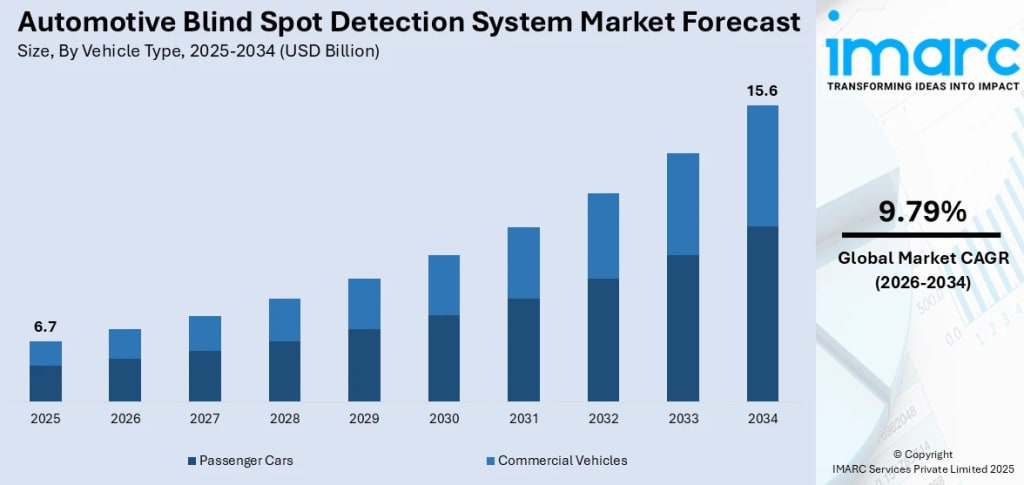
Rising safety concerns, stringent government regulations, and the increasing adoption of Advanced Driver Assistance Systems (ADAS) are driving the demand for automotive blind spot detection systems. This growth is further supported by ongoing technological advancements in radar and sensor fusion, as well as a significant shift in consumer preference toward vehicles equipped with proactive safety features. According to IMARC Group’s latest data, the global automotive blind spot detection system market size reached USD 6.72 Billion in 2025. Looking forward, IMARC Group estimates the market to reach USD 15.57 Billion by 2034, exhibiting a CAGR of 9.79% from 2026-2034.
The automotive blind spot detection (BSD) system has evolved into a multi-billion-dollar global industry, transitioning from a luxury-only feature to a standard expectation in mid-range and economy vehicles. Market expansion is propelled by high-resolution radar technology, AI-driven sensor fusion, and the rise of autonomous driving levels that require 360-degree environmental awareness. Major segments include radar-based systems, which lead the market due to their reliability in adverse weather, followed by camera-based and ultrasonic solutions. With internal combustion engine (ICE) vehicles still holding a major share and electric vehicles (EVs) rapidly adopting these systems as core safety components, the industry is witnessing a robust integration phase across all vehicle segments, prioritizing collision prevention and driver confidence.
Download a Complimentary “Automotive Blind Spot Detection System Market” Report Sample
Automotive Blind Spot Detection System Market Growth Drivers:
- Stringent Government Safety Regulations
Regulatory mandates are a primary catalyst for the widespread adoption of blind spot detection technologies. For example, the European Union’s General Safety Regulation (GSR) recently mandated that all new heavy-duty trucks and buses over 3.5 tons must be equipped with blind spot information systems as of July 2024. Similar legislative blueprints are appearing globally, forcing manufacturers to move these features from "optional" to "standard." In the United States, updated crash ratings now factor in blind spot interventions, incentivizing automakers to integrate these systems to maintain competitive safety scores and meet federal highway safety goals.
- Rising Consumer Demand for Enhanced Road Safety
Modern drivers are increasingly prioritizing active safety over traditional aesthetics. Statistics from the Federal Highway Administration indicate over 840,000 blind spot-related incidents occur annually in the U.S. alone, leading to thousands of injuries. This has shifted consumer behavior; surveys show that over 70% of car buyers now prioritize advanced safety features during their purchase journey. This demand is particularly strong in urban environments where heavy traffic and frequent lane changes increase accident risks. Consequently, manufacturers are aggressively marketing BSD systems to cater to safety-conscious demographics seeking to mitigate human error on the road.
- Technological Integration with ADAS and AI
The convergence of blind spot detection with broader Advanced Driver Assistance Systems (ADAS) is significantly boosting market uptake. Rather than operating as standalone alerts, modern BSD systems are now integrated with lane-keeping assist and emergency braking. The industry is shifting toward "sensor fusion," which combines radar and camera data to provide 360-degree awareness with fewer false positives. Companies like Continental have recently produced their 200 millionth radar sensor, highlighting the massive scale of this technology. These AI-operated sensors allow for sophisticated real-time monitoring, enabling vehicles to actively intervene if a driver attempts a dangerous lane change.
Automotive Blind Spot Detection System Market Trends:
- Advancements in 77 GHz Radar Technology
There is a significant industry shift toward 77 GHz radar sensors, which offer a superior balance of performance, resolution, and range compared to older 24 GHz models. This technology allows for more precise object discrimination, even at high speeds and in harsh weather conditions like heavy rain or fog. The 77 GHz segment currently accounts for over 57% of the total market revenue because it supports more advanced automation levels. Leading OEMs are now installing multiple 77 GHz sensors at the corners of vehicles to provide comprehensive coverage, making these systems essential for the next generation of Level 2+ and Level 3 autonomous driving.
- Growth in the Commercial Vehicle and Fleet Management Sector
While passenger cars represent the largest volume, the commercial vehicle segment is experiencing the fastest growth. Fleet operators are increasingly adopting BSD systems to reduce liability, lower insurance premiums, and protect vulnerable road users like cyclists. In London, the Direct Vision Standard now requires retrofitting existing fleets with blind spot monitors to operate within the city. This trend is supported by "Vision Zero" commitments aimed at eliminating traffic fatalities. Modern commercial systems are also integrating with telematics, providing fleet managers with data on "near-miss" incidents to improve driver training and operational safety.
- Shift Toward CMOS Image Sensors and Camera-Radar Fusion
A major trend in the market is the transition from traditional CCD technology to high-resolution CMOS image sensors for camera-based detection. This evolution allows for clearer, undistorted images on infotainment screens and better night-vision capabilities. Manufacturers are moving toward a hybrid approach, using cameras to identify the type of object (e.g., a cyclist vs. a car) while radar measures the exact speed and distance. This fusion minimizes the common "false alarm" issue that frustrated earlier adopters, leading to a smoother, more reliable user experience that encourages drivers to keep these safety features active rather than turning them off.
Recent News and Developments in Automotive Blind Spot Detection System Market
- May 2025: Continental reached a major milestone by producing its 200 millionth radar sensor, securing its position as a global leader. The company also reported over USD 1.6 billion in new radar orders, signaling a massive ramp-up for vehicle models launching in 2026 and 2027.
- August 2025: The U.S. National Highway Traffic Safety Administration (NHTSA) finalized a major update to vehicle crash ratings for the 2026 model year, officially adding blind spot warning and intervention tests to the five-star rating criteria to motivate faster deployment by automakers.
- September 2025: Denso Corporation announced a strategic partnership with an Indian tech hub to develop low-cost, high-efficiency blind spot solutions tailored for emerging markets, focusing on reducing the hardware footprint for entry-level vehicle segments.
- January 2026: A leading semiconductor firm introduced a new 4D imaging radar module with ultra-high resolution, capable of detecting small objects in blind spots from a distance of 200 meters, specifically designed for upcoming autonomous trucking fleets.
Note: If you require specific details, data, or insights that are not currently included in the scope of this report, we are happy to accommodate your request. As part of our customization service, we will gather and provide the additional information you need, tailored to your specific requirements. Please let us know your exact needs, and we will ensure the report is updated accordingly to meet your expectations.
About the Creator
Andrew Sullivan
Hello, I’m Andrew Sullivan. I have over 9+ years of experience as a market research specialist.
Keep reading
More stories from Andrew Sullivan and writers in Futurism and other communities.
Animal Wound Care Market Growth: Bioactive Dressings, Veterinary Clinics Expansion & Forecast to 2033
Rising pet humanization, increasing veterinary surgical procedures, and advancements in advanced wound care technologies are driving animal wound care demand, supported by favorable government animal welfare policies, a surge in pet insurance adoption, and the expanding global livestock industry. According to IMARC Group’s latest data, the global animal wound care market size reached USD 1.3 Billion in 2024. Looking forward, IMARC Group expects the market to reach USD 2.1 Billion by 2033, exhibiting a growth rate (CAGR) of 5.16% during 2025-2033.
By Andrew Sullivanabout 13 hours ago in Futurism
Australia Auto Parts Aftermarket Market: Vehicle Parc Growth, Replacement Demand & E-commerce Channels
According to IMARC Group, the Australia auto parts aftermarket market reached USD 10,456.2 Million in 2025 and is projected to expand to USD 16,137.8 Million by 2034, exhibiting a compound annual growth rate (CAGR) of 4.79% during 2026–2034. This steady growth reflects structural expansion in vehicle ownership, longer vehicle lifespans and evolving distribution channels across Australia. The auto parts aftermarket includes replacement components, accessories, performance upgrades and collision repair parts supplied outside original equipment manufacturer (OEM) channels. As the vehicle parc expands and consumer preferences shift toward digital procurement, Australia’s aftermarket ecosystem is undergoing significant transformation.
By Shrestha Roy4 days ago in Futurism
Australia Construction Equipment Market: Infrastructure Growth, Urban Development & Technology Adoption
According to IMARC Group, the Australia construction equipment market reached USD 1.9 Billion in 2024 and is projected to expand to USD 2.4 Billion by 2033, exhibiting a compound annual growth rate (CAGR) of 2.50% during 2025–2033. This steady growth reflects sustained infrastructure expansion and urban development across Australia. Construction equipment—including excavators, loaders, cranes, bulldozers and road-building machinery—plays a critical role in delivering transportation networks, residential housing, commercial developments and mining operations. As Australia invests in modernization and sustainability, demand for advanced and eco-friendly equipment solutions continues to evolve.
By Kevin Cooperabout 12 hours ago in Futurism


Comments
There are no comments for this story
Be the first to respond and start the conversation.