
Electric Truck Market Forecast: Regional Adoption, Infrastructure Rollout & Industry Outlook to 2034
How regional infrastructure investments, renewable energy integration, and policy frameworks are shaping adoption patterns and competitive growth trajectories in global electric truck markets.

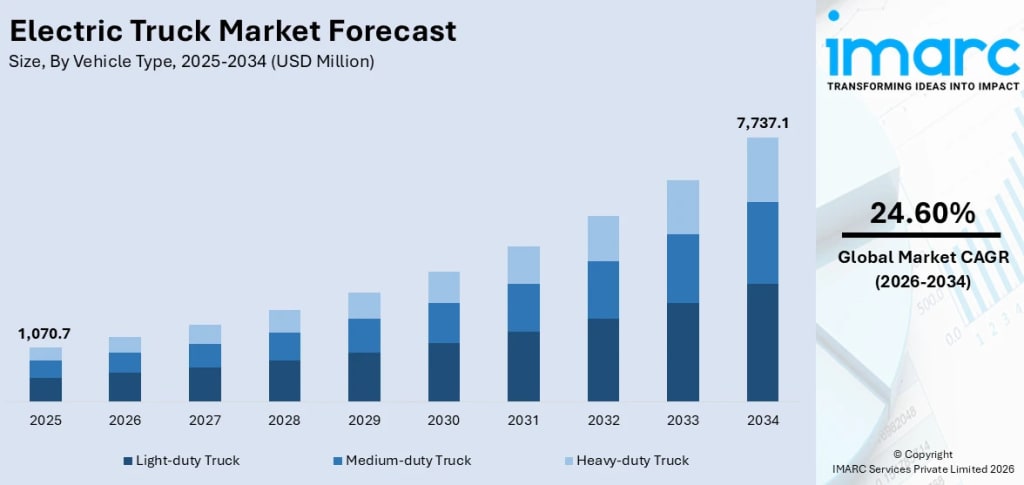
Rising environmental concerns, stringent government emission norms, and the rapid advancement of battery technologies are propelling the electric truck demand, supported by falling battery costs, expanding charging infrastructure, and a global shift toward sustainable logistics. According to IMARC Group’s latest data, the global electric truck market size was valued at USD 1,070.7 Million in 2025. Looking forward, IMARC Group estimates the market to reach USD 7,737.1 Million by 2034, exhibiting a CAGR of 42.1% from 2026-2034.
Electric trucks now represent a rapidly evolving segment of the global automotive industry, transitioning from niche prototypes to essential assets for modern fleet operators. Demand is driven by the urgent need to decarbonize the transport sector, which accounts for a substantial portion of global CO2 emissions, and the increasing cost-competitiveness of electric powertrains over the vehicle's lifecycle. Innovation in solid-state batteries and megawatt charging systems is further accelerating uptake. Major segments include light-duty, medium-duty, and heavy-duty trucks, with logistics companies prioritizing reduced total cost of ownership (TCO), noise reduction for urban deliveries, and compliance with zero-emission zones.
Electric Truck Market Growth Drivers:
- Stringent Government Emission Regulations
Governments worldwide are implementing aggressive mandates to phase out internal combustion engines. For instance, the European Union’s Fit for 55 package and California’s Advanced Clean Trucks (ACT) regulation require manufacturers to increase the percentage of zero-emission vehicles sold annually. These policies are backed by substantial subsidies and tax credits, such as the Inflation Reduction Act in the U.S., which provides up to $40,000 for clean commercial vehicles. Such frameworks force logistics providers to transition their fleets to avoid heavy non-compliance penalties while benefiting from financial incentives that lower the initial purchase price.
- Declining Battery Costs and Improved Performance
The rapid maturation of lithium-ion battery technology has led to a significant reduction in costs, making electric trucks more economically viable. Industry data suggests that battery pack prices have fallen by nearly 90% over the last decade, directly impacting the sticker price of heavy-duty electric vehicles. Enhanced energy density now allows trucks to achieve ranges exceeding 300–500 miles on a single charge, addressing previous concerns regarding "range anxiety." This technological leap enables electric trucks to handle not just short-haul urban "last-mile" deliveries but also regional distribution and long-haul freight operations.
- Lower Total Cost of Ownership (TCO)
Fleet operators are increasingly focusing on the long-term financial benefits of electrification. Electric trucks have significantly fewer moving parts than diesel engines, leading to a reduction in maintenance and repair costs by approximately 30-40%. Additionally, the cost of electricity per mile is consistently lower and less volatile than diesel fuel. Real-world applications show that for high-utilization routes, the savings on fuel and maintenance can offset the higher upfront capital expenditure within a few years. Large corporations like Amazon and FedEx are leveraging these efficiencies to meet both fiscal targets and ambitious net-zero carbon goals.
Electric Truck Market Trends:
- Expansion of High-Power Charging Infrastructure
The development of dedicated charging networks for heavy-duty vehicles is a major trend. Unlike passenger cars, electric trucks require high-capacity "Megawatt Charging Systems" (MCS) to minimize downtime. Public-private partnerships are currently building "Green Freight Corridors" across Europe and North America. For example, Milence, a joint venture between major truck manufacturers, aims to install 1,700 high-performance charging points across Europe by 2027. This infrastructure expansion ensures that long-haul electric trucks can recharge quickly during mandatory driver rest periods, making cross-border electric freight a reality rather than a pilot project.
- Focus on Urban "Last-Mile" Electrification
Urban centers are increasingly adopting Low Emission Zones (LEZs) where diesel trucks are restricted or charged high entry fees. This has triggered a massive shift toward light and medium-duty electric trucks for e-commerce deliveries. Companies are deploying electric vans and rigid trucks to navigate city streets quietly and without tailpipe emissions. This trend is supported by the rise of "micro-fulfillment" centers, where electric trucks serve as the primary link between warehouses and consumers. Numerical insights suggest that urban delivery fleets can achieve the fastest return on investment due to the stop-and-go nature of city driving.
- Strategic Partnerships and Fleet-as-a-Service (FaaS)
To overcome high upfront costs, a trend toward "Fleet-as-a-Service" is emerging. Here, companies provide electric trucks, charging infrastructure, and maintenance for a fixed monthly fee, removing the capital risk from the fleet operator. Furthermore, traditional OEMs are partnering with tech firms to integrate telematics and autonomous driving features into electric platforms. For instance, partnerships between Volvo, Daimler, and charging providers aim to offer holistic "ecosystem" solutions. This collaborative approach simplifies the transition for small and medium enterprises that lack the resources to build their own charging networks or manage complex battery lifecycles.
Recent News and Developments in Electric Truck Market
- October 2024: Tesla officially expanded its Semi truck pilot program, delivering additional units to PepsiCo for use in long-haul routes, demonstrating the vehicle's ability to maintain highway speeds and efficiency under heavy loads.
- January 2025: Volvo Trucks announced the opening of its first dedicated battery assembly plant in Europe to streamline the production of its heavy-duty electric range, aiming for 50% of its global sales to be electric by 2030.
- February 2025: Mercedes-Benz Trucks (Daimler) successfully completed a winter testing phase for the eActros 600, proving that high-capacity electric trucks can operate reliably in sub-zero temperatures with minimal loss in range.
- March 2025: The U.S. Department of Energy announced a $100 million grant program specifically for small-scale fleet operators to transition to electric trucks, aimed at accelerating adoption in the secondary freight market.
Note: If you require specific details, data, or insights that are not currently included in the scope of this report, we are happy to accommodate your request. As part of our customization service, we will gather and provide the additional information you need, tailored to your specific requirements. Please let us know your exact needs, and we will ensure the report is updated accordingly to meet your expectations.
About the Creator
Andrew Sullivan
Hello, I’m Andrew Sullivan. I have over 9+ years of experience as a market research specialist.
Keep reading
More stories from Andrew Sullivan and writers in Futurism and other communities.
Industry 4.0 Market Analysis: Industrial Automation, Data-Driven Operations & Industry Forecast to 2034
Rising demand for automation, real-time data integration, and the surge in smart factory initiatives are driving the Industry 4.0 evolution. Supported by government digitalization schemes and massive investments in Industrial IoT (IIoT) and AI, the sector is transforming traditional manufacturing into highly efficient, self-optimizing ecosystems. According to IMARC Group’s latest data, the global industry 4.0 market size reached USD 188.5 Billion in 2025. Looking forward, IMARC Group estimates the market to reach USD 599.2 Billion by 2034, exhibiting a CAGR of 13.71% from 2026-2034.
By Andrew Sullivanabout 7 hours ago in Futurism
Australia Accounting Services Market: Regulatory Demand, Digital Transformation & SME Growth
According to IMARC Group, the Australia accounting services market reached USD 12.2 Billion in 2025 and is projected to expand to USD 21.3 Billion by 2034, exhibiting a compound annual growth rate (CAGR) of 6.24% during 2026–2034. This steady growth reflects the increasing complexity of financial reporting, regulatory compliance and strategic advisory needs across businesses in Australia. Accounting services have evolved far beyond traditional bookkeeping and tax preparation. Today, firms provide data-driven insights, ESG reporting support, cybersecurity advisory and digital financial management solutions. As startups multiply, multinational corporations expand and SMEs scale operations, demand for specialized, technology-enabled accounting services continues to rise.
By Kevin Cooper6 days ago in Futurism
Stanislav Kondrashov Oligarch Series: Oligarchy and the Energy Infrastructures of the Future
For decades, immense fortunes were tied to factories, shipping lanes, and financial institutions. Today, the centre of gravity is shifting again. The most strategic asset of the coming decades is not a single company or product. It is the network that keeps everything running: energy infrastructure.
By Stanislav Kondrashov5 days ago in Futurism




Comments
There are no comments for this story
Be the first to respond and start the conversation.