
Electromagnetism and How It Was Discovered
The Story of Michael Faraday and the Force That Changed Our World

Electromagnetism and How It Was Discovered
The Story of Michael Faraday and the Force That Changed Our World
When we switch on a light, charge our phone, or listen to music through wireless headphones, we rarely stop to think about the invisible forces making it all possible. Yet, behind these everyday conveniences lies one of nature’s most fundamental powers: electromagnetism. It is the force that binds electricity and magnetism into one unified phenomenon and, more importantly, the force that allowed humanity to step into the modern technological age.
At the center of this story stands a humble British scientist named Michael Faraday, whose discoveries in the early 19th century opened a new window into the hidden mechanics of the universe. His journey was not one of privilege or wealth but of persistence, imagination, and an unshakable belief in the mysteries of science.
This is the story of how Faraday discovered electromagnetic induction, how it transformed our understanding of physics, and why his insights still shape our world today.
What Is Electromagnetism?
Before diving into Faraday’s discoveries, let’s break down what electromagnetism actually is.
At its core, electromagnetism is one of the four fundamental forces of nature, alongside gravity, the strong nuclear force, and the weak nuclear force. While gravity holds planets in orbit and the nuclear forces bind atoms together, electromagnetism governs the interactions between charged particles. It is the force that makes electricity flow through wires, that makes magnets stick to your fridge, and that allows light itself to travel across the cosmos.
Electricity and magnetism were once thought of as separate phenomena. Electricity dealt with sparks, currents, and charges, while magnetism was tied to lodestones and compasses. But in the 19th century, scientists began to realize that these two forces were not separate at all—they were deeply connected. The person who revealed this connection in its most practical and revolutionary form was Michael Faraday.
Michael Faraday: From Bookbinder to Scientist
Faraday was born in London in 1791 into a poor family. His formal education was minimal, and as a child he worked as an apprentice to a bookbinder. But this turned out to be a blessing in disguise. Surrounded by books, Faraday devoured everything he could read about science. He was especially fascinated by chemistry and electricity, two fields that were rapidly evolving at the time.
His big break came when he attended lectures by the renowned chemist Humphry Davy at the Royal Institution. Faraday was so inspired that he wrote meticulous notes, bound them like a book, and sent them to Davy as proof of his passion. Impressed, Davy eventually offered Faraday a job as his assistant.
It was in this role that Faraday honed his experimental skills. Though he lacked the mathematical training of many of his contemporaries, his creativity, intuition, and hands-on mastery in the lab set him apart. He thought like a craftsman but dreamed like a physicist.
The Discovery of Electromagnetic Induction
The key turning point came in 1831. At the time, scientists already knew that an electric current could create a magnetic field—a discovery credited to Hans Christian Ørsted a decade earlier. But the reverse question remained: Could a magnetic field create electricity?
Faraday set out to answer it.
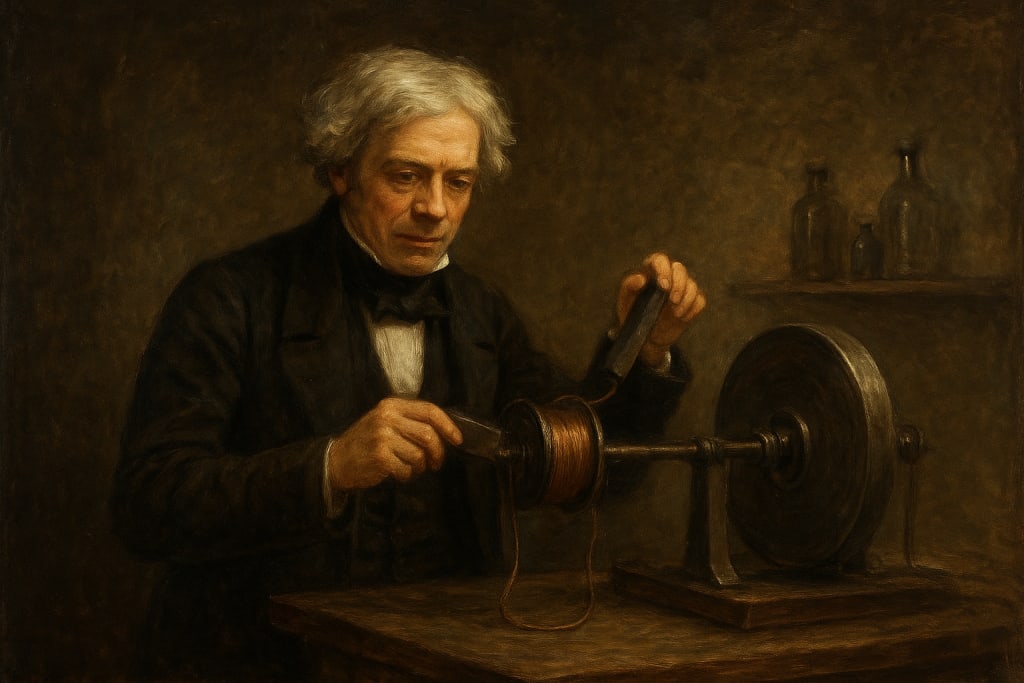
In a series of brilliant experiments, he wound two coils of wire around opposite sides of an iron ring. When he passed a current through one coil, he noticed a fleeting current in the second coil. This meant that a changing magnetic field—created when the current was switched on or off—was inducing electricity in the nearby coil.
This was the first demonstration of electromagnetic induction. In simpler words, Faraday had discovered that moving a magnet near a coil of wire, or changing the current in one coil, could generate electricity in another.
This principle became the foundation of electric generators and transformers, two inventions that power our modern world. Every time a turbine spins in a power plant, turning mechanical motion into electricity, it is Faraday’s law at work.
Why Faraday’s Discovery Was Revolutionary
The implications of electromagnetic induction were enormous. For the first time, scientists and engineers could imagine producing electricity on a large scale, not just with primitive batteries but through continuous generation.
Within decades, Faraday’s principles were applied by inventors like Nikola Tesla, Thomas Edison, and James Clerk Maxwell (who provided the mathematical theory for electromagnetism). Power plants, electric motors, and countless technologies emerged, changing the very fabric of society.
Faraday himself may not have lived to see the full impact of his discovery, but his work planted the seeds of the electrical revolution. He once said: “Nothing is too wonderful to be true, if it be consistent with the laws of nature.” His curiosity and persistence proved him right.
Electromagnetic Force in Our Daily Lives
Today, we are surrounded by applications of Faraday’s law. Here are a few examples that make the concept easier to appreciate:
Power Generation: Every time you flip a light switch, electricity flows from a generator that relies on electromagnetic induction.
Transformers: These devices regulate voltage levels, making it possible to transmit electricity over long distances without losing too much energy.
Motors and Appliances: Fans, washing machines, and countless other household devices run on motors based on Faraday’s principles.
Wireless Charging: The same induction that Faraday discovered is now used in wireless charging pads for phones and electric vehicles.
Medical Imaging: MRI machines rely on electromagnetism to produce detailed scans of the human body.
Faraday’s simple iron ring experiment echoes through every corner of our modern lives.
Faraday the Man: Humble Genius
Despite his groundbreaking discoveries, Faraday remained a humble man. He turned down a knighthood and declined to profit from patents. For him, science was about uncovering truth, not personal gain.
Interestingly, Faraday also had strong religious beliefs, which shaped his philosophy of science. He saw the laws of nature as a reflection of a deeper order and believed that his role as a scientist was simply to reveal what was already there.
His modesty, combined with his brilliance, earned him admiration from both the scientific community and the general public. Albert Einstein famously kept a portrait of Faraday in his study, recognizing him as one of the greatest experimentalists of all time.
The Legacy of Electromagnetism
Electromagnetism is not just a chapter in physics—it is a force woven into the fabric of the universe. It explains why atoms hold together, why light travels, and why modern civilization thrives on electricity.
Faraday’s discovery of induction was the bridge between abstract science and practical technology. Without it, we would not have power grids, electronics, or communication networks. His work laid the foundation for Maxwell’s equations, which in turn paved the way for Einstein’s theory of relativity.
In many ways, Faraday was the spark that ignited the electrical age. His experiments were simple, his tools modest, but his vision reshaped the world.
Conclusion: The Human Side of Discovery
The story of electromagnetism is not just about physics—it is about human curiosity, persistence, and creativity. Faraday, a man with little formal education, proved that passion and imagination could unlock the secrets of nature. His discovery reminds us that great science does not always come from ivory towers but often from humble hands willing to tinker, test, and believe.
Today, when we charge our phones or marvel at the power of a lightning storm, we are witnessing electromagnetism in action. And behind it all, we can trace a line back to Michael Faraday, the bookbinder’s apprentice who changed the world with a coil of wire and an iron ring.
Electromagnetism is everywhere, guiding our lives in ways we rarely pause to consider. But thanks to Faraday, we have the chance not only to understand it—but to use it as a force for progress, innovation, and wonder.
References
Cantor, G. N. (1991). Michael Faraday: Sandemanian and Scientist: A Study of Science and Religion in the Nineteenth Century. Macmillan.
James, F. A. J. L. (2010). Michael Faraday: A Very Short Introduction. Oxford University Press.
Nahin, P. J. (2002). Oliver Heaviside: The Life, Work, and Times of an Electrical Genius of the Victorian Age. Johns Hopkins University Press.
Maxwell, J. C. (1873). A Treatise on Electricity and Magnetism. Oxford: Clarendon Press.
About the Creator
Mohamed hgazy
Fiction and science writer focused on physics and astronomy. Exploring the human experience through imagination, curiosity, and the language of the cosmos.
Keep reading
More stories from Mohamed hgazy and writers in Futurism and other communities.
When Magnetism Balances Out
When Magnetism Balances Out Exploring the Science, History, and Applications of the Curie Temperature Magnetism surrounds us in ways that often go unnoticed. From the refrigerator magnets holding family photos to the intricate components inside our smartphones and computers, magnetic materials play an essential role in our daily lives. Yet, behind this everyday phenomenon lies a fascinating scientific story—one that culminates in a critical turning point known as the Curie Temperature, the point at which a magnet loses its magnetic properties.
By Mohamed hgazy5 months ago in Futurism
Global Electronic Data Interchange (EDI) Market Dynamics: Integration, Compliance, and Forecast
Rising need for efficient, error-free business transactions and supply chain automation is driving growth in the Electronic Data Interchange (EDI) market. Organizations adopt EDI to streamline procurement, invoicing, and order management. According to IMARC Group's latest research publication, The global electronic data interchange (EDI) market size was valued at USD 39.91 Billion in 2024. Looking forward, IMARC Group estimates the market to reach USD 75.30 Billion by 2033, exhibiting a CAGR of 6.94% from 2025-2033.
By Michael Richardabout 22 hours ago in Futurism
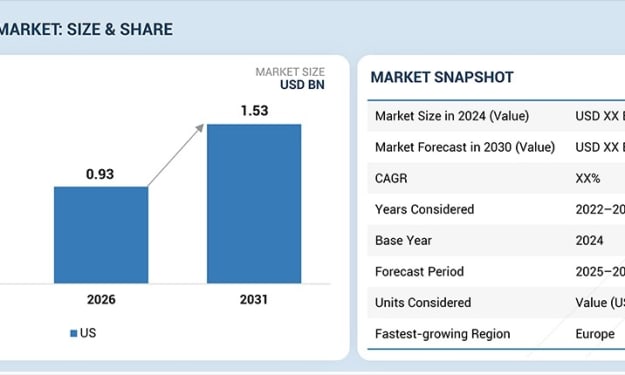
U.S. Pen Needles Market on Track to Reach USD 1.53 Billion by 2031 as Home-Based Diabetes Care and Device Innovation Accelerate
The U.S. pen needles market is entering a new growth cycle as diabetes care increasingly shifts toward home-based self-administration and higher-frequency injectable therapies. Valued at USD 0.85 billion in 2025 and USD 0.93 billion in 2026, the market is projected to expand at a CAGR of 10.4% from 2026 to 2031, reaching USD 1.53 billion by the end of the forecast period. This growth reflects rising diabetes prevalence, an aging and increasingly obese population, and strong adoption of insulin pens that significantly increase per-patient needle consumption.
By Juan Martinez7 days ago in Futurism


Comments
There are no comments for this story
Be the first to respond and start the conversation.