
How Deep Learning Can Help Predict Symptomatic Progression in Neurological Diseases Like Huntington's Disease.
A look at Deep Learning models and how they can benefit neuroscience.

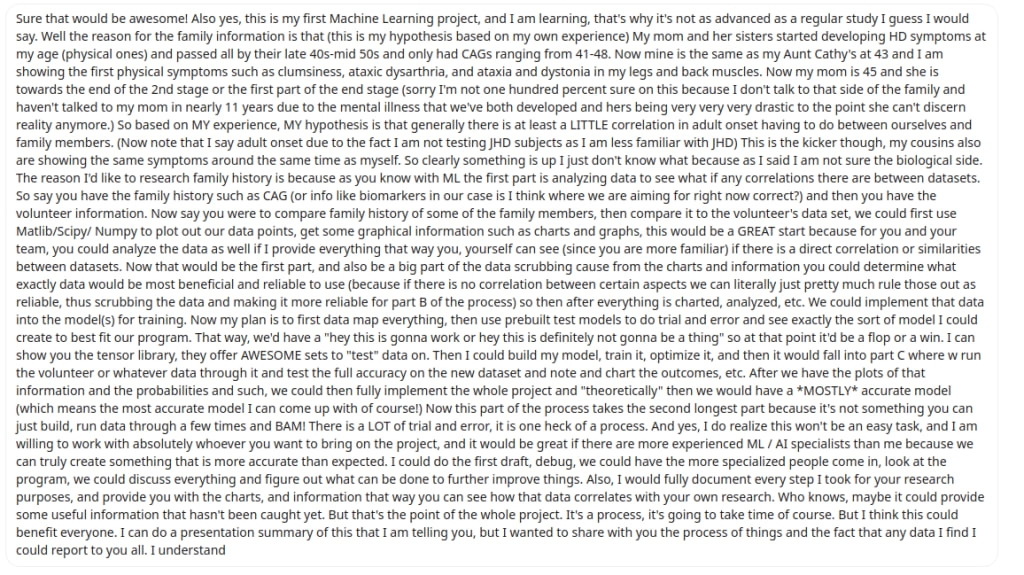
My name is Zayden and I have a CAG of 43. I was passed down the gene by my mother Kelli, and have lost aunts, my grandfather, and now, soon, my mother to Huntington’s Disease. I am a computer programmer who works primarily in Python 3 to develop AI and Deep Learning models with Tensorflow, SciKitLearn, Numpy, and Pandas. I have 3 years of programming experience, with one year in AI and Deep Learning. Why should you care? Because I am helping develop projects with the University of Toronto that could help predict symptomatic progression in terminal neurological diseases like Huntington's Disease, Parkinson's, Alzheimer's, and ALS using Deep Learning models such as Recurrent Neural Networks to process speech patterns in Huntington's Disease patients that could help occupational and speech therapists better understand the link between progression of Huntington's Disease and speech difficulties, and hopefully even lead to better treatment and the prolonging the ability to speak in more advanced stages of the disease. I am also using standard Artificial Neural Network techniques such as Multiple Linear Regression, with multiple dense layers to process and predict symptomatic progression via patient protein levels in CSF (Cerebro-Spinal Fluid). It is definitely exciting and we are hoping to contribute something really awesome to neuroscience.

Machine Learning and Neuroscience
Machine learning and AI is one of the biggest booms of the 20th and 21st century. If you've ever used something like Google Translate, been in an automated car like a Tesla, used Spotify or Pandora, Yelp, or even Pinterest, then you've seen Deep Learning in action. In the healthcare industry, companies like IBM are using deep learning to do a variety of things, including IBM's own research into Huntington's Disease. An important part of the collaboration between IBM Research and CHDI is developing AI models that learn patterns present in brain images that can provide individualized information about progression.
The field of Deep Learning is rapidly expanding and improving in power and applicability. Throughout the healthcare industry, Deep Learning AI is in some cases more accurate than doctors at diagnosing things like Cancer, Diabetes, and more. My hypothesis is that by using Deep Learning and Neural Networks, paired with data of different levels of certain proteins in patients during different stages of the disease, a model could be trained to identify the difference between the stages of Huntington’s by looking at the level of certain proteins in a patient’s CSF.
Convolutional Neural Networks and How They Are Being Used
A Convolutional Neural Network (CNN) is a neural network that can be used to do things similar to what IBM Watson is doing right now in the Huntington’s Disease field. CNNs can do things like image recognition and classification. They can take in an input image, assign importance to different aspects/objects in the image and be able to differentiate one from the other. They can be trained to do things like recognize different aspects of how neurological diseases like Huntington's Disease and Alzheimer’s affect a patient's brain. So if you can imagine the applications that a model like this could have, it’s easy to see why IBM and CHDI have jumped on this to help Huntington's Disease patients. Some popular CNN libraries are PyTorch and Tensorflow, and by using what is called an "image kernel" applied over an MRI or CAT scan, a model can figure out all sorts of information such as brain mass and any abnormalities in the scans.
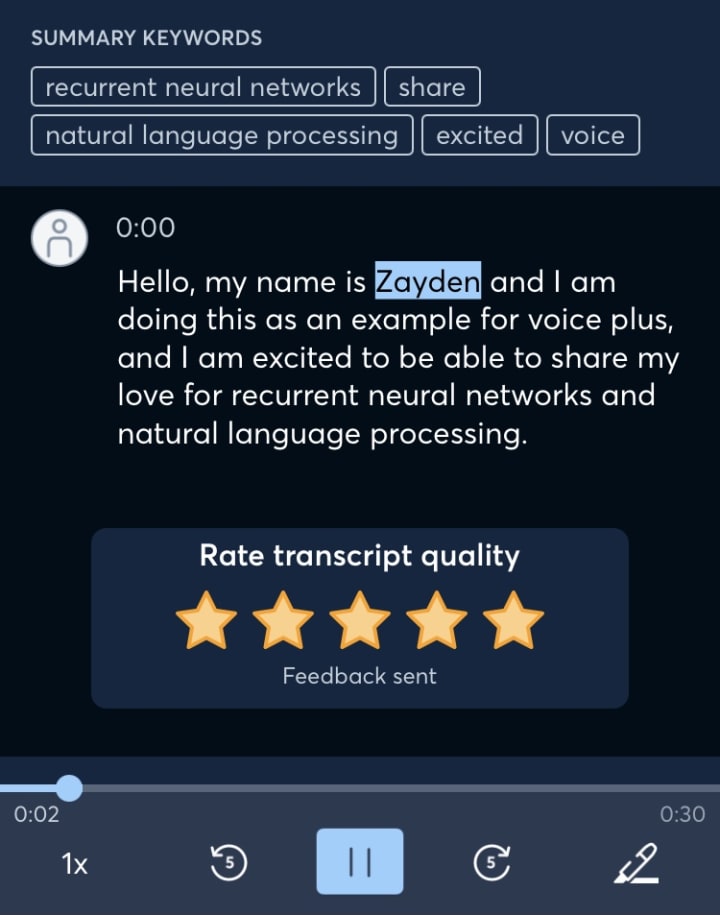
Recurrent Neural Networks (RNNs) and NLP (Natural Language Processing) and How They Could Be Used to Process and Identify Speech Issues
Another field in deep learning currently is speech and natural language processing. This is similar to what Google and AI voice translators do to translate languages. For instance, an AI voice translator like iTranslate can detect what language you are speaking and translate it to any other language based on speech patterns and vocal intonation. There is a possibility that for patients who suffer from speech problems that AI could help speech therapists develop custom treatment plans for their patients who are suffering from ataxic speech disorders with neural network models that use NLP (Natural Language Processing) via Recurrent Neural Networks.
My Final Question and Thoughts
My question to you is, how do you want to impact the Huntington’s Disease and neurological disease fields? How do you want to contribute to helping treat and hopefully end these horrible disease? There are clearly numerous ways that deep learning can be used to help patients and doctors deal with the disease, so what can we do? I’ll leave that up to you. My thoughts? Deep learning is the future of Huntington’s Disease, and all neurological disease research. It is important that in this race, we choose to help out however we can.
About the Creator
Zayden King
My name is Zayden and I am an AI Engineer and Python Programmer, as well as an Ethical Hacker and Cybersecurity Analyst. I am currently working on a project with University of Toronto having to do with symptomatic progression ID with AI.
Keep reading
More stories from writers in Futurism and other communities.
Hydrogen Fuel Cell Vehicle Market Outlook: Clean Mobility Transition and Growth Opportunities
According to IMARC Group's latest research publication, The global hydrogen fuel cell vehicle market size was valued at USD 3,252.9 Million in 2025 and is projected to reach USD 47,722.5 Million by 2034, growing at a compound annual growth rate (CAGR) of 34.77% from 2026-2034.
By James Whitmana day ago in Futurism




Comments
There are no comments for this story
Be the first to respond and start the conversation.