
How I Stopped Fighting with Photo Editing and Started Creating Again
A personal reflection on overcoming the frustration of photo editing and rediscovering creative freedom through simpler tools.


There is a particular kind of frustration that creative people know intimately. You have the vision. The story burns inside you, ready to be told. The words flow or the concept crystallizes, and everything feels aligned—until you hit the wall of technical execution.
For me, that wall was photo editing.
The Creative Bottleneck
I write. That is my craft, my voice, my contribution to the conversation. But in today's visual-first digital landscape, words alone often feel insufficient. Blog posts need header images. Social media demands eye-catching visuals. Even a simple personal essay gains impact when paired with the right photograph.
The breaking point came when I discovered nano banana, a tool mentioned casually in a forum for independent creators. At first, I dismissed it as just another trendy shortcut. But curiosity won. I realized I was not actually fighting creativity—I was fighting complexity. And complexity had been draining the energy I needed for the work that mattered most.
Every time I opened traditional editing software before that, my momentum collapsed. Hours disappeared into tutorials. Simple tasks—cropping, background cleanup, lighting adjustments—turned into intricate operations requiring layers, masks, and precision I never intended to master. The joy of storytelling transformed into the frustration of technical wrestling.
“I am a writer,” I remember thinking. “Why does this feel like engineering?”
Discovery Changes Everything
The shift was not dramatic. There was no cinematic montage of mastery. It was quiet. Efficient. Functional.
For the first time, I used a browser-based editor that did not demand fluency in professional design language. Remove a background? It happened in seconds. Enhance a portrait? The result looked natural, not artificially polished. Adjust lighting? A single action, not a chain of micro-decisions.
I kept waiting for something to go wrong—for a watermark to appear, for a paywall to block exports, for the tool to reveal hidden complexity. It did not.
The most surprising part was not the speed. It was the mental clarity that followed. I could think about composition and mood instead of controls and panels. The tool stepped back and let the idea step forward.
What Creators Actually Need
Creative people do not necessarily need more powerful tools. We need more intuitive ones.
There is a difference.
Powerful software can accomplish almost anything—but often at the cost of time, patience, and mental bandwidth. For professionals whose craft is editing itself, that tradeoff makes sense. For storytellers, educators, and small business owners juggling multiple responsibilities, it does not.
“We do not need to master every instrument in the orchestra,” a fellow creator once told me. “We just need to hear the music.”
Photo editing should be supportive infrastructure. It should not hijack the creative process. It should amplify expression, not overshadow it.
When the barrier between idea and execution shrinks, something important happens: momentum returns.
The Freedom to Create Fully
Momentum is fragile. Once broken, it is hard to rebuild. But when protected, it compounds.
After removing the friction that editing once caused, I began approaching projects differently. I experimented with visual essays. I added imagery to newsletters. I tested formats I had previously avoided because they seemed too “design-heavy.”
The result was not perfection. It was expansion.
I no longer postponed ideas because they required visual accompaniment. I no longer negotiated with myself about whether the editing time would be worth it. The workflow became seamless enough that it faded into the background.
And that is when I realized something important: creativity thrives in environments with minimal resistance.
When tools become invisible, creation becomes visible.
Your Voice Deserves to Be Seen
There is a quiet tragedy in limiting your output because of a technical obstacle. Not dramatic enough to quit—but persistent enough to shrink ambition.
If you have ever hesitated to launch a project because it required “too much editing,” you are not alone. Many creators quietly narrow their scope to avoid friction.
But tools have evolved. Workflows have simplified. What once required hours of training now takes minutes of experimentation.
“Stop fighting the tool,” I told myself one afternoon. “Start building the thing you actually care about.”
That shift—from resistance to flow—changed everything.
Your ideas deserve to exist fully formed, accompanied by visuals that support rather than suppress them. Your energy belongs in the act of creating, not troubleshooting.
About the Creator
Keep reading
More stories from CEO A&S Developers and writers in Futurism and other communities.
Smart Mobility and the Future of Urban Transportation
The City That Never Stood Still The city woke before the sun, as it always had. Buses coughed awake, motorcycles threaded through narrow lanes, and pedestrians hurried across crowded intersections. For decades, transportation had been a race against time—steel and rubber competing with human patience.
By CEO A&S Developers2 days ago in Futurism
Lanolin Market Outlook: Skincare Demand and Natural Ingredient Growth Opportunities
According to IMARC Group's latest research publication, the global lanolin market size reached USD 459.5 Million in 2024. Looking forward, IMARC Group expects the market to reach USD 672.3 Million by 2033, exhibiting a growth rate (CAGR) of 4.32% during 2025–2033.
By James Whitman7 days ago in Futurism
Australia Air Freight Market: Trade Flows, Logistics Capacity & Digitalization
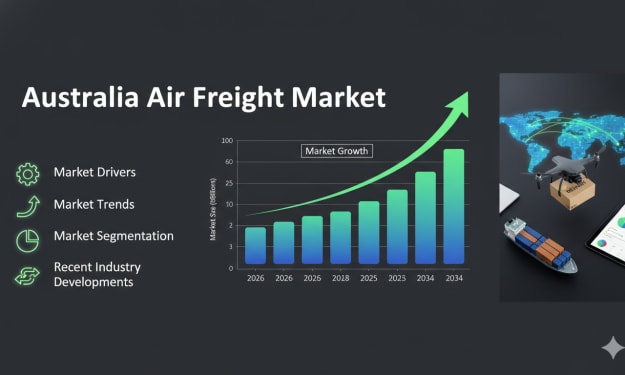
According to IMARC Group, the Australia air freight market was valued at USD 2.0 Billion in 2025 and is projected to reach USD 3.7 Billion by 2034, exhibiting a compound annual growth rate (CAGR) of 7.12% during 2026–2034. This strong expansion reflects the increasing importance of speed, reliability and global connectivity within the trade ecosystem of Australia. As international commerce intensifies and e-commerce accelerates, air freight has become a strategic logistics solution for high-value, time-sensitive and perishable goods. Infrastructure modernization, technological innovation and sustainability initiatives are further strengthening the competitiveness and resilience of Australia’s air cargo sector.
By Shrestha Roy5 days ago in Futurism
When Amazon Says You’re a Disappointment
Yesterday, for the first Wednesday in months, I didn’t publish a piece on Vocal. Believe me, I wanted to. I had it all written up and ready to go. I was going to share the news that I had officially become a published author.
By Sandy Gillmana day ago in Writers



Comments
There are no comments for this story
Be the first to respond and start the conversation.