
Materials That Only Work in Space: When the Universe Becomes the Laboratory
Space

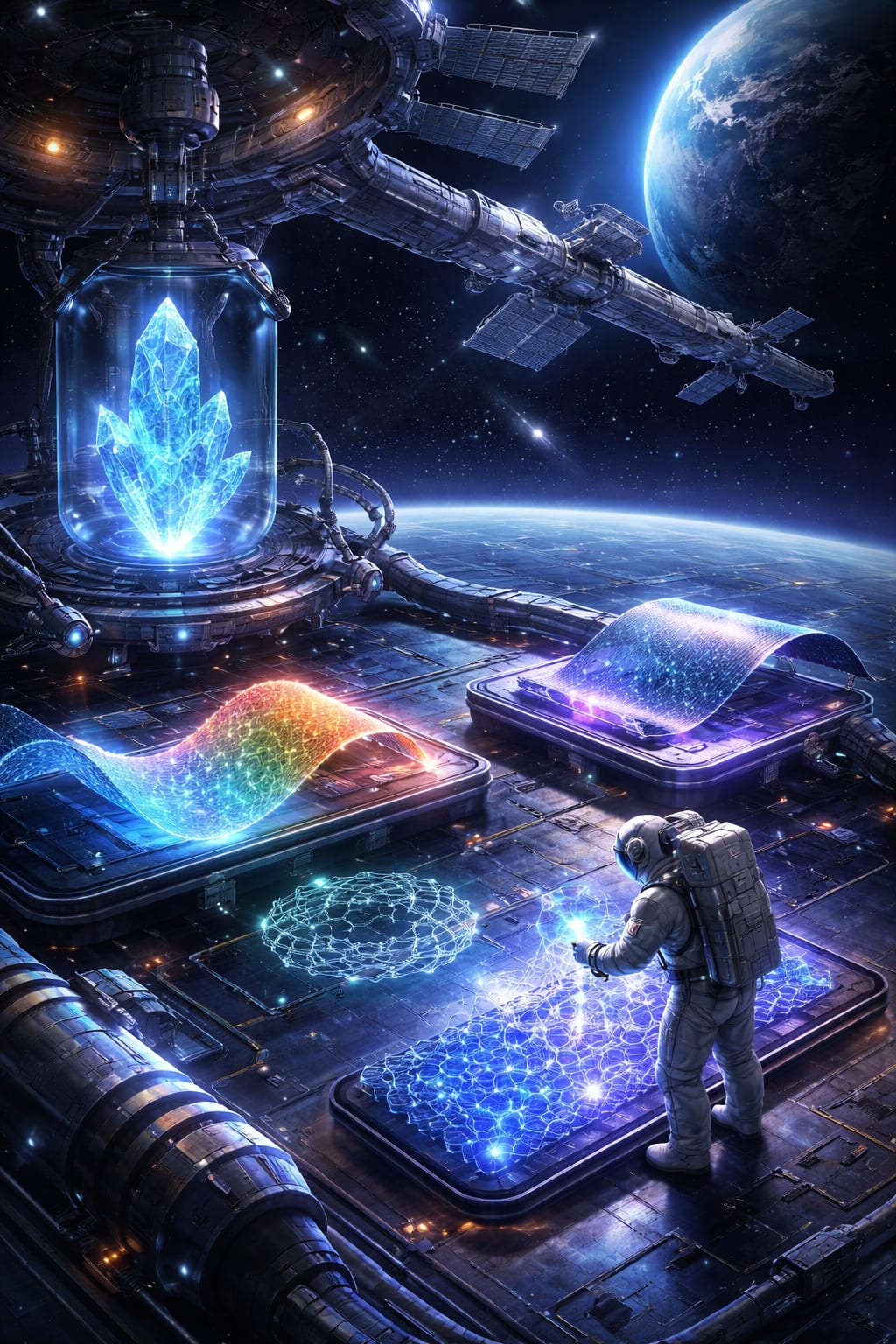
For most of human history, materials science has been constrained by Earth itself. Gravity shapes how crystals grow, air corrodes exposed surfaces, moisture seeps into polymers, and temperature changes happen gradually. But beyond Earth’s atmosphere lies an environment so extreme—and so different—that entirely new classes of materials can exist. Some of them do not merely perform better in space; they only function in space.
As humanity moves deeper into orbital manufacturing, deep-space exploration, and long-duration missions, space is no longer just a destination. It is becoming a production environment, one where materials emerge that cannot survive, or even be created, on Earth.
Why Space Changes the Rules of Materials Science
Space combines several conditions that never coexist naturally on Earth:
- Near-perfect vacuum
- Microgravity or zero gravity
- Intense ionizing radiation
- Extreme and rapid temperature swings
On Earth, these factors are treated as problems to be mitigated. In space, they become tools.
Without gravity, particles do not settle. Without air, oxidation slows dramatically. Without convection, heat and matter behave in unfamiliar ways. These differences allow atoms and molecules to organize themselves into structures that collapse or degrade immediately under terrestrial conditions.
Perfect Crystals Without Gravity
One of the clearest examples of space-only materials is defect-free crystals.
On Earth, gravity causes heavier atoms and impurities to sink during crystal growth, creating internal stresses and microscopic defects. Even the best industrial processes cannot fully eliminate this effect. In microgravity, however, crystals grow symmetrically, layer by layer, without sagging or internal strain.
Experiments aboard the International Space Station have produced protein crystals and semiconductor materials with levels of structural perfection far beyond Earth-based equivalents. These crystals are essential for:
- ultra-stable laser systems,
- quantum sensors,
- next-generation atomic clocks,
- high-precision optics for space telescopes.
Back on Earth, many of these crystals lose their properties under their own weight or fracture due to thermal and mechanical stress. Their ideal form exists only in orbit.
Materials Stabilized by Vacuum
Some materials are fundamentally incompatible with Earth’s atmosphere. They oxidize, absorb moisture, or chemically react with air in seconds. In the vacuum of space, these same materials can remain stable for years.
Examples include:
- atom-thin metallic films,
- exotic carbon allotropes,
- highly reactive nanostructures.
In orbit, these materials display remarkable electrical and mechanical behavior: near-zero friction, unusual conductivity, and extreme sensitivity to electromagnetic fields. Such properties are invaluable for spacecraft mechanisms, precision gyroscopes, and deployable structures.
On Earth, these materials require complex vacuum chambers and still degrade over time. In space, the environment itself maintains their stability.
Self-Organizing Materials in Microgravity
Gravity is an invisible architect. Remove it, and matter begins to assemble in radically different ways.
In microgravity, molecules and nanoparticles can self-organize into perfectly symmetrical, three-dimensional structures that collapse under Earth’s gravity. These include:
- colloidal crystals,
- photonic lattices,
- metamaterials with engineered optical properties.
Such materials can bend light in unconventional ways, filter specific wavelengths, or even exhibit a negative refractive index. On Earth, producing them requires magnetic or acoustic levitation and still results in imperfect structures. In space, they form naturally.
This opens the door to advanced radiation shields, ultra-efficient optical filters, and compact sensors that function only in orbit.
Radiation as a Feature, Not a Bug
Radiation is one of space’s greatest dangers—but it can also be a catalyst.
Certain polymers and composite materials are designed to activate or evolve under radiation exposure. Instead of degrading, they strengthen, heal microcracks, or change optical properties in response to cosmic rays and solar particles.
Examples include:
- coatings that harden over time in orbit,
- self-healing polymers that repair radiation damage,
- materials that record radiation exposure as a physical memory.
Earth’s radiation background is too weak or too shielded to trigger these effects. Only the constant, energetic radiation of space allows these materials to function as designed.
Materials That Use Extreme Temperatures
In low Earth orbit, a spacecraft can swing from over +120°C in direct sunlight to below −170°C in shadow—within minutes. Some materials are engineered to use these extremes as part of their operating cycle.
These include:
- phase-change composites that absorb and release heat predictably,
- layered thermal skins that adjust emissivity automatically,
- structures with directional thermal expansion for passive control.
On Earth, temperature changes are slower and dampened by air and moisture. The materials never reach their functional thresholds. In space, they operate continuously and reliably, often without moving parts or power input.
Manufacturing Materials in Space
Perhaps the most transformative idea is this: some materials may not just work in space—they may need to be manufactured there.
Orbital experiments have already demonstrated superior optical fibers, ultra-pure alloys, and advanced composites produced in microgravity. Without gravity-driven defects, these materials outperform their Earth-made counterparts in strength, clarity, and efficiency.
This points toward a future where space is not just a testing ground, but a factory—producing high-value materials that cannot be economically or physically manufactured on Earth.
A New Reason to Go to Space
For decades, space exploration was justified by science, prestige, and curiosity. Now a new motivation is emerging:
We go to space because some technologies can only exist there.
Materials that function exclusively in the cosmic environment are reshaping how we think about orbit, industry, and innovation. Space is no longer merely hostile—it is selective. It destroys what does not belong, but empowers what is designed for it.
As orbital infrastructure grows, the materials of the future may not be adapted from Earth, but born beyond it—engineered for a universe where gravity is optional and the vacuum is home.
About the Creator
Keep reading
More stories from Holianyk Ihor and writers in Futurism and other communities.
Why Future Human Colonies May Be Built Underground
When people imagine humanity’s future beyond Earth, they often picture shining cities beneath transparent domes, towering structures on Mars, or lunar bases with panoramic views of alien landscapes. These images are inspiring—but they are also deeply optimistic. In reality, the first long-term human colonies on other worlds are far more likely to be hidden beneath the surface. Paradoxically, the safest and most practical path to becoming a spacefaring civilization may lead us underground.
By Holianyk Ihorabout 5 hours ago in Futurism
Australia Meat Market: Protein Demand, Consumer Preferences & The Future of Food Supply
According to IMARC Group, the Australia meat market was valued at USD 29.15 Billion in 2025 and is projected to reach USD 34.39 Billion by 2034, growing at a compound annual growth rate (CAGR) of 1.85% during 2026–2034. While this growth rate reflects a relatively mature market, it underscores the continued structural importance of meat within Australia’s food system. The sector remains a cornerstone of domestic nutrition and a critical contributor to agricultural exports, even as consumer expectations, sustainability pressures and dietary awareness reshape demand patterns. Traditional meat categories such as beef, poultry and lamb continue to dominate consumption, but purchasing decisions are increasingly influenced by quality, provenance, ethical sourcing and environmental impact. As food security, climate responsibility and evolving consumer lifestyles gain prominence, the Australia meat market is transitioning from a scale-driven industry toward a value-focused, innovation-led protein ecosystem across Australia.
By Shrestha Royabout 12 hours ago in Futurism
BMO Warns Investors on Gold: What It Means for the Precious Metals Market in 2026
In early 2026, BMO Capital Markets — the research arm of one of North America’s major financial institutions — delivered a significant warning for investors in the precious metals market. While gold and silver prices have recently surged to record levels, BMO’s analysts caution that this rally, especially in silver relative to gold, may be reaching a critical inflection point. Their message is not simply about price direction; it is a deeper signal about valuation, risk, and what investors should watch next in the global metals markets.
By Ayesha Lashariabout an hour ago in Futurism




Comments
There are no comments for this story
Be the first to respond and start the conversation.