
Meta’s Chips-for-Stock Deal With AMD Signals a New Phase of the AI Hardware Arms Race
A multiyear agreement for billions in AI chips—plus an option for Meta to take up to a 10% stake—highlights how “circular” financing is reshaping who can afford to build the next generation of data centers.

What Happened (Facts)
Meta has agreed to buy billions of dollars’ worth of AI chips from Advanced Micro Devices (AMD) as part of a multiyear arrangement to support Meta’s AI development and data-center expansion. The most unusual element of the deal is that Meta can also take a financial stake of up to 10% in AMD, according to the report you shared.
This isn’t AMD’s first time using equity as a lever to win major AI customers. The article notes that in October, AMD reached a similar arrangement with OpenAI, providing chips in exchange for a potential financial stake. Together, these deals represent a “novel strategy” for AMD as it tries to catch up to Nvidia, which has dominated AI accelerators and continues to be the default supplier for most hyperscale AI buildouts.
The Meta-AMD agreement is presented as another example of the self-reinforcing deal loops increasingly common in the AI boom. The report points out that Nvidia itself has invested billions in several customers—including OpenAI, Elon Musk’s xAI, and CoreWeave—who then spend heavily on Nvidia chips. Separately, cloud giants such as Microsoft, Google, and Amazon have invested in AI labs like OpenAI and Anthropic, which rely on those same tech firms for compute.
Meta’s purchase volume in this agreement is described in unusually concrete infrastructure terms: AMD said Meta is buying a volume of chips equivalent to up to six gigawatts of electricity, which the article compares to enough power for more than five million homes. (The report also includes a correction noting this figure is “gigawatts,” not “gigabytes.”)
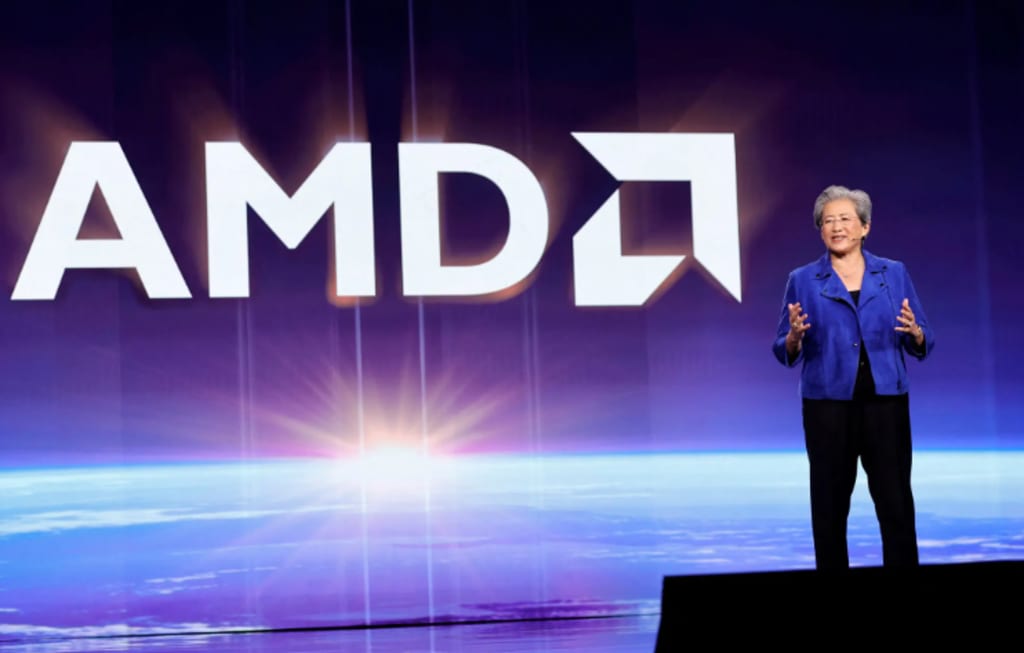
AMD’s CEO, Lisa Su, said the partnership would put AMD “at the center of the global AI build out.” AMD also said it will build chips to Meta’s specifications, and that shipments will begin in the second half of 2026.
Market reaction was immediate. The article says AMD’s stock rose more than 6% in early trading, while Nvidia’s stock fell around 2%. Nvidia was described as holding more than 90% share of the AI chip market and charging premium prices due to performance advantages—costs that have pushed buyers like Meta and OpenAI to seek alternatives.
Importantly, the report stresses that Meta is not “switching away” from Nvidia entirely. Meta remains a major Nvidia customer and recently agreed to spend billions more on millions of Nvidia chips (though the companies did not specify the power capacity attached to that purchase).
Finally, the article notes growing investor anxiety that these circular arrangements may be bubble-like, because they can obscure where true demand begins and ends. A quoted analyst argues that only a small group of companies can fund an AI buildout of this scale, and that if the expected commercial payoff doesn’t materialize, investment could slow sharply.
What Is Analysis (Interpretation)
1) AMD is effectively “buying” market share with equity—because the market is that concentrated
AMD’s willingness to offer customers a stake in its business is a signal about just how difficult it is to break Nvidia’s dominance. AI accelerators are not commodity chips. The hardware matters, but so do software tooling, developer ecosystems, compilers, libraries, and years of optimization. If you’re behind, it’s hard to close the gap by specs alone.
This chips-for-stock tactic is best understood as a way to lower the effective price for customers without simply slashing chip pricing. It also gives buyers like Meta a direct upside if AMD succeeds, which can justify the risk of diversifying away from Nvidia.
But it comes with a tradeoff: if AMD gives meaningful equity to customers repeatedly, it could look like dilution-by-strategy—a long-term cost that shareholders will scrutinize if AI chip margins don’t ramp fast enough.
2) Meta is hedging against a single-vendor future—on price, supply, and leverage
For hyperscalers, relying on one supplier is a strategic vulnerability. Nvidia’s premium pricing and limited supply in peak-demand periods make “single-source dependence” risky. By building a second major supplier relationship (and securing a potential ownership stake), Meta gets:
pricing leverage in negotiations
supply resilience if one pipeline gets constrained
customization: chips built to Meta’s specifications could improve performance-per-watt on Meta-specific workloads
This isn’t just about cost—it’s about control. Whoever controls compute controls the pace at which models can be trained, updated, and deployed.
3) The six-gigawatt figure reveals the real story: AI is now an energy-and-infrastructure business
Talking about chip orders in gigawatts is a reminder that AI competition increasingly looks like industrial policy. Training and serving frontier models is no longer “software plus servers.” It’s:
massive power procurement
data-center construction
supply-chain logistics
grid and cooling constraints
geopolitical hardware dependencies
In that context, these deals aren’t just tech partnerships—they’re resource commitments. That’s also why investors are sensitive to bubble risk: the buildout costs are enormous, and payback depends on whether AI revenues can scale to match the infrastructure burn.
4) Circular financing can both stabilize the ecosystem and hide fragility
The article frames these arrangements as a loop: chipmakers invest in customers, customers spend on chips, cloud giants invest in model labs, labs buy compute, and so on. In the best case, this creates a virtuous cycle that accelerates innovation until AI demand becomes broad-based and self-sustaining.
In the worst case, it becomes demand opacity—a market where spending is partially propped up by capital recycling among a small set of companies. If end-user willingness to pay doesn’t grow fast enough, the loop can unwind quickly, and the same “strategic partnerships” that looked like momentum can start looking like overexposure.
5) Nvidia’s grip is real—but this deal is a sign the “second supplier” era is arriving
Nvidia remains the standard for performance and (critically) the software ecosystem that makes accelerators usable at scale. But major buyers increasingly want a credible alternative. Even if AMD doesn’t dethrone Nvidia, becoming the default “second option” across multiple hyperscalers could be a huge business.
The challenge for AMD is execution: shipping competitive parts on time, supporting them with robust software, and proving reliability across real workloads—because hyperscalers don’t buy chips; they buy uptime and throughput.
Bottom line
This deal is less about one purchase order and more about a new competitive pattern: AI compute is so expensive that suppliers are willing to share ownership to secure demand, and buyers are willing to diversify aggressively to control cost, supply, and strategic dependence. If AI demand keeps growing, AMD’s approach could look like a masterstroke. If the buildout slows, it could become a case study in how “circular” deals magnify both upside and systemic risk.
About the Creator
Keep reading
More stories from Behind the Tech and writers in Futurism and other communities.
“Sam Altman Is Losing His Grip on Humanity”: A Critique of AI’s Favorite Analogy
What Happened (Facts) This is an opinion essay by Matteo Wong (The Atlantic, dated Feb. 23, 2026), not a straight news report. Its central trigger is a remark OpenAI CEO Sam Altman made at an AI summit in India while responding to a question about the natural resources and energy required to train and run generative AI models.
By Behind the Techabout 8 hours ago in Futurism
Australia Fast Food Market: Consumer Preferences, Convenience Demand & Digital Ordering
According to IMARC Group, the Australia fast food market reached USD 18.8 Billion in 2025 and is projected to grow to USD 26.5 Billion by 2034, exhibiting a compound annual growth rate (CAGR) of 3.80% during 2026–2034. This steady expansion reflects evolving dining habits, urban lifestyles and digital transformation across Australia. Fast food in Australia encompasses quick-service restaurants (QSRs), takeaway outlets, drive-through formats and app-based delivery platforms. As consumers increasingly prioritize speed, affordability and convenience, the industry continues to adapt through menu innovation, digital ordering systems and competitive pricing strategies.
By Kevin Coopera day ago in Futurism




Comments
There are no comments for this story
Be the first to respond and start the conversation.