
Potting Compound Market Outlook: Material Trends and Growth Opportunities
The potting compound market is experiencing steady growth, driven by increasing demand for reliable protection of electronic components across automotive, industrial, consumer electronics, and renewable energy applications.

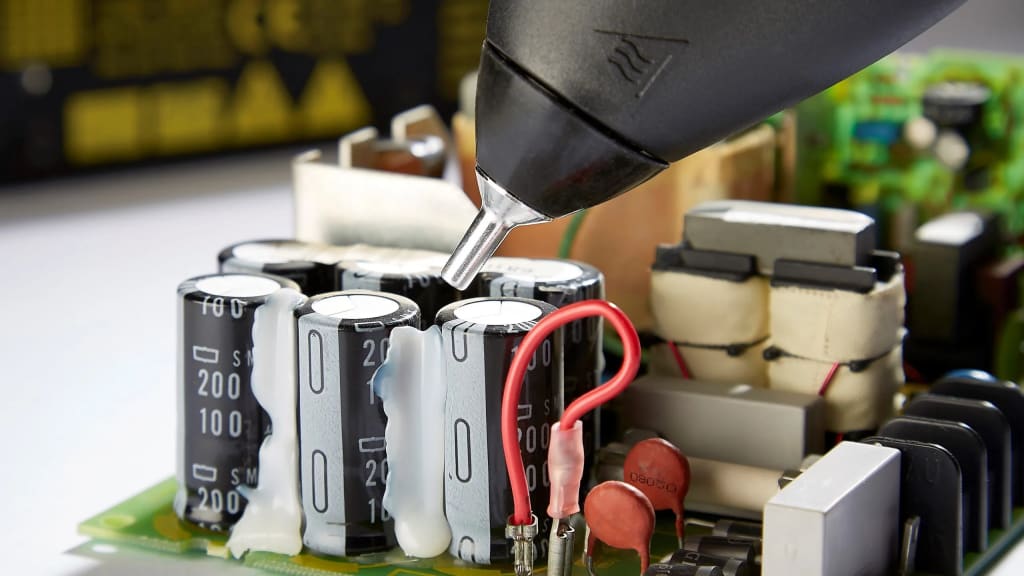
Rising demand for protection of electronic components against moisture, vibration, heat, and chemicals is driving growth in the potting compound market. Expansion of electronics, automotive, renewable energy, and industrial equipment sectors supports adoption. According to IMARC Group's latest research publication, The global potting compound market size reached USD 3.4 Billion in 2024. Looking forward, the market is expected to reach USD 4.8 Billion by 2033, exhibiting a growth rate (CAGR) of 3.6% during 2025-2033.
How AI is Reshaping the Future of Potting Compound Market
- Real-Time Defect Detection and Quality Control: Computer vision systems analyze thousands of product images per second, catching defects invisible to human inspectors. AI-powered systems achieve 99%+ detection rates while maintaining consistent accuracy across continuous production shifts, reducing customer return rates by up to 31% within implementation cycles.
- Predictive Maintenance and Equipment Optimization: Machine learning monitors sensor data from dispensing equipment to predict failures before breakdowns occur. Manufacturers report eliminating unplanned downtime through AI alerts sent to mobile devices when components begin degrading, with one facility saving over €1 million through early intervention strategies.
- Automated Material Formulation and Process Control: AI analyzes production parameters including temperature, viscosity, and curing times to optimize compound formulation automatically. Deep learning models continuously improve by analyzing inspection results over time, reducing false positives while adapting formulations to meet evolving performance requirements across applications.
Potting Compound Industry Overview:
Asia Pacific dominates the global market, driven by concentrated electronics manufacturing in China, Japan, and South Korea. China alone contributes over 950 kilotons of potting compound production, supported by robust electronics assembly operations and electric vehicle gigafactories. The semiconductor industry expansion under India's Semicon Programme creates additional demand streams as OSAT plants in Gujarat and Tamil Nadu commence operations, while Japan and South Korea maintain technology leadership in compact camera modules and automotive power devices requiring thermally conductive silicones.
Potting Compound Market Trends & Drivers
The electronics industry's rapid expansion drives potting compound consumption as manufacturers require reliable component protection against moisture, dust, and thermal stress. The USA operates 13,106 electronics facilities employing 1.1 million workers with annual sales of $1.8 trillion, while 56% of electronics manufacturers export products internationally. India's electronics manufacturing sector is projected to grow from $75 billion to $300 billion between 2020-21 and 2025-26, according to the Ministry of Electronics & Information Technology. Over 65% of modern electronic assemblies now require protective compounds for insulation and environmental resistance, with 60% of consumer devices relying on potting materials.
Electric vehicle proliferation creates substantial demand for thermally conductive potting solutions in battery management systems, inverters, and on-board chargers. India's EV market is expanding from $3.21 billion to $113.99 billion with a 66.52% compound annual growth rate by 2029, supported by Rs. 5,790 crore in subsidies for 1,341,459 electric vehicles under the FAME India Scheme. EV manufacturers increased potting compound usage year-over-year by 28%, particularly in inverter applications, with battery packs using up to 3 kg of compound per vehicle when designers encapsulate junction boxes and busbars. Cell-to-pack battery designs and high-power inverters require flame-retardant encapsulants, driving specialized product launches.
Renewable energy infrastructure expansion generates consistent demand for potting compounds protecting critical components in harsh outdoor environments. U.S. electricity generation from solar and wind reached a record 401.4 terawatt hours between January and June 2024, surpassing nuclear power plants' 390.5 TWh output for the first time. India approved its first offshore wind energy projects with 1 GW capacity divided between Gujarat and Tamil Nadu at a total cost of Rs. 7,453 crore. Around 39% of renewable energy inverters integrate high-temperature encapsulation for protection, while solar installations require UV-resistant potting compounds ensuring long-term reliability in temperature-variable conditions.
Leading Companies Operating in the Global Potting Compound Industry:
- 3M Company
- Aremco
- Dymax
- EFI Polymers
- Electrolube
- Epic Resins
- Henkel Adhesive Technologies
- Huntsman International LLC
- MG Chemicals
- Parker Hannifin Corp
- The Dow Chemical Company
- WEVO Chemical (Asia-Pacific) Pte. Ltd.
Potting Compound Market Report Segmentation:
By Resin Type:
- Epoxy
- Polyurethane
- Silicone
- Polyester
- Polyamide
- Polyolefin
- Acrylics
Silicone accounts for the largest market share owing to its exceptional thermal stability, flexibility, and resistance to extreme temperatures ranging from -65°C to 250°C.
By Curing Technology:
- UV Curing
- Thermal Curing
- Room Temperature Curing
UV curing technology holds the majority share due to its fast-curing speed, energy efficiency, and ability to cure at room temperature while reducing thermal stress on sensitive components.
By End User:
- Electronics
- Aerospace
- Automotive
- Industrial
- Others
Electronics exhibits clear dominance in the market as 44% of global revenue comes from this segment, driven by high-density circuit layouts in smartphones, IoT devices, and automotive ECUs.
Regional Insights:
- North America (United States, Canada)
- Asia Pacific (China, Japan, India, South Korea, Australia, Indonesia, Others)
- Europe (Germany, France, United Kingdom, Italy, Spain, Russia, Others)
- Latin America (Brazil, Mexico, Others)
- Middle East and Africa
Asia Pacific exhibits a clear dominance in the potting compound market, accounting for 41% of global revenue. The region benefits from concentrated electronics manufacturing, EV production expansion, and aggressive investments in renewable energy infrastructure.
Recent News and Developments in Potting Compound Market
- November 2024: Henkel launched Loctite SI 5643 and Loctite SI 5637, two thermally conductive silicone potting compounds optimized for EV power conversion components including on-board chargers and inverters. Both two-component solutions feature fast-curing, low-viscosity formulations with exceptional fast-flowing characteristics providing pourable, self-leveling potting capable of filling small gaps while delivering exceptional heat transfer.
- May 2024: Henkel introduced three automotive-grade potting adhesives—Loctite SI 5035, Loctite AA 5832, and Loctite PE 8086 AB—to enhance durability and performance of electronic components in vehicles. The solutions address moisture exposure, automotive fluid ingress, and thermal management challenges in ECU connectors, sensors, and e-motors with seamless manufacturing integration.
- June 2024: India's Union Cabinet approved the country's first offshore wind energy projects with 1 GW capacity divided equally between Gujarat and Tamil Nadu at a total cost of Rs. 7,453 crore. This infrastructure investment creates demand for potting compounds ensuring durability and performance of critical components in renewable energy systems.
- April 2024: Huntsman Corporation expanded its battery solutions portfolio with new lightweight, durable polyurethane foam technologies for potting and fixation of cells mounted in electric vehicle batteries. The new range includes products for moldable encapsulation in battery modules or packs, addressing thermal management requirements.
- January 2024: WEVO-CHEMIE GmbH developed specially optimized potting compounds and gap fillers with targeted heat removal and mechanical stability features. The epoxy resin and silicone-based materials feature low ion content protecting against electrochemical corrosion while providing reliable electrical insulation.
Note: If you require specific details, data, or insights that are not currently included in the scope of this report, we are happy to accommodate your request. As part of our customization service, we will gather and provide the additional information you need, tailored to your specific requirements. Please let us know your exact needs, and we will ensure the report is updated accordingly to meet your expectations.
About the Creator
Michael Richard
Michael Richard is a Market Research Expert specializing in market intelligence, competitive analysis, and data-driven insights. He helps organizations understand trends and emerging opportunities through in-depth research.
Keep reading
More stories from Michael Richard and writers in Futurism and other communities.
Automotive 48V System Market Outlook: Electrification Trends and Growth Opportunities
Rising focus on fuel efficiency, emission reduction, and vehicle electrification is driving growth in the automotive 48V system market. Automakers adopt 48V architectures to support mild hybrid functions, start-stop systems, and electric boosting at lower cost than full hybrids. According to IMARC Group's latest research publication, The global automotive 48V system market size reached USD 8.5 Billion in 2024. Looking forward, IMARC Group expects the market to reach USD 43.8 Billion by 2033, exhibiting a growth rate (CAGR) of 18.96% during 2025-2033.
By Michael Richardabout 14 hours ago in Futurism
Telecom Service Assurance Market: Real-Time Analytics, 5G Monetization & Industry Evolution
Rising network complexity, 5G deployments, cloud migration, and escalating service quality expectations are driving demand for AI-driven analytics, real-time monitoring, automation, and proactive assurance solutions. According to IMARC Group's latest research publication, global telecom service assurance market size reached USD 8.3 Billion in 2024. Looking forward, IMARC Group expects the market to reach USD 15.9 Billion by 2033, exhibiting a growth rate (CAGR) of 7.22% during 2025-2033.
By Andrew Sullivana day ago in Futurism
Polyols Market: Automotive Lightweighting, Comfort Materials & Industry Growth Ahead
According to IMARC Group's latest research publication, global polyols market size reached USD 29.5 Billion in 2024. Looking forward, IMARC Group expects the market to reach USD 46.9 Billion by 2033, exhibiting a growth rate (CAGR) of 5.24% during 2025-2033.
By sujeet. imarcgroup3 days ago in Futurism




Comments
There are no comments for this story
Be the first to respond and start the conversation.