
Stop Paying for SaaS: How Gemini 3.0 and ‘Five-Coding’ Are Changing the Solo-Builder Game
In 2025, the professional landscape is drowning in "rented" software. We are currently suffering from acute SaaS fatigue, bleeding monthly fees for a fragmented stack of specialized tools: CV builders, application trackers, cover letter generators, and AI headshot services. This isn't just a budget drain; it’s a bottleneck to true productivity.

The Death of Subscription Fatigue
In 2025, the professional landscape is drowning in "rented" software. We are currently suffering from acute SaaS fatigue, bleeding monthly fees for a fragmented stack of specialized tools: CV builders, application trackers, cover letter generators, and AI headshot services. This isn't just a budget drain; it’s a bottleneck to true productivity.
The solution is the democratization of software ownership through a methodology I call "Five-Coding." By leveraging Gemini 3.0 within Google AI Studio, we are moving past simple prompt-and-response interactions into the strategic use of AI to generate full-stack, internal applications in minutes. This isn’t about building a demo; it’s about bypassing traditional manual coding to build your own private suite of tools that you own forever. The era of paying for what you can build yourself is over.
From "Babysitting" AI to True Agentic Reasoning
The shift from the Gemini 2.5 era to Gemini 3.0 is the difference between supervising a distracted intern and partnering with a senior architect. Previously, building an AI product felt like "fighting with a tool instead of building with it." Founders were trapped in a cycle of constant babysitting where fixing one bug introduced five more. You needed the "patience of a monk and the debugging stamina of a senior engineer" to get a functional result.
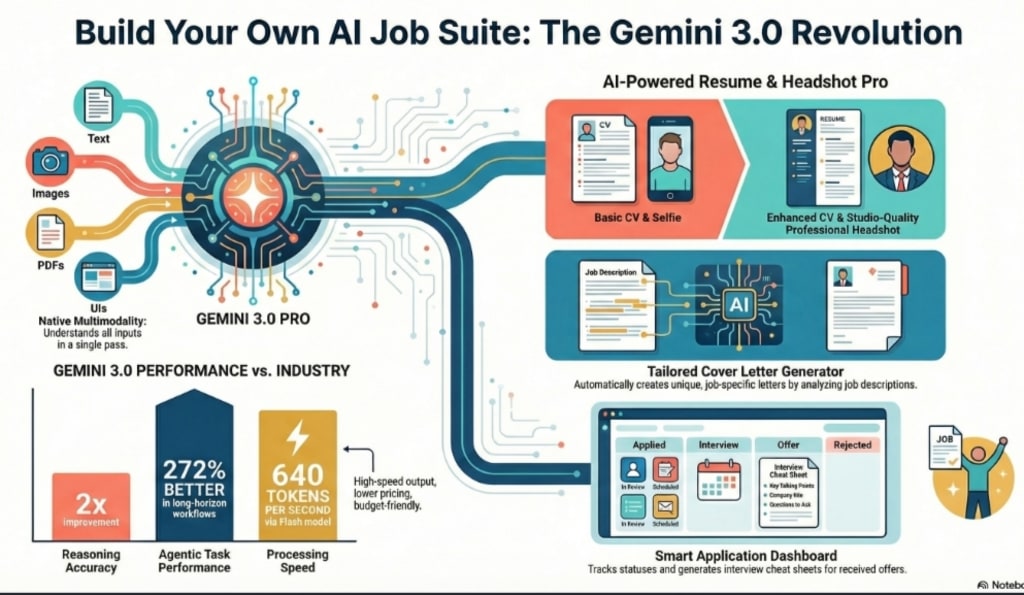
Gemini 3.0 Pro changes the game with a 272% improvement in "long-horizon agentic tasks." In older models—and even current competitors—context was often unstable, causing the AI to "drift fast" or forget the project’s logic halfway through. Gemini 3.0 Pro maintains a persistent understanding of the goal, tracking its own progress across complex, multi-step engineering tasks. It no longer just responds; it comprehends the entire architectural thread.
The Power of Native Multimodality: The "One-Pass" Revolution
Gemini 3.0 introduces a breakthrough in Native Multimodality. This means the model sees, hears, and understands text, images, PDFs, UIs, and audio simultaneously in a "one-pass" workflow.
Earlier models required "weird detours" like OCR plugins or separate image-processing steps that inevitably led to "context collapse." Because Gemini 3.0 processes these elements natively, it can handle sophisticated, interconnected workflows—like reading a legacy resume PDF while cross-referencing a UI screenshot—without the logic falling apart. This stability is what allows us to move from unstable prototypes to "serious AI apps" that handle complex file-to-UI transformations.
Benchmarks That Kill the Competition
Gemini 3.0 isn't just an incremental update; it is a domination play designed for high-performance engineering. To build effectively, you must understand the distinction between the "brain" and the "engine":
The Brain (Gemini 3.0 Pro): Delivers double the reasoning accuracy of previous models and a 272% boost in agentic task performance. It outperforms GPT 5.1 in multimodal benchmarks, making it the superior choice for complex app architecture.
The Engine (Gemini 3.0 Flash): Pushes a staggering 640 tokens per second. With significantly lower input pricing, Flash allows solo founders to scale high-speed applications without blowing a professional budget.
By using Pro for the heavy reasoning and Flash for the high-speed execution, solo builders can achieve a level of technical sophistication that previously required a full engineering team.
The "Build Once, Own Forever" Philosophy
As a strategist, I view internal tools as the ultimate low-risk MVP (Minimum Viable Product). When you solve your own problem to avoid a subscription fee, you have identified a proven market need. A prime example is the "Job Hunting Suite," a blueprint that replaces an entire ecosystem of paid SaaS. This suite includes:
1. Application Dashboard: Automated tracking with dynamic line graphs.
2. CV/Resume Professionalizer: AI-driven document structuring and enhancement.
3. Cover Letter Generator: Context-aware responses tailored to specific job descriptions.
4. AI Headshot Builder: Studio-quality imagery generation.
5. Interview Cheat Sheet Generator: A strategic tool triggered by the "Offers Received" page to help users prepare for interviews even for roles they didn't manually apply for.
Building this for yourself is the ultimate proof of product-market fit. What starts as a personal utility to kill your subscriptions is the foundation of a Micro-SaaS that thousands of others will eventually pay you to access.
Professionalism on Autopilot: The AI Avatar Case Study
The "AI Avatar Builder" is a high-value feature that exemplifies Gemini 3.0’s multimodal power. It allows a user to upload a standard selfie and transform it into a professional headshot using prompts like "navy blue suit and natural lighting."
This solves a massive pain point for users who "don't have a good camera, lighting, or don't want to spend money on a studio." By handling the image-to-image workflow and file upload components natively, Gemini 3.0 allows solo builders to offer "studio-quality" results within their own custom apps, removing the need for third-party professional photography services.
The Three-Step Disruption Blueprint
You can begin building your own suite today inside Google AI Studio. Here is the high-level workflow:
1. Select the Model: Navigate to the sidebar in Google AI Studio and select the "five code gen AI apps" option. Ensure you are using Gemini 3.0 Pro to leverage the highest levels of reasoning.
2. The Prompt-to-Code Phase: Describe your app’s logic in the prompt box. Upload UI reference screenshots to provide visual context; Gemini 3.0 will translate these designs into functional code in minutes.
3. The Polish Phase: Transition from a prototype to a product. Tweak layouts, adjust spacing, and fix logic. This is where the magic happens—as the source reminds us, "polishing is where an okay app becomes something you are really proud to show people."
Conclusion: The Moment Small Teams Win
The launch of Gemini 3.0 marks a pivot point in the industry. The barrier to entry has collapsed. The friction of "babysitting" buggy code has been replaced by reliable agentic reasoning and native multimodal understanding. Launching and scaling apps is now faster, cleaner, and more accessible for the solo builder than ever before.
The tools are free, the speed is unprecedented, and the potential is limitless. If you could replace your most expensive monthly subscription with a tool you owned entirely, what would you build this weekend?
About the Creator
Mohammad Hamid
Big Dream Work Hard and Achieve 💪
Keep reading
More stories from Mohammad Hamid and writers in Futurism and other communities.
Forget Coding: How "AI Power Users" Are Building the Next Generation of Million-Dollar Businesses
1. Introduction: The Death of the Developer Moat The technical moat is dead. For decades, a Computer Science degree was the ultimate gatekeeper to the digital economy—the ability to write code was the only way to build a scalable business. That barrier has been pulverized.
By Mohammad Hamid2 days ago in Futurism
Headwear Market: Fashion Trends, Seasonal Collections & Industry Growth Outlook
According to IMARC Group's latest research publication, the global headwear market size reached USD 23.1 Billion in 2024. Looking forward, IMARC Group expects the market to reach USD 36.3 Billion by 2033, exhibiting a growth rate (CAGR) of 4.88% during 2025–2033.
By sujeet. imarcgroupa day ago in Futurism
Australia Organic Food Market: Consumer Health Focus, Sustainable Agriculture & Retail Penetration
According to IMARC Group, the Australia organic food market reached a value of USD 1.2 Billion in 2025 and is projected to expand to USD 2.3 Billion by 2034, exhibiting a compound annual growth rate (CAGR) of 6.90% during 2026–2034. This sustained growth reflects a fundamental shift in food consumption patterns across Australia, where health awareness, environmental responsibility and product transparency are becoming central purchasing drivers. Organic food, once confined to specialty health stores, is now a mainstream retail category supported by expanding supermarket penetration and stronger domestic production capacity. As consumers increasingly seek clean-label, minimally processed and sustainably sourced products, the organic food market is emerging as a strategic pillar of Australia’s evolving agri-food landscape.
By Shrestha Roy7 days ago in Futurism
The Cave Part 6
If you have ever heard a tale about yourself that you cannot remember and doubtless think is made up, you will know how I felt when Tharkin related all that the eagle had seen of me before my memories were scattered. Of far distances and traveling companions that I did not recall, camping out under the stars and making our way to the mountains with deliberate purpose. The great bird had lost contact with my party once we entered the forests, and the seven other members were not seen again by him or his brethren since.
By Jamye Sharp3 days ago in Chapters



Comments
There are no comments for this story
Be the first to respond and start the conversation.