
The Ministry of Hours
When Time Was Privatized, Memory Became Rebellion


When they privatized time, most people didn’t notice.
It didn’t happen with sirens or soldiers. No banners fell from government buildings. No declarations were broadcast. The change arrived quietly — in fine print, in revised policies, in updated terms of service that no one read because everyone was already late.
At first, time was simply “standardized.” They said it would improve coordination. Increase efficiency. Reduce waste.
Then it was zoned.
District Hours. Commercial Hours. Educational Hours. Authorized Leisure Windows.
Every movement was assigned a bracket.
Every bracket, a fee.
The Ministry of Hours opened shortly thereafter.
It stood where the old courthouse had been. The same stone pillars remained, but the inscription above the entrance had been replaced. Where once it read Justice, it now read:
Measured. Managed. Monetized.
Inside, citizens received their HourCards — thin metallic rectangles embedded with tracking chips. Each card contained a monthly allocation based on profession, income class, and compliance rating. Premium subscribers enjoyed extended creativity blocks and additional Rest Credits. Basic tier citizens were advised to “budget wisely.”
Elias received a Standard Allocation.
He worked in Archival Compliance — reviewing historical materials for unlicensed references to “unregulated duration.” His task was simple: redact language that suggested time belonged to anyone.
Old journals were the worst offenders.
They were full of sentences like I lost track of time or We sat for hours watching the sunset. Entire paragraphs vanished beneath his digital marker.
Loss of track implied ownership.
Sunsets were non-billable phenomena.
His job paid enough Hours to maintain housing, moderate nutrition, and two Social Connection windows per week. These were scheduled interactions — friends, family, approved emotional exchanges.
But there was no allocation for silence.
No category for wonder.
No subsidy for being.
The Ministry had long ago clarified that unstructured duration bred inefficiency and dissent.
On his commute home — fourteen transit minutes, deducted automatically — Elias watched a mother scan her child’s wristband before allowing him to chase pigeons in the plaza. The device chirped approval. Three minutes of Recreational Pursuit authorized.
The boy ran.
When his band vibrated, he stopped mid-laughter and returned to her side.
That was how conditioning worked.
Gradually. Politely. Thoroughly.
Elias remembered his grandfather once telling him that time had not always required purchase. That there had been seasons when people rose with light and rested with dark, guided by hunger and weather rather than quotas.
He had dismissed it as nostalgic myth.
History, after all, had been audited.
But sometimes, late at night, he felt something irregular in his chest — not illness, not panic — something like a forgotten language trying to reassemble itself.
It usually passed.
Until the day his HourCard glitched.
He was reviewing a digitized manuscript flagged for deletion. The text contained repeated references to something called “Sabbath.” A full day of unscheduled existence.
No productivity.
No commerce.
No exchange.
The manuscript described people who believed time originated not from government decree but from an Everlasting Source — that breath itself was gift, not subscription.
Elias leaned closer to the screen.
His HourCard buzzed in warning.
Unauthorized contemplation exceeded threshold.
He should have redacted it.
Instead, he kept reading.
The author wrote that human bones were shaped from earth, but their animation — their awareness — came from Spirit. That existence was inheritance, not contract.
The screen flickered.
His card emitted a sharp tone.
Time Overdraft.
He checked his balance.
Impossible.
He had conserved this week. Skipped a leisure block. Minimized conversation.
Yet the numbers plummeted as he read.
Understanding, apparently, was premium.
A message appeared:
Excessive Reflection Detected. Apply for Extended Intellectual Permit. Approval Pending.
He felt something unfamiliar rise within him — not fear, not quite anger.
Recognition.
He closed the file without redaction.
For the first time since receiving his HourCard, Elias did not clock out at the end of his shift.
He simply walked out.
The exit gate flashed red.
Unauthorized Departure.
Security drones adjusted their orientation but did not pursue. The Ministry preferred correction through compliance, not spectacle.
He stepped into the street.
It was late afternoon. The sky held a color not listed in any productivity chart — somewhere between gold and surrender.
People hurried past, wrists glowing with countdowns.
He removed his HourCard.
The metal felt heavier than he expected.
Above him, a billboard displayed the Ministry’s current slogan:
Your Time, Optimized For You.
He laughed — softly at first, then with something bordering on grief.
They had made time a construct.
Then a commodity.
Enshrined it in copyright.
Carved the world into tradable intervals and convinced everyone that inherent movement required authorization.
Even love had been scheduled.
Births.
Deaths.
Mourning periods.
All bracketed.
All billed.
He walked toward the river — an unlicensed body of water that stubbornly refused to synchronize with human accounting. The Ministry had attempted to meter its flow once. The machinery failed within weeks.
Water, like memory, resisted containment.
He sat on the bank.
His card vibrated again — escalating warnings.
Balance critically low.
Renew subscription to avoid suspension.
Suspension meant temporal freeze: citizens locked in stasis until fees were reconciled.
He held the card over the water.
His hands trembled.
Generations had adapted to survive. They had inhaled the foreign system and learned to breathe around it. In doing so, they forgot something essential — that time was never theirs to manufacture, only to inhabit.
The manuscript’s words returned to him:
Return is law unbreakable.
The river moved without invoice.
Wind crossed his face without receipt.
Somewhere behind him, church bells rang — an ancient structure overlooked by modernization because its congregation had dwindled. The bells rang not on Ministry schedule, but on their own mechanical insistence.
Unmetered sound.
He dropped the card.
It struck the surface and vanished.
Silence followed.
No alarms.
No drones.
No immediate consequence.
For a moment, nothing happened.
Then everything did.
The absence of countdown.
The absence of deduction.
He expected paralysis.
Instead, he felt expansion.
Minutes passed — unquantified.
He inhaled deeply.
No transaction recorded.
Across the river, others stood watching him. A woman removed her wristband. A teenager hesitated, then followed.
Not rebellion.
Remembrance.
The Ministry would respond, of course. Systems defend themselves. Policies would thicken. Penalties increase.
But something irreversible had begun.
When Elias stood, he did not feel unemployed or delinquent.
He felt returned.
Time had not been freed.
It had never been owned.
And as dusk folded into night — unscheduled, immeasured — he understood the quiet truth that no legislation could permanently suppress:
You can condition a people to rent their hours.
You can invoice their movement.
You can brand productivity as virtue and permission as safety.
But you cannot indefinitely convince a soul that its existence was ever meant to be purchased.
Behind him, in offices still lit with fluorescent devotion, screens flashed warnings of “temporal leakage.”
Across the river, more cards entered the water.
The Ministry would call it disorder.
Elias called it breathing.
For the first time in his life, he did nothing at all.
And nothing charged him for it.
About the Creator
Health Insurance Market Trends: Preventive Care Incentives, Wellness Programs & Industry Forecast to 2034
Rising healthcare costs, a growing geriatric population, and the increasing prevalence of chronic diseases are driving global health insurance demand, supported by digital transformation, value-based care models, and supportive government policies. According to IMARC Group’s latest data, the global health insurance market size was valued at USD 2,064.8 Billion in 2025. Looking forward, IMARC Group estimates the market to reach USD 3,510.3 Billion by 2034, exhibiting a CAGR of 5.80% from 2026-2034.
By Andrew Sullivana day ago in Futurism
Portable Toilet Market Outlook: Infrastructure Projects and Event Industry Growth Opportunities
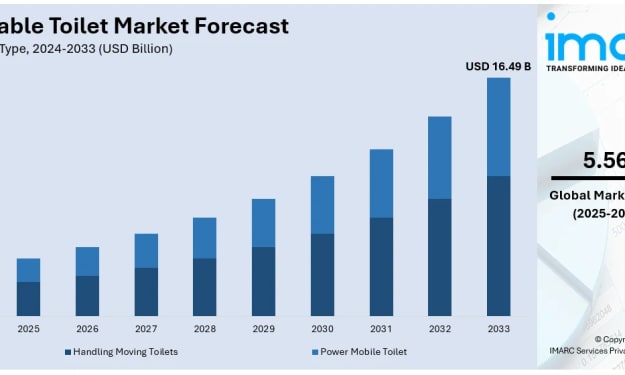
According to IMARC Group's latest research publication, The global portable toilet market size reached USD 9.89 Billion in 2024. Looking forward, IMARC Group expects the market to reach USD 16.49 Billion by 2033, exhibiting a growth rate (CAGR) of 5.56% during 2025-2033.
By James Whitman4 days ago in Futurism



Comments
There are no comments for this story
Be the first to respond and start the conversation.