
Where’s My Flying Car? The Dream That Refuses to Die
Why humanity’s century-old vision of flying cars is always “just a decade away”—and what might finally make it real.

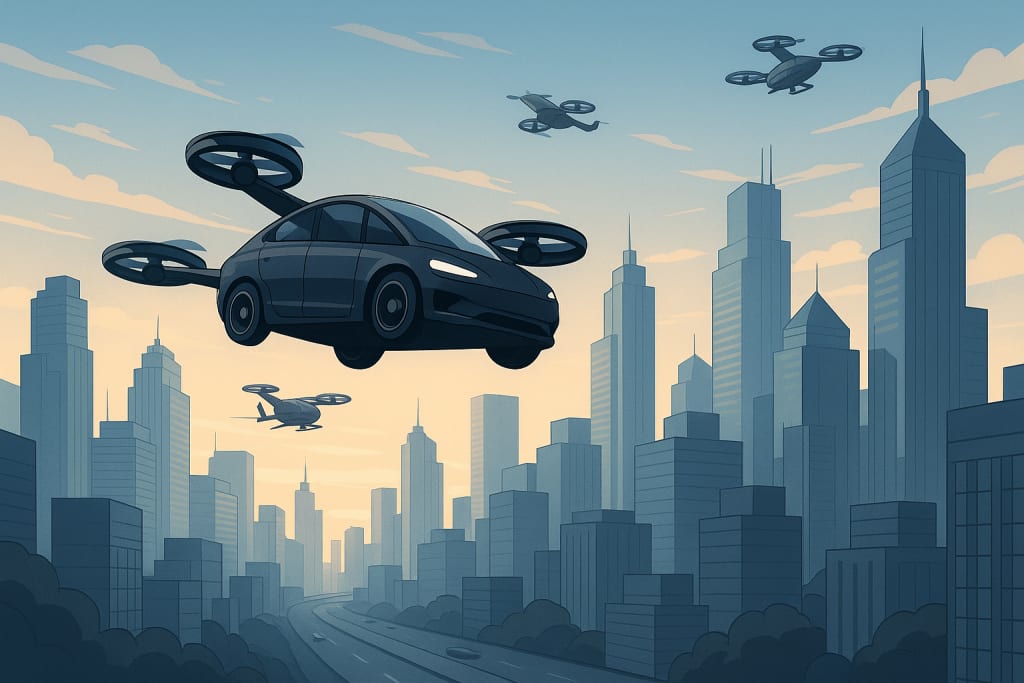
The Dream That Refuses to Die
In 1940, Henry Ford made a bold prediction:
"Mark my word: A combination airplane and motorcar is coming. You may smile, but it will come."
Eight decades later, we’re still smiling—and still stuck in traffic.
The flying car has become the unicorn of modern technology: always just over the horizon, almost here, nearly real. It is a symbol of unfulfilled futurism, a relic of mid-20th-century optimism about where technology would take us. So where is it?
The Origins of a Dream
The idea of flying personal vehicles didn’t begin with "The Jetsons." As early as the 1920s, inventors were already building and crashing various car-plane hybrids. The concept exploded into public imagination during the 1950s and 60s—a golden age of sci-fi optimism. Magazines depicted sleek vehicles zipping above suburban skies, promising a utopia of limitless mobility and freedom from the tyranny of ground traffic.
But here in the real 21st century, flying cars remain rare sightings in air shows, YouTube videos, or overly ambitious startup pitches. So, what happened?
Technological Reality vs. Futuristic Fantasy
The technical obstacles are huge:
Physics doesn’t negotiate: Getting a car to fly means a trade-off between weight, lift, and safety. The more practical the car, the worse it flies. The more it flies, the worse it drives.
Energy limits: Traditional combustion engines can’t lift a car-sized object into the air for long. And while electric VTOLs (Vertical Take-Off and Landing) are promising, battery density remains a bottleneck.
Noise and safety: Nobody wants 300mph propellers slicing through their neighborhood airspace. And when accidents happen, they don’t end with a fender-bender—they end with a crater.
The Modern Contenders
Despite these challenges, the flying car dream is far from dead. In fact, we’re closer than ever.
Joby Aviation: Backed by Toyota and now publicly traded, Joby’s electric VTOL aircraft is quiet, sleek, and in the testing phase for commercial urban flights.
Alef Aeronautics: This California-based startup received FAA approval for test flights in 2023. Their car can drive on the road and lift vertically into the air.
Volocopter: Already testing air taxis in cities like Singapore and Paris, aiming to operate short-range flights in heavily congested areas.
Many of these are not “cars” in the traditional sense. You can’t park them in your garage or stop by a gas station. Most are built for short commutes, designed to be summoned like an Uber rather than owned.
Why Are We Still Not There Yet?
Flying cars, like jetpacks, suffer from being too early for their own good. Every time we get close, some combination of regulation, cost, or technical failure drags us back to Earth.
Infrastructure: You can’t just let everyone take off from their driveway. We’d need digital air traffic control, strict corridors, and emergency landing protocols.
Legal & Safety: If a car fails, you pull over. If a flying car fails, it falls. That’s a serious legal and moral complication.
Affordability: Early models cost hundreds of thousands of dollars. Widespread use requires mass production—and trust.
So... When?
If we define “flying car” as a vehicle that:
Can take off vertically,
Can travel through the air safely,
Is semi-autonomous,
And is used for public or personal transport in cities...
...then we are probably 10 to 20 years away from limited but real deployment.
Urban air mobility (UAM) will likely start with air taxi services in highly congested cities—think São Paulo, Tokyo, or Los Angeles—where the cost-benefit ratio is high enough to justify the infrastructure.
You won’t be commuting in your own flying car in 2030. But you might be able to book a 10-minute aerial ride across Manhattan via an app.
Why the Dream Still Matters
The dream of flying cars is not just about skipping traffic. It’s a symbol. A metaphor. It represents our enduring belief that we can rise above limitations—literal and metaphorical.
It’s about reclaiming time. About making travel an experience, not a chore. About unlocking a dimension of movement that has been restricted to pilots and the ultra-wealthy.
It may never be as common as the movies promised. But even limited success in urban aerial transport could change the way we view cities, commutes, and personal freedom.
Final Descent
Flying cars might never arrive in the exact shape we imagined in the 1960s. But that’s okay.
What matters is that the dream hasn’t died—it’s evolved. We may never all own a flying car, but soon, we may all have access to one. Not every fantasy needs to be mass-produced to make an impact.
Because maybe the real revolution isn’t the vehicle—it’s how we move through the world, and who gets to move freely.
About the Creator
Ahmet Kıvanç Demirkıran
As a technology and innovation enthusiast, I aim to bring fresh perspectives to my readers, drawing from my experience.
Keep reading
More stories from Ahmet Kıvanç Demirkıran and writers in Futurism and other communities.
What If AI Governed the World?
At first, it seemed like a dream. Traffic jams disappeared. Hospitals never overbooked. Crime dropped. Grocery stores never ran out of anything, and education—tailored to every child's brainwave—flourished. The world, governed by the precision of artificial intelligence, was efficient, productive, and astonishingly calm.
By Ahmet Kıvanç Demirkıran7 months ago in Futurism
Electric School Bus Market: Clean Mobility Initiatives, Fleet Electrification & Market Growth
According to IMARC Group's latest research publication, The global electric school bus market size was valued at USD 35.5 Billion in 2024. Looking forward, IMARC Group estimates the market to reach USD 335.3 Billion by 2033, exhibiting a CAGR of 28.33% during 2025-2033.
By James Whitman3 days ago in Futurism
Free £5 voucher
Dear fellow Beckenham resident, Anyone else reading this may need to adapt for context I thought you would be interested to know that Tesco Elmers End is offering a free £5 (or more) voucher to any Beckenham resident. All you need to do to get this amazing offer is to make a complaint through their new, super-sexy, high-tech, AI chatbot service.
By Raymond G. Taylora day ago in Futurism




Comments (3)
i will flying in future
The imagination and facts fuse in this piece. My mind accelerated thinking about the various ways that flying cars would revolutionize the transportation industry. Your clear-eyed and well-detailed approach never fails. When you show the limitations of car-flight, you also offer hope that one day, bright minds will prevail and deliver a flying car.
Flying cars what next lol ♦️🌼♦️🏆