
Why AI Deployment Feels Closer to Distributed Systems Engineering?
I expected deploying AI to feel like shipping a feature. Instead, it started to resemble coordinating a network of moving parts that refused to stay still.

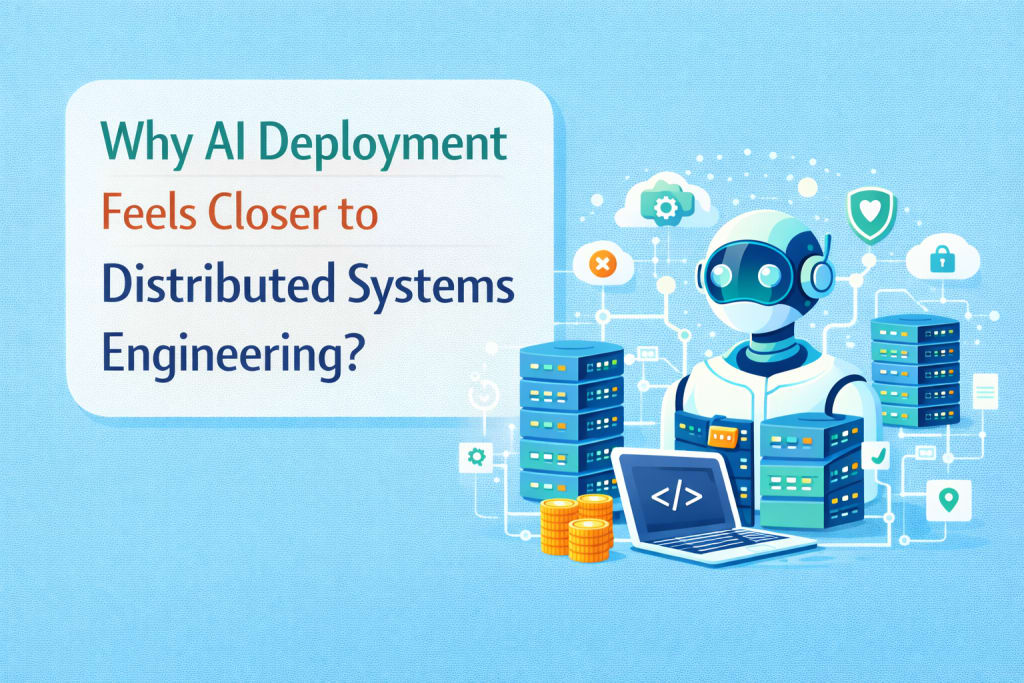
The first time I deployed an AI-powered system, I treated it like any other release. Prepare the environment, test endpoints, validate outputs, monitor performance. That mental model didn’t last long. Within days, I realized that deploying AI wasn’t about placing code into production. It felt more like orchestrating a distributed ecosystem where every component influenced the others.
Traditional deployments focus on stability. AI deployments focus on balance. Models, data pipelines, APIs, caching layers, and monitoring systems all operate together. If one piece shifts, the entire system responds differently. That experience made me rethink deployment entirely.
Distributed Systems Thinking Appears Earlier Than Expected
I used to associate distributed systems engineering with large-scale backend infrastructure — microservices, load balancing, scaling clusters across regions. AI deployments introduce similar challenges even at smaller scales.
An AI application rarely exists as a single service. Instead, it involves:
- Model inference endpoints.
- Retrieval systems providing contextual data.
- Orchestration layers managing prompts and responses.
- Evaluation pipelines measuring performance continuously.
- External APIs or integrations shaping data flow.
Each component operates independently yet remains interconnected. Latency in one area affects the entire experience.
I remember debugging a delay that turned out to be caused by data retrieval rather than model inference. That moment clarified how deployment complexity spreads across layers rather than residing in a single service.
Deterministic Deployments vs Probabilistic Systems
Traditional software deployment focuses on delivering predictable behavior. Once code passes tests, developers expect consistency.
AI systems introduce probabilistic behavior. Deployment doesn’t guarantee identical outcomes across environments because outputs depend on context and evolving data. This variability shifts deployment goals from ensuring identical responses to maintaining acceptable performance ranges.
Research around AI operations suggests continuous monitoring becomes necessary because model performance can change without direct code updates. That requirement aligns closely with distributed systems practices where observability and monitoring drive reliability.
Infrastructure Coordination Becomes the Main Challenge
I initially assumed model performance would dominate deployment discussions. Instead, infrastructure coordination consumed most of the effort.
Questions emerged constantly:
- How do we handle scaling under unpredictable traffic?
- What happens when an external API fails?
- Where do fallback responses live?
- How do we monitor behavior across multiple services?
These questions resemble distributed systems engineering more than traditional application deployment. Teams design failover strategies, caching mechanisms, and redundancy layers to maintain stability.
One engineer described AI deployment as “managing interactions rather than managing code.” That perspective felt accurate once I experienced real-world deployment scenarios.
Latency and Reliability Shape Architecture Decisions
Distributed systems always involve trade-offs between speed and reliability. AI deployments amplify those decisions because model inference can be resource-intensive.
For mobile environments, latency becomes especially visible. Users expect fast responses even when backend processing involves complex computations. Conversations with teams working in mobile app development Milwaukee often highlight how AI features require careful architecture planning to maintain smooth performance across networks and devices.
Balancing inference time, caching strategies, and data retrieval pipelines feels less like deploying a single service and more like optimizing a distributed network.
Continuous Evaluation Mirrors Distributed Monitoring
Another similarity involves monitoring practices. Distributed systems rely on observability tools tracking metrics across services. AI deployments require similar evaluation loops.
Teams monitor:
- Response latency across regions.
- Accuracy trends over time.
- Error rates across different input types.
- User interaction patterns.
These metrics create a feedback loop where deployment evolves continuously. Instead of shipping once, teams refine infrastructure based on ongoing observations.
Failure Modes Become More Complex
Distributed systems engineers expect partial failures. AI deployments introduce additional failure modes:
- Model responses that degrade subtly.
- Data pipelines introducing unexpected bias.
- Integration layers failing silently.
- Context retrieval returning outdated information.
Traditional deployment frameworks don’t always capture these scenarios. Teams design monitoring strategies that account for probabilistic behavior rather than binary failure.
I found myself thinking less about whether the system worked and more about how it behaved under imperfect conditions.
Collaboration Shifts Across Roles
Deploying AI requires collaboration between disciplines that traditionally operated separately. Backend engineers, data scientists, infrastructure specialists, and product designers all contribute to deployment decisions.
Distributed systems engineering already emphasizes cross-functional collaboration. AI deployments extend that requirement because system behavior emerges from interactions between components.
I noticed meetings shifting from model discussions toward workflow architecture. Conversations centered on data flow, orchestration logic, and system resilience.
Statistics That Reinforced the Parallel
Several industry patterns shaped my thinking:
- Many AI initiatives struggle during deployment stages rather than model development.
- Continuous monitoring and observability tools are becoming central to AI operations.
- Data management and infrastructure coordination often consume more resources than algorithm design.
These trends suggest AI deployment complexity aligns closely with distributed systems engineering challenges.
The Emotional Shift From Control to Coordination
One of the hardest adjustments involved letting go of the idea that deployment ends with release. Distributed systems require ongoing coordination, and AI deployments follow the same pattern.
I used to measure success by whether a deployment completed without errors. Now I measure success by whether the system maintains balance over time.
That change altered how I approach architecture. Instead of designing static workflows, I focus on creating systems capable of adjusting to new conditions.
Why AI Deployment Feels Fundamentally Different
AI doesn’t replace traditional software practices. It expands them. Deployment becomes less about delivering code and more about managing interactions between distributed components.
The more I work with AI systems, the more I see how deployment resembles distributed systems engineering — a continuous process of monitoring, adjusting, and coordinating moving parts.
For teams integrating AI into real-world applications, including those connected to mobile app development Milwaukee, this shift requires rethinking deployment strategies from the ground up.
And once you accept that deployment never truly finishes, AI systems start to feel less like products and more like living infrastructures — systems that require constant attention, balance, and awareness of how each piece influences the whole.
About the Creator
Saudi Arabia Truck Industry Trends Industrial Expansion, Smart Fleet Solutions & Future Opportunities
According to IMARC Group's latest research publication, Saudi Arabia truck market size reached USD 74.7 Billion in 2025. The market is projected to reach USD 136.1 Billion by 2034, exhibiting a growth rate of 6.90% during 2026-2034.
By Faisal Al-Harbi6 days ago in Futurism
Australia Accounting Services Market: Regulatory Demand, Digital Transformation & SME Growth
According to IMARC Group, the Australia accounting services market reached USD 12.2 Billion in 2025 and is projected to expand to USD 21.3 Billion by 2034, exhibiting a compound annual growth rate (CAGR) of 6.24% during 2026–2034. This steady growth reflects the increasing complexity of financial reporting, regulatory compliance and strategic advisory needs across businesses in Australia. Accounting services have evolved far beyond traditional bookkeeping and tax preparation. Today, firms provide data-driven insights, ESG reporting support, cybersecurity advisory and digital financial management solutions. As startups multiply, multinational corporations expand and SMEs scale operations, demand for specialized, technology-enabled accounting services continues to rise.
By Kevin Coopera day ago in Futurism




Comments
There are no comments for this story
Be the first to respond and start the conversation.