
Why Enterprise Apps Age Faster Than Consumer Products?
How complexity, slow change, and organizational constraints cause enterprise apps to feel outdated long before they stop working.

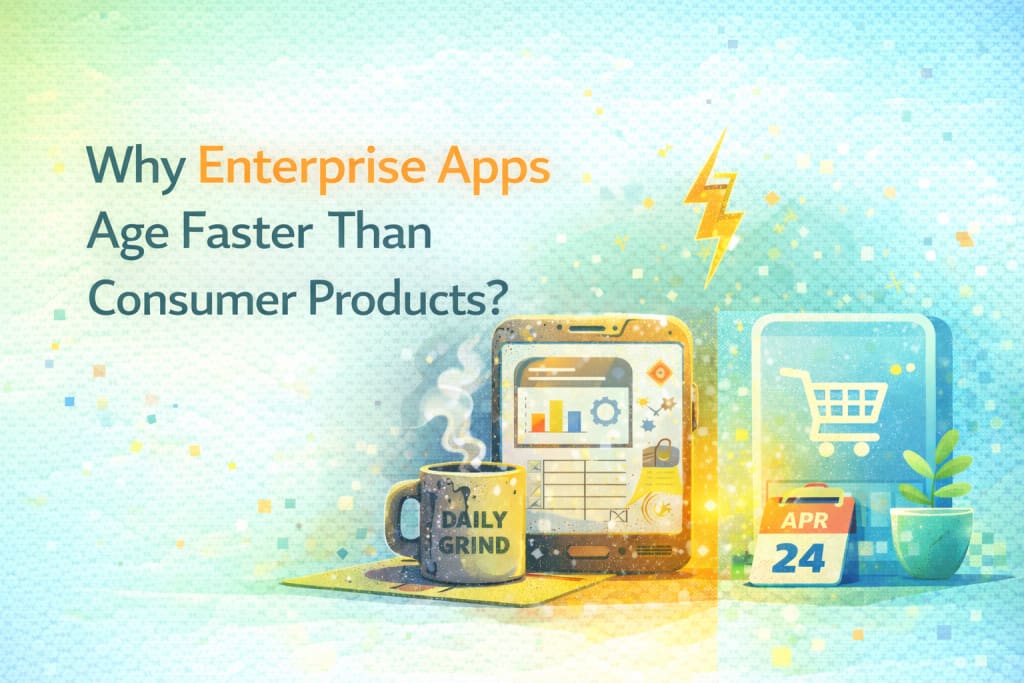
Enterprise apps feel old long before they actually are.
That’s the part nobody wants to admit in meetings. The app is only three years old. Five, maybe. Still supported. Still technically functional.
And yet, users talk about it like it’s ancient.
“Clunky.”
“Slow.”
“Hard to use.”
Consumer apps from the same era don’t get that treatment. They evolve. They refresh. They feel current even when the core hasn’t changed much.
Enterprise apps, on the other hand, seem to age in dog years.
Aging starts the moment real work touches the app
Consumer apps usually meet users in relaxed moments. Scrolling. Browsing. Killing time. The bar for tolerance is oddly high.
Enterprise apps meet users mid task. Under pressure. With deadlines. With managers waiting. With real consequences tied to every click.
CDC research on workplace stress shows that tools used during high pressure tasks are judged more harshly than tools used in casual contexts, even when performance differences are minor.
So the same delay that feels fine in a social app feels unacceptable in a work app.
That accelerates perceived aging.
Enterprise apps inherit organizational history
Consumer apps answer to users. Enterprise apps answer to organizations.
That difference matters more than people think.
Enterprise apps accumulate layers of policy, compliance, approvals, and exceptions. Each one adds UI elements, validations, and workflows that never quite go away.
Pew Research Center research on enterprise technology adoption shows that once processes are embedded into software, organizations are reluctant to remove them, even when they’re no longer relevant.
So the app carries ghosts of decisions past.
Old workflows. Legacy fields. Screens nobody likes but nobody dares remove.
That weight shows up as age.
Release cycles stretch time differently
Consumer apps update constantly. Weekly. Sometimes daily. Small changes, frequent feedback.
Enterprise apps move slower. Quarterly releases. Annual roadmaps. Long validation cycles.
By the time feedback turns into changes, user expectations have already moved.
McKinsey research on enterprise software delivery found that longer release cycles correlate strongly with declining user satisfaction, even when feature sets are comparable.
The app isn’t worse. It’s just outpaced.
And catching up feels impossible because everything requires coordination. Legal. Security. IT. Training.
Momentum favors consumer products.
Performance debt hides behind “acceptable”
Enterprise users are trained to tolerate friction.
They expect logins. They expect forms. They expect slowness. So teams accept “acceptable” performance far longer than they should.
That tolerance becomes permission.
Harvard studies on system usability show that tolerated inefficiencies tend to persist and compound, while visible failures get fixed quickly.
So enterprise apps quietly accumulate latency, complexity, and awkward flows. Nobody screams. Everyone adapts.
Until the app feels ancient.
Customization accelerates decay
Enterprise apps pride themselves on flexibility. Configurations. Permissions. Custom fields. Role based flows.
Each customization creates a branch in behavior. Each branch increases testing cost. Each test slows change.
Eventually, improving one path risks breaking another.
Statista reports that highly customized enterprise systems experience slower modernization cycles compared to standardized platforms, even when user demand is high.
Customization feels like value early. Later, it feels like rust.
And here’s the first contradiction I won’t clean up.
Customization is often necessary. Lack of it kills adoption.
But customization also locks apps into the past.
Both are true.
User experience takes a back seat to coverage
Enterprise apps optimize for coverage. Handle every case. Support every department. Capture every data point.
Consumer apps optimize for clarity. Do one thing well. Hide the rest.
As enterprise scope grows, interfaces thicken. More tabs. More menus. More conditions.
Harvard research on cognitive load shows that as interface density increases, perceived usability declines sharply, even if task completion remains possible.
Users can still do the work. It just feels heavier every year.
That heaviness reads as age.
Technology stacks fossilize quietly
Consumer apps migrate stacks aggressively. New frameworks. New patterns. New devices.
Enterprise apps move cautiously. Stability matters. Security reviews matter. Certifications matter.
So stacks freeze.
The app keeps working, but tooling ages. UI patterns age. Performance lags behind modern expectations.
Google and Apple both update platform guidelines yearly. Consumer apps chase them. Enterprise apps lag behind by necessity.
That gap shows.
A familiar scenario that keeps repeating
Picture a company doing mobile app development Miami based, building internal tools for large organizations.
The app launches. Adoption is strong. It solves real problems.
Over time, more teams rely on it. More features get added. More rules get enforced.
Usage grows. Satisfaction slowly declines.
Nothing catastrophic happens. The app just feels harder to use each year. Training takes longer. Support tickets rise.
People start asking for replacements instead of improvements.
That’s aging in action.
Enterprise apps can’t shed weight easily
Consumer apps can kill features. A/B test removals. Pivot fast.
Enterprise apps carry contractual obligations. Regulatory needs. Training materials. User habits.
Removing anything feels risky.
McKinsey research on enterprise modernization shows that feature removal is one of the strongest predictors of long term usability improvement, yet it’s one of the least practiced strategies.
So apps grow outward, never inward.
They don’t slim down. They stiffen.
The second contradiction that never resolves
Enterprise apps are expected to be stable.
Enterprise apps are expected to evolve.
Stability resists change. Evolution demands it.
Most enterprise products fail not because they break, but because they can’t reconcile those two expectations.
Consumer apps pick evolution. Enterprise apps pick stability.
The aging follows.
Why users blame the app, not the system
Users don’t see governance. Or compliance. Or procurement cycles.
They see screens. Delays. Confusion.
So they call the app outdated.
Pew research on workplace technology perception shows that employees often associate poor usability with organizational stagnation, even when leadership invests heavily in digital tools.
That perception hurts adoption and morale.
The app becomes a symbol of slowness, whether that’s fair or not.
What actually slows the aging process
Not silver bullets. Tradeoffs.
- Ruthless prioritization of core workflows
- Regular removal of unused features
- Performance budgets enforced over time
- Design systems that evolve gradually
- Clear ownership of user experience
None of these are easy in enterprise environments. All of them matter.
And yes, they slow feature delivery sometimes.
That’s the cost of staying young.
Why enterprise apps still matter despite all this
Because they do real work.
Payroll. Logistics. Healthcare. Infrastructure. Compliance. Operations.
They carry weight consumer apps never touch.
But weight doesn’t have to mean decay.
The enterprise apps that age well treat usability, performance, and adaptability as ongoing responsibilities, not launch day goals.
The ones that don’t end up replaced, not because they failed, but because they felt too old to keep up.
FAQs
Why do enterprise apps feel outdated faster?
Because they accumulate complexity, move slower, and operate under stricter constraints than consumer apps.
Is aging mostly a UX problem?
UX is a big factor, but performance, release cycles, and organizational processes contribute heavily.
Can enterprise apps be modernized successfully?
Yes, but it requires feature removal, performance discipline, and ongoing investment, not just redesigns.
Why don’t enterprise teams update apps more often?
Long approval cycles, risk aversion, and customization make frequent changes difficult.
How can teams slow enterprise app aging?
By prioritizing core workflows, reducing complexity, and treating usability as a long term responsibility.
About the Creator
Ash Smith
Ash Smith writes about tech, emerging technologies, AI, and work life. He creates clear, trustworthy stories for clients in Seattle, Indianapolis, Portland, San Diego, Tampa, Austin, Los Angeles, and Charlotte.
Used Cooking Oil Market Outlook: Recycling Trends and Growth Opportunities
Rising emphasis on sustainability, waste valorization, and renewable energy production is driving growth in the used cooking oil market. Increasing use as a feedstock for biodiesel and bio-based chemicals supports demand. Government mandates on waste management and clean fuels encourage collection and recycling. According to IMARC Group's latest research publication, The global used cooking oil market size was valued at USD 7.0 Billion in 2024. Looking forward, IMARC Group estimates the market to reach USD 11.6 Billion by 2033, exhibiting a CAGR of 5.7% during 2025-2033.
By James Whitman4 days ago in Futurism
Wind Turbine Components Market Outlook: Technology Trends and Growth Opportunities
Rising investments in renewable energy, supportive government policies, and global decarbonization targets are driving growth in the wind turbine components market. According to IMARC Group's latest research publication, The global wind turbine components market size was valued at USD 135.34 Billion in 2024. Looking forward, IMARC Group estimates the market to reach USD 235.99 Billion by 2033, exhibiting a CAGR of 6.05% from 2025-2033.
By James Whitman7 days ago in Futurism



Comments
There are no comments for this story
Be the first to respond and start the conversation.