

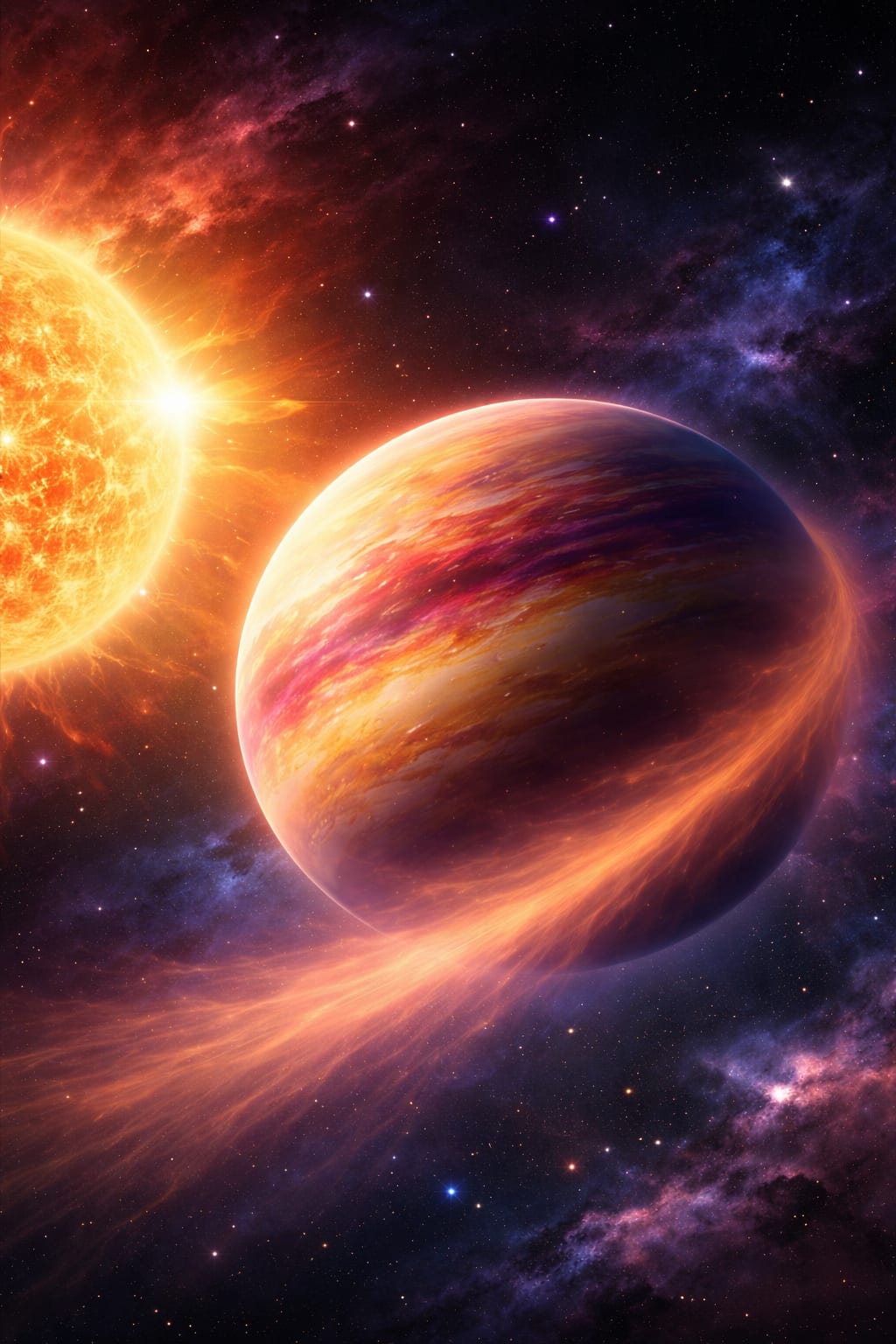
When astronomers first began discovering exoplanets—planets orbiting stars beyond our Solar System—they expected familiar patterns. Some worlds would resemble rocky Earth-like planets, others would look like gas giants similar to Jupiter or Saturn. Instead, the universe delivered a surprise. Among thousands of known exoplanets, scientists found a strange class of worlds that appear abnormally large, swollen far beyond what their mass should allow. These planets look “puffed up,” like overheated balloons floating in space.
What causes a planet to grow so large and fluffy? The answer reveals a complex story of extreme heat, powerful gravity, and exotic physics unlike anything we see close to home.
What Does “Puffed Up” Actually Mean?
In astronomy, a “puffed-up” exoplanet is typically a gas giant with an unusually large radius compared to its mass. Some of these planets have masses similar to Jupiter but radii 50–100 percent larger. This makes them incredibly low-density objects—so light and diffuse that, in theory, they could float in water if such a thing were possible.
Most puffed-up planets belong to a category known as hot Jupiters. These are gas giants that orbit extremely close to their parent stars, often completing a full orbit in just a few days. Their proximity exposes them to conditions far more extreme than anything experienced by planets in our Solar System.
Stellar Heat: The Primary Culprit
The most important factor behind planetary inflation is intense heating from the host star. Hot Jupiters receive enormous amounts of energy, especially in ultraviolet and X-ray wavelengths. This radiation heats the planet’s upper atmosphere to thousands of degrees.
Unlike solid planets, gas giants have no sharp surface boundary. Their atmospheres gradually thin out with altitude. When heated, these gaseous layers expand outward, dramatically increasing the planet’s observed radius. In some extreme cases, the atmosphere becomes so extended that hydrogen gas escapes into space, forming long, comet-like tails trailing behind the planet.
A famous example is WASP-12b, a hot Jupiter so intensely heated that its atmosphere is actively being stripped away by its star.
Internal Heating and Tidal Forces
Stellar radiation alone does not explain every inflated exoplanet. Some planets remain puffed up even when models predict they should have cooled and contracted long ago. This suggests that additional internal heat sources are at work.
One major contributor is tidal heating. If a planet’s orbit is slightly elliptical rather than perfectly circular, the star’s gravity constantly stretches and compresses the planet as it moves closer and farther away. This repetitive deformation generates friction deep inside the planet, releasing heat—similar to how Jupiter’s moon Io becomes volcanically active due to tidal forces.
This internal heating can slow down planetary contraction, keeping the planet bloated for billions of years.
Trapped Heat and Slow Cooling
Young gas giants are naturally large and hot, but over time they cool and shrink as heat escapes into space. For puffed-up exoplanets, this cooling process appears to be unusually inefficient.
One reason may be the composition of their atmospheres. If an atmosphere contains heavy elements, thick clouds, or haze particles, it can trap heat more effectively. These layers act like an insulating blanket, preventing thermal energy from escaping. As a result, the planet retains its youthful, expanded size far longer than expected.
In this sense, some puffed-up planets are not truly “young”—they simply age very slowly.
Magnetic Fields and Exotic Physics
Recent research has introduced even more exotic explanations. Many hot Jupiters have partially ionized atmospheres, meaning their gases carry electric charges. Powerful winds—traveling at thousands of kilometers per hour—move these charged particles through the planet’s magnetic field.
This motion generates electrical currents, which dissipate energy as heat deep within the planet, a process known as ohmic heating. While still under active study, this mechanism offers a compelling explanation for why the most strongly irradiated planets tend to be the most inflated.
Why Puffed-Up Exoplanets Matter
These strange worlds are more than cosmic curiosities. They challenge traditional theories of planet formation and evolution, which were largely built around the relatively calm environment of our Solar System. Puffed-up exoplanets show that planetary structure is deeply influenced by external conditions, especially stellar radiation and gravitational interactions.
They also provide unique laboratories for studying atmospheric physics, heat transport, and magnetic effects under extreme conditions—processes that are impossible to recreate on Earth.
Looking Ahead
With next-generation telescopes like the James Webb Space Telescope, astronomers can now analyze exoplanet atmospheres in unprecedented detail. By measuring temperature profiles, chemical compositions, and atmospheric escape, scientists are getting closer to understanding why some planets inflate while others remain compact.
Ultimately, puffed-up exoplanets remind us of a fundamental truth: the universe is far more inventive than our expectations. Even familiar objects like planets can take on astonishing forms when placed in extraordinary environments, expanding our understanding of what planetary worlds can be.
About the Creator
Keep reading
More stories from Holianyk Ihor and writers in Futurism and other communities.
Worlds on the Edge: Planets Nearly Torn Apart by Their Stars
In the vast diversity of planetary systems across the universe, some worlds exist in a state that seems almost impossible. These are planets that orbit so close to their parent stars that gravity itself threatens to tear them apart. They are not science fiction, nor distant theoretical curiosities. Astronomers have already discovered many such worlds, and they are among the most extreme objects ever observed beyond our Solar System.
By Holianyk Ihorabout 12 hours ago in Futurism
Egypt E-Commerce Market Analysis: Industry Overview, Key Players & Future Outlook
According to IMARC Group's latest research publication, Egypt e-commerce market size reached USD 101.6 Million in 2025. The market is projected to reach USD 202.1 Million by 2034, exhibiting a growth rate of 7.70% during 2026-2034.
By Abhay Rajput6 days ago in Futurism
Cat Food Market: Functional Nutrition, Digestive & Urinary Health & Growth Outlook
According to IMARC Group's latest research publication, The global cat food market size was valued at USD 37.07 Billion in 2024. Looking forward, IMARC Group estimates the market to reach USD 49.80 Billion by 2033, exhibiting a CAGR of 2.99% from 2025-2033
By Michael Richard4 days ago in Futurism


Comments
There are no comments for this story
Be the first to respond and start the conversation.