
Will Artificial Intelligence (AI) take over our jobs?
AI is already here and there's no denying it. So, how long till the AI-powered machines take over our jobs and makes us all redundant? What the future job market will look like? Read on to find out.


I still remember that particular scene from the movie I, Robot, in which Del Spooner, a cop (played by Will Smith) while investigating a murder, goes to meet the CEO of US Robotics (USR).
The discussion eventually shifts to the fact that the company is planning to launch its biggest rollout of robots yet, aiming to have one robot in every home.
Spooner, who is already against robots, offers his idea for one of the commercials run by the company. This is exactly how he conveys it to the CEO. I am quoting the dialogues here:
Spooner: You could see a carpenter making a beautiful chair. And then one of your robots comes in and makes a better chair, twice as fast.
CEO: Mm-hmm.
Spooner (continues): And then you superimpose a message on the screen . . . USR shi**ing on the little guy!
CEO: Ah! I assume your father lost his job to a robot. Maybe you would have simply banned the Internet to keep the libraries open!
Why am I telling you all this?
For one, it is a phenomenal movie (watch it please) and for the other because most professionals, at least those are aware about AI, think that they are the proverbial ‘little guy’ in this scenario. I have to admit that I too shared a similar sentiment till few months ago. But when I researched about it, all my doubts were settled.
Now, while there are those who vouch for all the good that AI is capable of producing, most of the general population is apprehensive of its impact especially on the job market.
Therefore, most of us, including myself, have one of the following questions in their mind:
How will AI impact the job market?
Whether my current skills would become irrelevant after AI starts invading job market significantly?
What should I do to ensure that I remain relevant with respect to future job landscape dominated by AI?
All these questions have one thing in common - an air of uncertainty. If you too have such questions, then you’ll find all of them answered here.
Let's begin with the most fundamental question first.
Why is AI viewed in a bad light?
Here are some reasons which might be responsible:
- Firstly, I think this whole paranoia is partly due to the fact that we as humans tend to be wary of anything new, let alone something as novel & disruptive as AI.
- The second reason in my opinion is the mainstream media, especially the movie industry. A full -blown revolution by AI-powered machines seems to be the only logical conclusion of every movie even remotely related to AI. People are more likely to watch movies than read research papers or go through myth-busting in-depth editorials on AI.
- Thirdly, there is a definitive lack of awareness on AI due to paucity of simple, distilled & comprehensive sources explaining different facets of AI to the general populace.
So, what is the actual truth?
Simple answer – AI, like every new technology, is a mixed bag.
For a long and detailed answer, continue to read on.
Is AI adoption on the rise?
Yes.
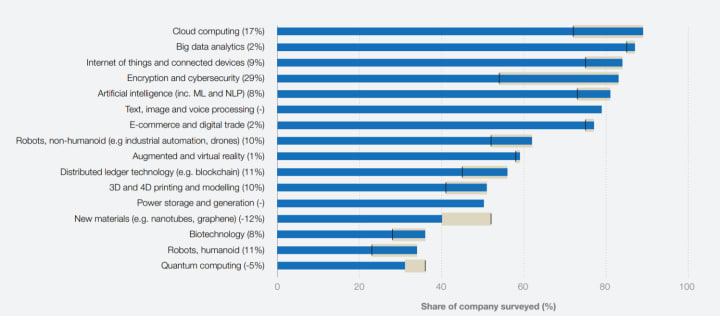
If we are to go by World Economic Forum’s Future of Jobs Report 2020, then Cloud computing, big data and e-commerce remain high priorities of the companies, but there's also been a significant rise in interest for encryption, non-humanoid robots and artificial intelligence.
What are the sectors in which AI is finding greater adaptation?
Artificial intelligence is finding the broadest adaptation among the Digital Information and Communications, Financial Services, Healthcare, and Transportation industries.
Is this broader adaptation of AI a cause of worry?
Well, yes and no, both.
No. We don’t have to worry, because as per WEF’s report, these new technologies are set to drive future growth across industries, as well as to increase the demand for new job roles and skill sets.
On the other hand, there is indeed a cause for worry, because such positive effects may be counter-balanced by workforce disruptions meaning AI will impact workers’ jobs by displacing some tasks performed by humans into the realm of work performed by machines. The extent of disruption will vary depending on a worker’s occupation and skill set
How many jobs will be displaced by 2025 due to advances in technology?
WEF estimates that by 2025, 85 million jobs may be displaced by a shift in the division of labour between humans and machines, while 97 million new roles may emerge that are more adapted to the new division of labour between humans, machines and algorithms.
This is good news because it means that the new technological advances, including AI, would result in net job creation instead of destruction.
Also, till what extent machines will take over human work, can be gauged from the fact that by 2025 the average estimated time spent by humans and machines at work will be at parity based on today's tasks.
Whether the skills I have would become irrelevant after AI starts invading job market significantly?
A far better question would be –
What are the skills which would become redundant in the future by the technological advances, including AI?
As per WEF’s Future of jobs report 2020, jobs expected to be redundant by 2025 are:
- Data entry clerks
- Administrative and executive secretaries
- Accounting, bookkeeping and payroll clerks
- Accountants and auditors
- Assembly and factory workers
- Business services and administration managers
- Client information and customer service workers
- General and operations managers
- Mechanics and machinery repairers
- Material-recording and stock-keeping clerks
What are the skills whose demand is expected to grow?
Leading job positions whose demand is expected to grow are:
- Data analysts and scientists
- AI and machine learning specialists
- Big data specialists
- Digital marketing and strategy specialists
- Process automation specialists
- Business development professionals
- Digital transformation specialists
- Information security analysts
- Software and applications developers
- Internet of things specialists
What are the key skills that will rise in prominence by 2025?
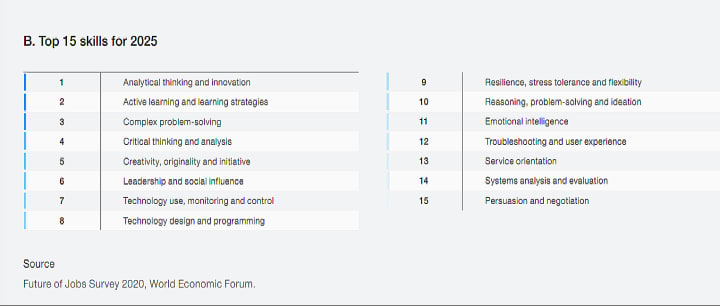
Here is a screenshot taken from WEF’s report itself. It clearly mentions skills which will be rising in prominence in the lead up to 2025:
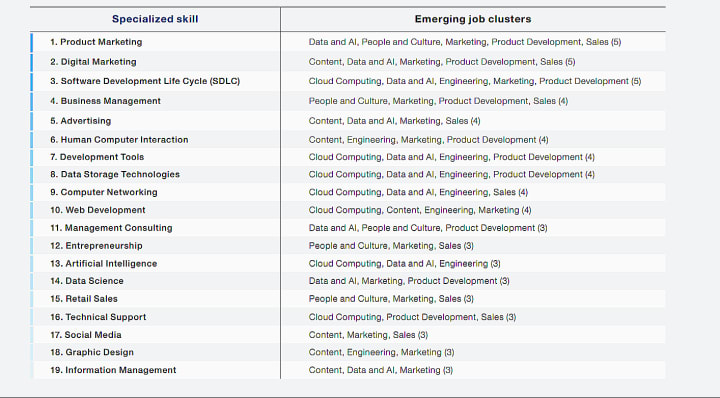
Further, the report mentions top cross-cutting specialized skills of the future. Cross-cutting skills are those skills that are applicable and easily transferable across many occupations and roles.
I hope this article is an eye-opener to those who think AI is bad or something to be afraid of. While I understand that winds of change often carry tides of disruption along with them, but as they say:
Change is the only constant
The sooner we accept this, the sooner we will be able to focus on the important task at hand, which is preparing ourselves for the future by cultivating the skills of the future.
Redundancy or growth?
The choice is yours.
About the Creator
LuV Sharma
I write about the future. Thinking, reading and writing about the infinite possibilities that our future might hold, excites me. It makes me feel alive.
Come, join me on this ride, for a sneak peek into the future.
Keep reading
More stories from writers in Futurism and other communities.



Comments
There are no comments for this story
Be the first to respond and start the conversation.