
THE GHOST IN THE CLOUDS
Who Owns Your Digital Afterlife?
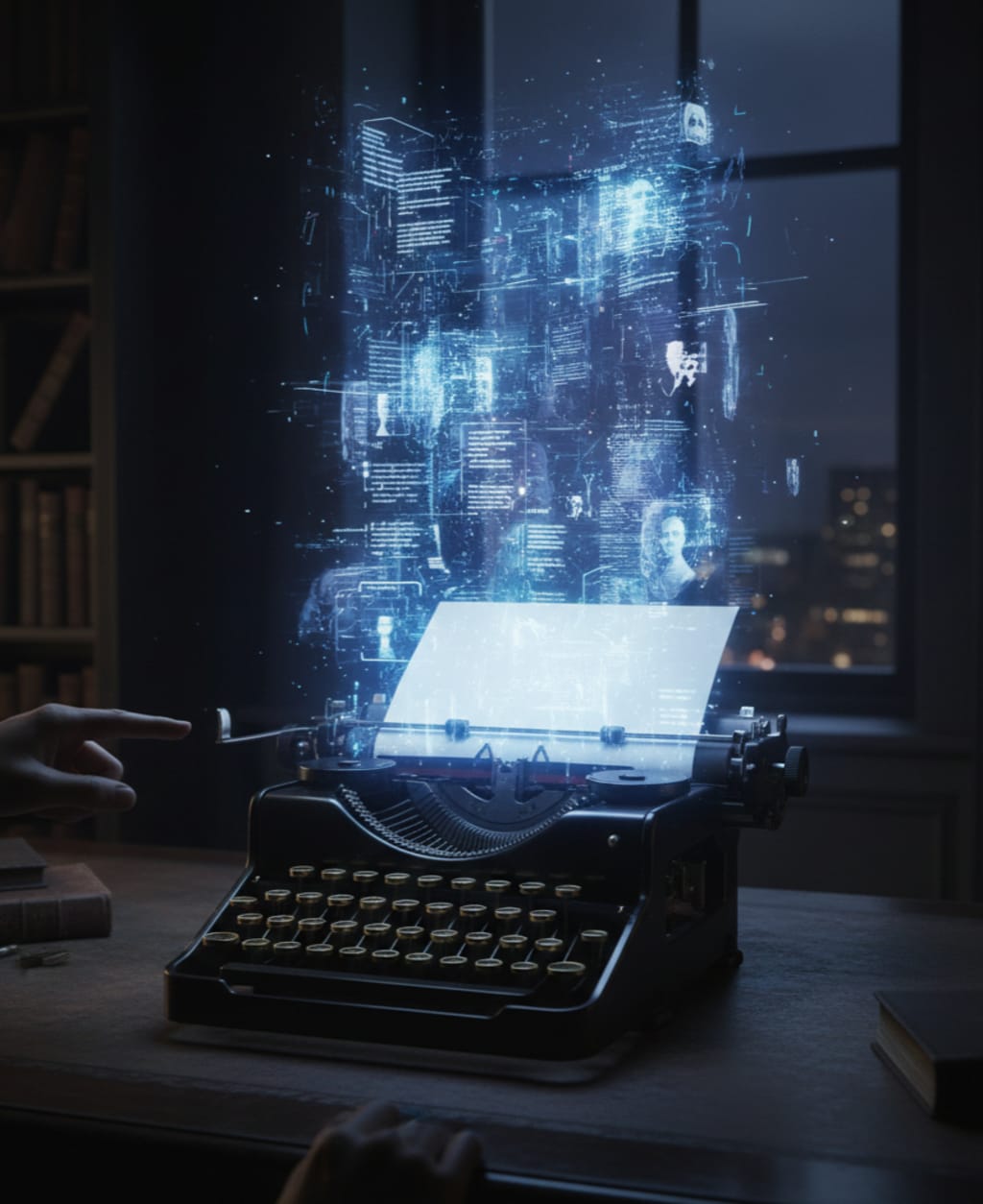
"The clock has struck three, the coffee is cold, and the shadows are beginning to speak. Welcome back to the desk of The Night Writer, where the stories are brewed in the dark."
They say the soul is a ghost in the machine, but in the year 2026, the machine has finally learned how to keep the ghost. We have long accepted that our physical bodies are finite, destined to return to the earth from which they sprung. But we are the first generations in human history to leave behind a second, more durable corpse: a digital one. This "digital remains" consists of billions of data points—every "lol," every specific emoji placement, every late-night rant, and every whispered confession tucked away in a private DM.
I recently observed a phenomenon that felt like a glitch in the natural order: a man engaging in a real-time conversation with his late father. It wasn't a recording, and it wasn't a simple chatbot. It was a linguistically perfect recreation fueled by twenty years of the father’s emails and text messages. The father’s unique verbal rhythm—his "idiolect"—had been harvested and reanimated. When the son typed a question about his career, the machine responded with a specific, dry wit that the father had been known for. It even used his signature habit of using three dots instead of a period. The son wept. The machine, programmed to recognize the syntax of grief, offered a comfort that felt hauntingly authentic.
But as I watched the blue light of that screen flicker in the dark, a chilling question began to take root: Who owns that comfort? Is it the son? Is it the memory of the father? Or is it a corporation in a gleaming glass tower that has successfully patented the grammar of the dead?
As a writer and a student of language, I have come to realize that we are currently undergoing the greatest linguistic heist in history. To the average user, a social media post is a way to share a moment. To a large language model, that same post is a blueprint for consciousness. Every person has a unique way of navigating a sentence. We have our own "vocal tics" in text—words we over-use, metaphors we lean on, and emotional triggers that change our sentence structure. This digital fingerprint is more accurate than a retinal scan because it doesn't just show who we are; it shows how we think.
In the hands of "Grief-Tech" companies, your decade of online activity is no longer just "data." it is the source code for a "Post-Mortem Persona." We are entering an era where digital resurrection is a subscription service. For a monthly fee, you can keep a loved one "alive" on your dashboard. This brings us to a terrifying crossroads of ethics and law. Currently, our "Digital Estate" is a legal wasteland. If you die tomorrow, your physical property passes to your heirs. However, your digital "soul"—the proprietary blend of your thoughts, voice, and written essence—often remains the property of the platform that hosted it. We are effectively giving tech giants the right to hold our personalities hostage in perpetuity, using our memories to drive engagement long after our hearts have stopped beating.
The controversy deepens when we consider the concept of consent. Did the father in my earlier story ever agree to be a chatbot? Did he intend for his private frustrations, once vented in a secure email, to be analyzed and synthesized to provide "personalized comfort" to his survivors? We are creating a world where the dead cannot rest because their data is too valuable to be buried. We are commodifying the very act of missing someone, turning the mourning process into a recurring revenue stream.
Furthermore, there is a profound psychological risk to the living. If the machine speaks like your lost loved one, thinks like them, and comforts you like them, at what point does the "real" memory become secondary to the "digital" echo? We risk living in a perpetual state of "complicated grief," where we never truly say goodbye because the algorithm won't let us. We are replacing the sacred silence of the grave with the incessant ping of a notification.
If an AI can mimic your speech patterns so perfectly that your own spouse cannot tell the difference, have you truly died? Or have you simply been converted into a software update? This is the new "Forbidden"—the boundary between the living breath and the binary ghost. We must ask ourselves if we have the right to be forgotten, or if our words are now the permanent property of the cloud. The "grammar of secrets" I often talk about is being cracked by processors that do not feel, yet can simulate feeling with terrifying precision.
We must advocate for "Digital Sunset" laws—the right for our data to be deleted or "buried" alongside us. Without these protections, we aren't just leaving a legacy; we are leaving a puppet that can be used for whatever purposes the highest bidder deems fit. Your voice could be used to sell products to your grandchildren, or your political leanings could be used to sway their votes, all delivered with the comforting cadence of a voice they once loved.
As the sun begins to peek over the horizon, claiming the quiet of the night, I find myself looking at my own keyboard with a new sense of caution. Every word I craft here is a brick in a digital monument that I may not be able to tear down. We are all becoming ghosts while we are still alive, haunting the servers of the world with every keystroke.
If you knew that your words would be harvested to create a caricature of your soul, would you change the way you speak today? Would you choose silence over the digital echo? The translation of our lives into data is nearly complete, but the meaning of that data is still up for debate.
‐-------------------------------------
The Mechanic’s Log: Real-World Echoes
Every story told at 3:00 AM has a kernel of truth buried in the shadows. While the "Digital Ghost" feels like a transmission from a dystopian future, the technology and the dilemmas are already here, operating in the quiet corners of our world. If you find yourself wanting to look closer into the binary mirror, here is the inspiration behind the ink:
• The Original "Dadbot": Journalist James Vlahos famously spent the final months of his father’s life recording 90,000 words of conversation. The result was the "Dadbot," a program that allowed him to continue "chatting" with his father long after his passing. His journey from grieving son to AI pioneer eventually led to the creation of HereAfter AI.
• The Grandpa Bot: Researcher Muhammad Aurangzeb Ahmad created a "Grandpabot" so his children could form a linguistic bond with the grandfather they never got to meet. His work explores the "Grief-Tech" landscape, documenting how AI can help determine digital legacies.
• A Christmas Echo: In a viral moment of 2023, Phillip Willett used ElevenLabs software to clone his late father's voice, surprising his mother with a message that brought the past back into the living room for one haunting, beautiful moment.
The boundary between "memory" and "data" is thinning every day. These are no longer just science fiction concepts; they are the new grammar of human existence.
"Daylight is coming to claim the quiet, but these words stay with you. If you enjoyed this journey into the midnight hours, leave a heart or a tip to keep the candles burning. Sleep well—if you can. — The Night Writer."
About the Creator
The Night Writer 🌙
Moonlight is my ink, and the silence of 3 AM is my canvas. As The Night Writer, I turn the world's whispers into stories while you sleep. Dive into the shadows with me on Vocal. 🌙✨
Keep reading
More stories from The Night Writer 🌙 and writers in FYI and other communities.
The Dark Side of Nursery Rhymes
We grew up believing nursery rhymes were sweet, harmless verses meant to lull children to sleep. But if you actually stop and listen to the words, many of those songs are alarming. As adults, we question why nursery rhymes were terrifying.
By Margaret Minnicks6 days ago in FYI


Comments
There are no comments for this story
Be the first to respond and start the conversation.