
The roundest object in the world
Surely many of you have asked the question: what, what is the roundest object? Please watch the video below to find out!

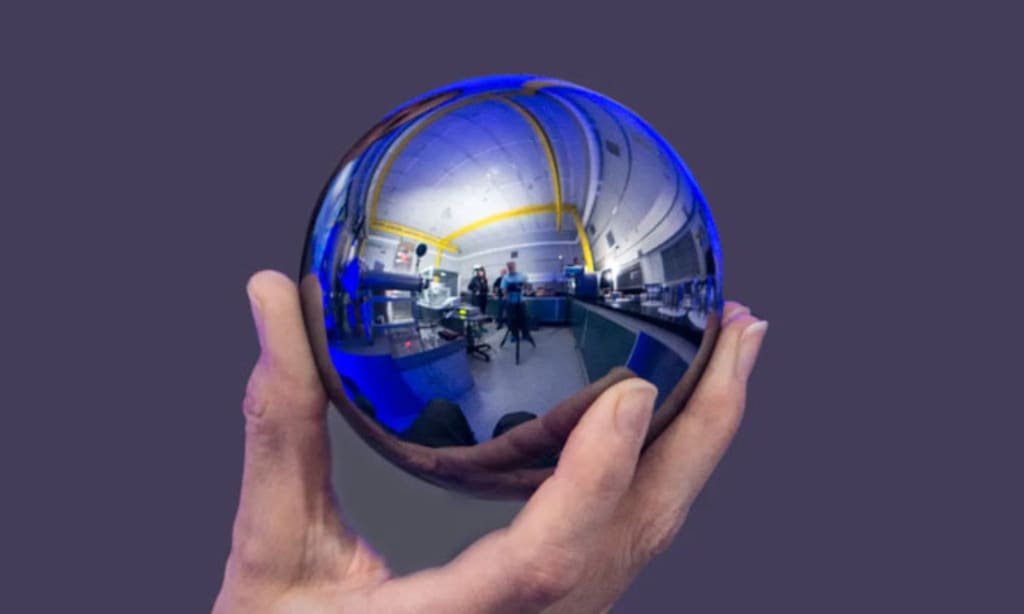
Surely many of you have asked the question: what, what is the roundest object? Please watch the video below to find out!
The silicon spheres used to define the kilogram are so smooth that if they were as large as Earth, their highest and lowest points would be only a few meters apart.
Scattered in facilities far apart in Australia, the US, Germany, Japan... is a collection of 7 carefully polished and strictly protected spheres. These are the silicon spheres of the International Avogadro Project . They were manufactured at the Australian Commonwealth Scientific and Industrial Research Organization (CSIRO) with extremely high precision and are considered the roundest objects in the world.
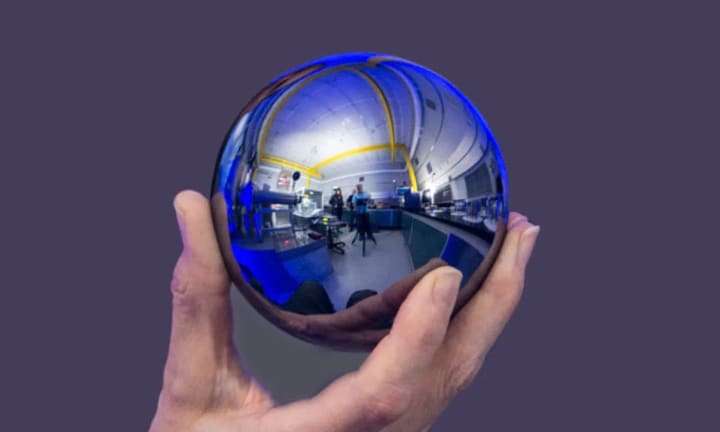
A silicon sphere similar to those used in the measurement of Avogadro's constant.
Their surfaces are so smooth that if magnified to the size of Earth, the distance between the tallest mountain and the deepest ocean would be just 3 to 5 meters, according to the National Institute of Standards and Technology (NIST), one of the organizations involved in the International Avogadro Project. Optical interferometers have allowed researchers to measure the spheres’ widths to nanometer precision. Each sphere costs about $3.2 million and is handcrafted by skilled lens makers.
So what is the purpose of these spheres? The International Avogadro Project aims to use perfect silicon spheres to precisely determine the value of the Avogadro constant (a fundamental physical constant), according to the Powerhouse Museum , which has housed a prototype sphere since 2016. Specifically, the goal is to redefine the kilogram based on the Avogadro constant.
Back in the 18th century, when the metric system was invented, the first definitions were based on the natural world. The meter was one-ten-millionth of the distance between the North Pole and the equator, measured in a straight line through Paris. The liter was the volume of 1/1,000m3 of water, measured at the melting point of ice. The kilogram was the mass of that amount of water in a vacuum.
After coming up with these definitions, the French Academy of Sciences began to formalize them. In 1799, they used physical objects to illustrate the units of measure, including a one-kilogram cylinder called Le Grand K or Big K .
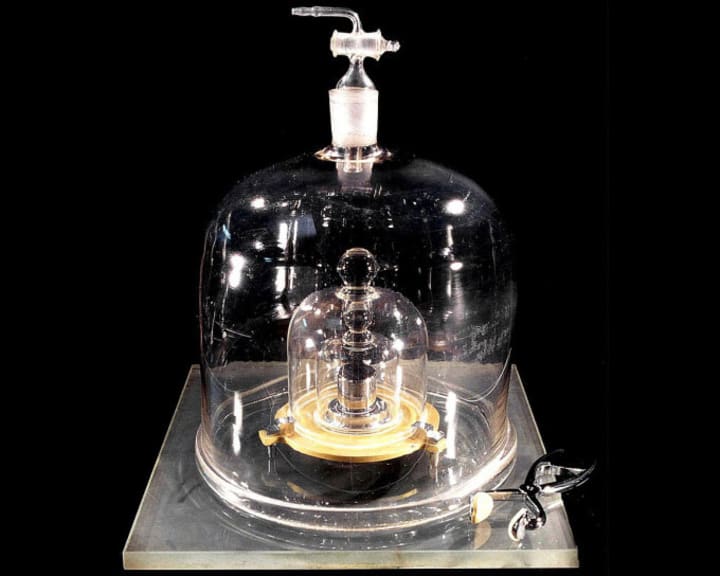
The Le Grand K block is preserved in Paris.
Over time, these measurements became universally accepted. But a serious problem was that they were based entirely on physical objects. The circumference of the Earth seemed to be a constant to the people who developed the system, but it was constantly changing. In fact, the system was also flawed from the start, because the scientists who were responsible for calculating the length made a 0.2 mm error and no one ever corrected the final figure.
For this and other reasons, in the 20th century, people began to advocate redefining units in terms of more precise natural constants. Among them, the mole - the unit used to measure the amount of substance - was defined as the amount of substance of 6.02214076 x 10²³ elementary entities, this is also known as Avogadro's constant .
In 2005, at the 94th meeting of the International Committee for Weights and Measures, experts recommended that the kilogram be redefined in terms of a universal constant. The committee decided that the best option was to use the Planck constant.
But some scientists have a different idea. Since the current definition of Avogadro's constant depends on the mass of an object, they think it might be possible to exploit this relationship in reverse. But first, they need to define the constant with greater precision—the relative error would be just 20 parts per billion—so that a new Avogadro-based definition of the kilogram could compete in accuracy and reliability with the current standard.
Basically, the plan is to make an object from a precise amount of a known substance, and then define the kilogram accordingly. This object is a silicon sphere, which has many advantages over the Big K. Losing or damaging the silicon spheres does not affect the definition of the kilogram, because the kilogram is defined not by a physical object but by a concept.
When the definition of an international base unit depends on counting the number of atoms in an object, calculations have to be extremely precise. That's why spheres are so round. "A sphere was chosen as the ideal shape because it has no corners or edges (to avoid chipping or wear), and if a sphere were made perfectly enough, its volume could be calculated from a single parameter (the diameter) ," the Powerhouse Museum explains.
Silicon, meanwhile, was chosen because processes for producing and manipulating ultra-high-purity silicon were already well established. Silicon also offered scientists many advantages: The mass of the silicon-28 isotope was known, and the spatial parameters of the crystal lattice were standardized, allowing for calculations of the number of atoms in the sphere.
Although the International Committee for Weights and Measures chose the Planck constant as the basis for redefining the kilogram, other constants of nature could also be used, at least to help check the accuracy of the Planck definition, according to NIST.
About the Creator
HK Decor
Telling stories my heart needs to tell <3 life is a journey, not a competition
If you like what you read, feel free to leave a tip,I would love some feedback
https://s.shopee.vn/7fFUMxnnBx?share_channel_code=8
A Failed Artist, A Disillusioned Poet, An Underpaid Game Show Host
I took my son and niece to Gori, a small town in Georgia where Joseph Stalin was born. They talked me into visiting the Stalin's Museum, the largest in the post-Soviet space. I had resisted going there because I just can't stand the monster and know enough about him, or so I thought.
By Lana V Lynx29 days ago in FYI
Off the Book
It ended like every other stupid idea. Badly, and alone. I’m researching digital confession ethics, he said. A tech ethicist. He gestured at floating data I couldn’t see then pulled out a physical notebook. Actual paper, fountain pen. He held it up like he was showing me scripture.
By Nicky Frankly4 days ago in Fiction



Comments
There are no comments for this story
Be the first to respond and start the conversation.