


Is the zine scene alive and well in the digital age? You bet it is. In fact, it’s enjoying a kind of revival right now thanks, in part, to a traveling art show called Copy Machine Manifestos: Artists Who Make Zines. Created and curated by two art historians from New York’s Brooklyn Museum, it’s been touring across the United States and Canada billed as the first ever exhibition dedicated to the rich history of North American zines. The exhibition included photographs, videos and original pages from the who’s who of the zine world. I saw it at my local art gallery and it blew me away. It’s gone now and that’s too bad because it concisely summed up the contribution zines have made to our cultural history. I learned a lot.
I learned, for example, that zines originated as fanmags for the sci-fi crowd in the 1930’s. Fans would take pieces of paper, fill them with drawings and content, photocopy the pages and then staple them together to create a mini magazine, hence the term zine. Then they’d be handed out to friends and fellow fans.
By the 1940’s, comic book aficionados got in on the action and by the 1960’s when Aids was endemic, those creatives suffering with the disease turned to zines for support and information. That’s how it was in the pre-Internet days; zines were a cheap and easy DIY way to connect with like-minded people, united in a common interest. 1960’s zines, cheaply made, crude and often pornographic had an underground vibe to them. They still do.
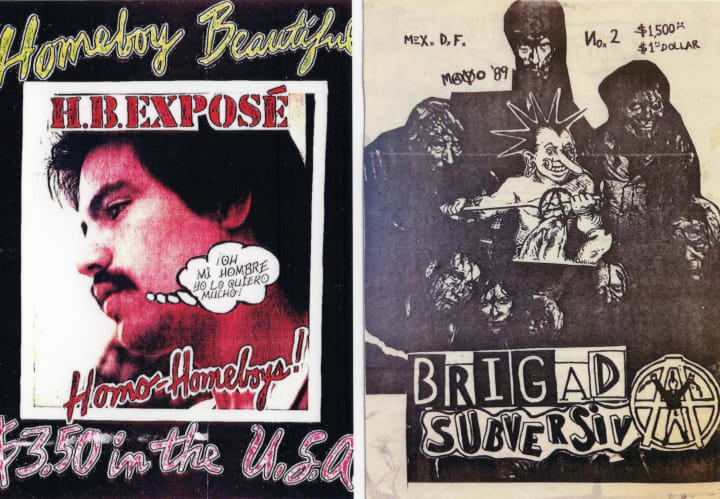
Vietnam. Civil Rights. Punk Rock. Feminism. These were the issues zines tackled in the last half of the twentieth century. Visual artists, drawn by the no-holds barred appeal of self publishing also joined in. It was the era of grunge and gays expressed in collage, cut and paste clip art, hand drawn text and a disdain for layout which in a bizarre way led to its own distinctive interpretation of negative and positive space. Zines gave creatives a chance to experiment with style and content and Copy Machine Manifestos didn’t hold back honoring those creatives that cut their teeth on these early mags.
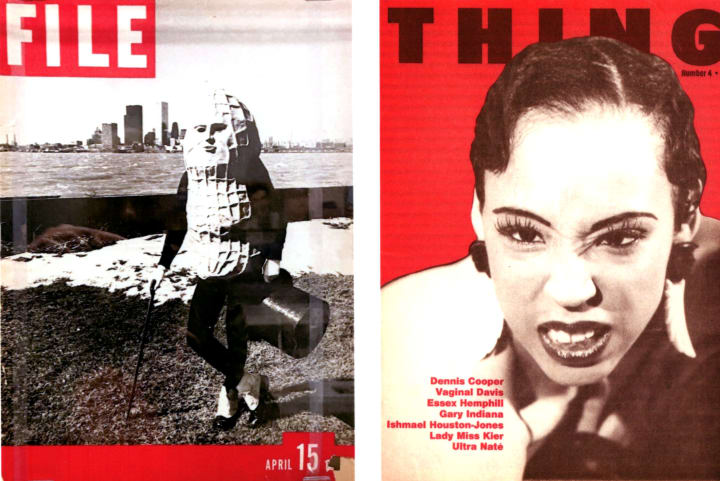
Early pioneers included performance artist Vaginal Davis, who gave voice to the queer community by telling their stories no matter how disturbing and General Idea, a trio of conceptual artists who made fun of blind consumerism though performance and parody like dressing up as Mr. Peanut for the cover of File, a riff on Life magazine.
People like artist Raymond Pettibon who was remembered for his stark black-and-white drawings reminiscent of caricaturist William Hogarth. Pettibon later designed the cover of a 1990 Sonic Youth album Goo and painter Amy Sillman who was trained in fine art with an MFA from New York’s Bard College. She filled her early zines with free-form text and line drawings before going on to exhibit her abstract paintings at MOMA where her work is part of the permanent collection.
And then there was Riot Grrrl, the subculture that grew out of the feminist movement of the 1990’s. It addressed the issues of sexism, domestic abuse and female empowerment through women-led bands Bikini Kill, Bratmobile, Slant 6 and others and the zines they created.
Zines became a voice for the marginalized and overlooked in the1970’s , ‘80’s and ‘90’s, providing an alternate take on pop art, music and politics. By 1993, an estimated 40,000 zines were in circulation throughout the States and Canada.

Zines are either cheeky or subversive depending upon your point of view but one thing’s for sure, zines are no longer outliers. Dare I say it? They’re almost respectable. For example, the nation’s libraries started building their zine collections in the early 2000’s. Sure enough, a visit to my local library revealed shelves full of early zines, and some newer ones too, on everything from social justice issues to movie reviews.
Zine fests are also common. In my neck of the woods it’s the annual Zine Harvest, an opportunity to meet the creators, check out their latest editions and perhaps buy a few zines. Inspired by the Copy Machine Manifestos show, I got to Zine Harvest before the general public, talked to some vendors and bought a ten-page collection of drawings from a Gen Z art student.
“I’m taking animation at Emily Carr,” the artist said, referring to the local art school that turns out painters and sculptors. Her zine was a carryover from her studies, a natural outlet for her creativity. Her drawings were printed on glossy paper, a far cry from the cheap mimeographs and photocopies of yesteryear. A couple of zines were professionally bound, no staple guns involved. Wow, how times have changed. Modern zines are more diverse offering a wide range of topics than in the earlier days. And distribution has expanded too. Zines for purchase are more readily available at community centers, record stores and what we used to call head shops. Enterprising zinesters even solicit purchases on line.
It's been argued platforms like Instagram and TikTok are the zines of today but I disagree. Social media is great for communicating but it’s not the same. Zines are tactile. You can pick up one up and flip through the pages. The physical interface fosters a more intimate connection with the creator. Emily, the art student I bought my zine from, told me, as a creator, she finds instant freedom in picking up pen and paper, free from thinking about those pesky algorithms which may or may not drive readers to her artwork. She just creates. It’s instantaneous. Today’s zinesters may use the internet to grab an image or two but, for me, a true zine ends up on paper.
Copy Machine Manifestos: Artists Who Make Zines helped me understand the zine scene. As the exhibition pointed out, zines have a long tradition of speaking your mind especially in times of upheaval and censorship. It's an honorable tradition. The underground spirit lives on and given the state of the world right now I suspect zines are going to be around for quite a while.
About the Creator
John Thomson
Former television news and current affairs producer now turned writer. Thanks Spell Check. Visit my web page at https://woodfall.journoportfolio.com
Keep reading
More stories from John Thomson and writers in FYI and other communities.
Unsinkable: The Aircraft Carrier Made Out of Ice
It looked good on paper, a WWII aircraft carrier 2,000 feet long and 300 feet wide, three times larger than any other carrier at the time and capable of carrying 200 Spitfire fighters or 100 Mosquito fighter-bombers. Its size and bulk would make it impervious to bombs or torpedoes rendering it virtually unsinkable. And it would be made out of ice.
By John Thomson4 years ago in FYI
A Failed Artist, A Disillusioned Poet, An Underpaid Game Show Host
I took my son and niece to Gori, a small town in Georgia where Joseph Stalin was born. They talked me into visiting the Stalin's Museum, the largest in the post-Soviet space. I had resisted going there because I just can't stand the monster and know enough about him, or so I thought.
By Lana V Lynx29 days ago in FYI
Microneedling Explained:Collagen Stimulation and Real Results
Introduction to Microneedling Overview of the Procedure Microneedling, also known as collagen induction therapy, is a minimally invasive cosmetic procedure designed to rejuvenate the skin. It involves the use of a device equipped with fine needles that create tiny, controlled punctures in the skin's surface. These micro-injuries trigger the body's natural wound healing process, stimulating the production of collagen and elastin, which are essential proteins for maintaining skin elasticity and firmness.
By Adrian Lawrencea day ago in FYI


Comments (1)
I love the idea of Zines!! How to get them to the public though. Yes, social media falls short but in holding people's attention it is the main avenue. A resurgence in print would be such a welcome thing.