
Book Review: "How Proust Can Change Your Life" by Alain de Botton
5/5 - a fantastic little book of great ways to appreciate life's smaller habits for longer...

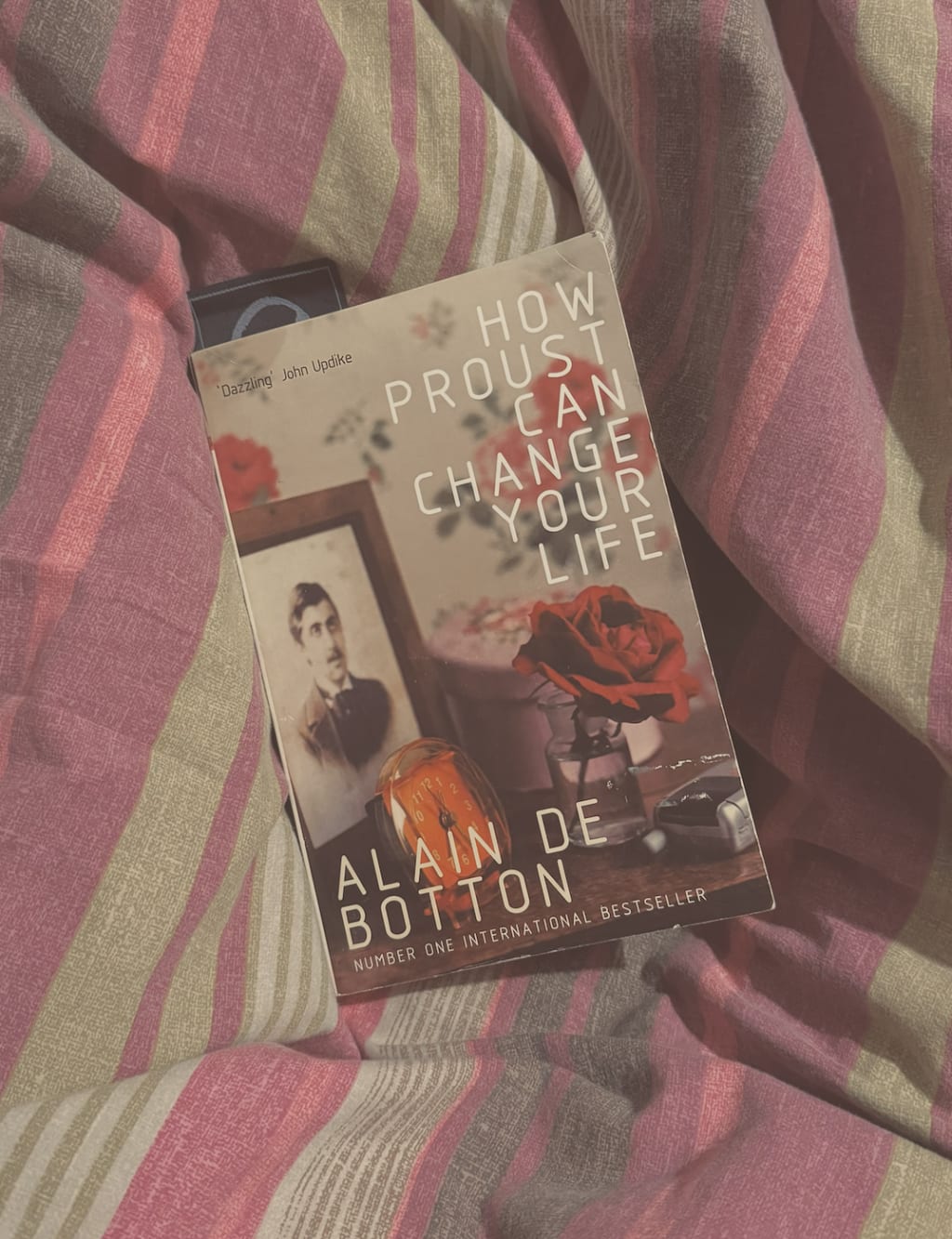
A while ago, I read A Therapeutic Journey by Alain de Botton and reviewed the writing style as being something to be admired. In his book How Proust Can Change Your Life, he details the importance of reading the works of one of the greatest writers of the modern age. We get insights into the strange writer's own life, the details of exercise from his own father and the way in which Marcel Proust himself lived life unconventionally - going through money like water. As we move through the book, there are hints and helper points when it comes to reading Proust - what we should be looking for and how we are meant to find ourselves within his works are just as important as the story we are reading.
First, we must accept that In Search of Lost Time is as much a self-explorative text as it is a piece of important literature. Through the little observations on human nature in the text, we are forced to confront our own little habits and so, this book's author (who is also known for his therapy ideas) draws this parallel between Proust's novel and modern mindfulness practices. The book asks us to commit to acts of emotional intelligence as we attempt to understand Proust's relations with the people around him throughout the story. One the reasons for this is that Proust’s characters model a heightened sensitivity to detail in food, art, conversation, and memory. Our author argues that cultivating this type of attention enhances life, making ordinary experiences richer and more fulfilling. I am inclined to agree.
Alain de Botton makes a great argument about how In Search of Lost Time contrasts to modern life. Modern life advertises novelty and chases something new each time, yet Proust's novel urges us to pay attention to long-drawn out and often very slow scenes. Modern life's want for novelty often leads to shallow experiences that can be, after the fact, regrettably dull. Thus, we need something new next time and the time after that and so on and so forth. Appreciation requires time and deliberately slowing yourself down: noticing the texture of a meal, the nuance of a friend’s expression, or the emotions of music. The practice of attention is ethical and psychological: it strengthens empathy, deepens enjoyment, and cultivates gratitude for life’s often-overlooked moments.
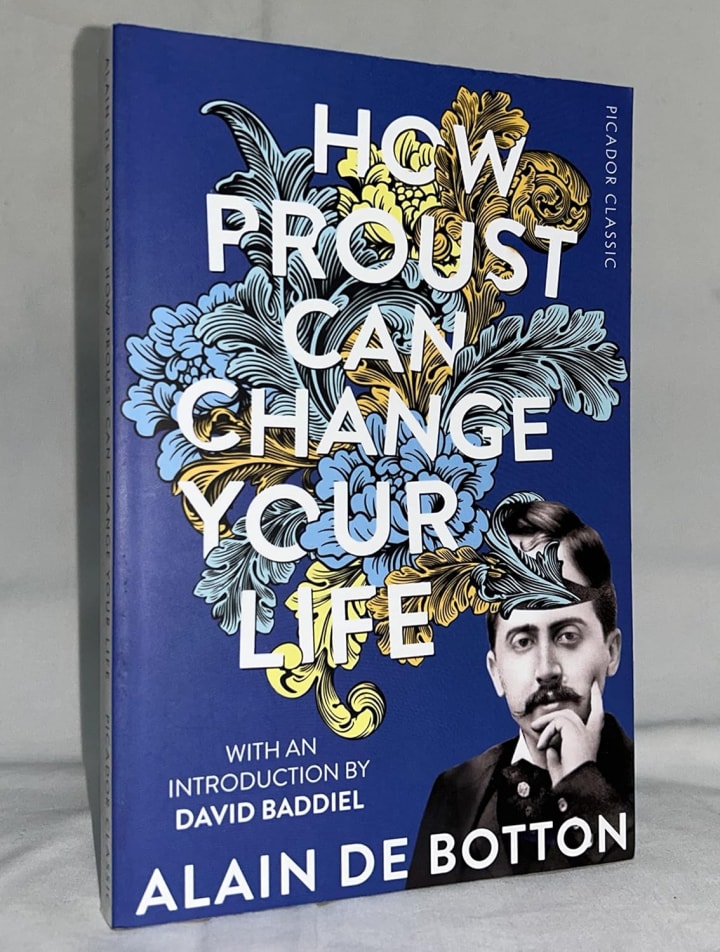
I honestly think that this particular argument is more important now than it was when de Botton's book was first written. Now that there are so many distractions in which people are searching for the next hit of dopamine, we seem to have lost the art of slowing down and appreciating things. I would say if you would like to relearn how to, then this book is most likely aimed at you.
Anyone who has read any Proust knows that he exposes the ways people manipulate appearances to gain esteem, mask inadequacies, or assert superiority. He demonstrates the advantages of emotional intelligence and honesty, understanding that there is a universality behind social anxieties and pressures, something we can all be seen to have committed to in our lifetimes. If we acknowledge our responsibilities for authenticity whilst also accepting that we fall prey to some of these social pressures, we can not only live more like ourselves but we also prevent our personas unecessary sufferings and obstacles. Pretending to be someone you aren't is exhausting for anyone and is a short-term solution to a wider societal problem.
Proust definitely viewed solitude as the ultimate experience of human beings - one that allows us to reflect, learn and get better at recognising ourselves. Solitude is not isolation, but a space to develop one’s inner life and refine judgment. Proust's own solitude, de Botton states, allowed him to cultivate an emotional resilience yes, but it also allowed him to write a work like In Search of Lost Time. Therefore, we can assume that solitude is not only necessary in order for us to pursue creative talents, but it is also a skill with a purpose - a resource that does not mean failure. In our modern world, solitude often sounds like we have failed in social endeavours - but social endeavours aren't even half of our world. They matter less than we are lead to believe by the media.
Honestly, I would simply say read this book. It is short, it has some great points that matter more and more with each passing day and it teaches us about the lessons Proust littered into his best work. With slow appreciation, with dedication and with passions for literature and the arts - we can hopefully relearn something that is growing lost with our modern, more short-form-driven lives.
About the Creator
Annie Kapur
I am:
🙋🏽♀️ Annie
📚 Avid Reader
📝 Reviewer and Commentator
🎓 Post-Grad Millennial (M.A)
***
I have:
📖 280K+ reads on Vocal
🫶🏼 Love for reading & research
🦋/X @AnnieWithBooks
***
🏡 UK
Keep reading
More stories from Annie Kapur and writers in Geeks and other communities.
Book Review: "The Dark Side of Genius" by Donald Spoto
There is a certain fear in imprisonment that Alfred Hitchcock surely had, Donald Spoto observes. There is a certain fear of being isolated that was explored in his films and of course, there was something about autobiography that his movies were observed for. Loner, outsider, stranger - Sir Alfred Hitchcock was a man of many sides and his darker parts were worked into the storylines of his motion pictures. Donald Spoto explores the history of Alfred Hitchcock, opening with him receiving a lifetime achievement award and moving all the way backwards into his early life. Each step of the way, we get clues as to how the master of suspense turned out to be such a genius, yet also so dark and awkward in persona.
By Annie Kapura day ago in Geeks
Sudan’s Military Claims Breakthrough After Lifting RSF Siege in Kordofan
Sudan’s enduring civil war — now in its third year — has been marked by devastating sieges, shifting frontlines, and immense human suffering. On January 26, 2026, the Sudanese Armed Forces (SAF) announced a significant military development: they have broken the nearly two‑year siege imposed by the paramilitary Rapid Support Forces (RSF) on the strategically located town of Dilling in South Kordofan. According to the military, this achievement also means regaining control over major supply routes that had been choked off by the RSF in its attempt to dominate the region. Dilling sits at the heart of South Kordofan and once served as a vital connector between the state’s capital, Kadugli, and key cities to the north and west. By holding Dilling, the RSF had effectively isolated large parts of the region, constricting the flow of food, medicine, and other essential goods and deepening a severe humanitarian crisis. But Sudan’s military says it has reopened the main Dilling road, allowing relief supplies and trade to begin flowing once again. In an official statement, the SAF declared that its forces had inflicted “heavy losses” on the RSF and its allies during the operation to retake access to the town. The military described its advance as a “successful operation” and vowed to continue pressing its campaign until stability is restored across the country. Despite these claims, there has been no immediate response from the RSF — a group that has been in open conflict with the military since April 2023, when a power struggle between the two factions erupted into widespread violence across Sudan. Background: A War That Has Reshaped Sudan Sudan’s conflict began as a clash over control of the state between the established army and the RSF — a powerful paramilitary force originally formed from militia units. What started as a dispute within the Sudanese power structure soon escalated into a full‑blown civil war, engulfing multiple regions, displacing millions, and creating profound humanitarian challenges. International agencies estimate that tens of thousands of people have lost their lives, though exact figures vary, and more than 14 million people have been forced from their homes. The fighting has not been limited to South Kordofan. Other regions — including Darfur and parts of central Sudan — have seen intense clashes, siege operations, and shifting territorial control. Notably, the RSF took control of el‑Fasher in North Darfur in October 2025, a territory that had long been a bastion of resistance against its expansion. Against this backdrop, breaking the siege of Dilling represents a strategic victory for the Sudanese army. The reopening of major supply lines may enable deeper military advances into Kordofan and potentially disrupt RSF operations in other strongholds. Analysts also suggest that this development could weaken the RSF’s ability to project influence across key transportation routes in central and southern Sudan. What This Means for Civilians For the residents of Dilling and surrounding districts, the siege’s end could bring much‑needed relief. During the period of isolation, shortages of food, clean water, and medical supplies were severe. While independent verification is limited due to the conflict conditions, humanitarian groups have reported that hunger and malnutrition were widespread, and many families faced extreme hardship. The lifting of the siege could allow for the delivery of food, medicines, and other critical supplies — a lifeline that had been cut off for months. Yet, the challenges remain enormous. Even with the route open, securing safe and sustained humanitarian access requires cooperation among warring parties and protections for aid workers — neither of which are guaranteed in Sudan’s fragmented and violent environment. International observers caution that improvements on the ground may be slow and uneven, especially as fighting continues elsewhere in the country. Broader Implications for the Conflict The battle for Dilling underscores a broader strategic contest in Sudan’s protracted war. Control over infrastructure, roads, and supply routes has been as consequential as territorial gains in urban centers. For the military, regaining Dilling strengthens logistical capabilities and could pave the way for further operations into RSF‑held areas. For the RSF, the loss signals pressure on its hold over critical regions and potential vulnerabilities in its supply and communication networks. It also reflects a wider pattern of shifting fortunes. In recent months, both sides have had notable gains and setbacks. The RSF’s capture of key positions in West Kordofan and other zones demonstrated its continued capabilities, even as the SAF has pursued aggressive counter‑offensives on multiple fronts. The war’s complex alliances — including splinter factions and regional political interests — make any long‑term prediction difficult. The conflict is also drawing increased international concern. Humanitarian agencies have repeatedly highlighted the urgent need for peace to prevent further catastrophe. Donors, mediators, and neighbouring states are watching developments closely, though substantive breakthroughs in negotiations have been elusive. Looking Ahead As Sudan marks this new moment in its long conflict, the immediate focus will be on whether the opening of Dilling’s supply lines can translate into lasting improvements for civilians and whether the SAF can sustain its recent momentum on the battlefield. For now, the announcement has been cast by Sudan’s military as a symbolic and practical victory — one that could have far‑reaching implications for the future of the war and the lives of millions caught in it.
By Saboor Brohi 6 days ago in Geeks




Comments (1)
I knew you'd like it!