
Cost to Develop an MVP in 2026: Real Pricing, Timelines, and Hidden Expenses
Discover the real cost to develop an MVP in 2026, including pricing ranges, AI integration expenses, timelines, and hidden startup development costs.

Building a product in 2026 is hella different than it was a few years ago. You’d think with all the AI automation, the cost to develop mvp would have dropped to pennies. It hasn't. Not even close.
I reckon you're probably staring at a spreadsheet right now, wondering why one dev agency quoted you $30,000 and another said $150,000. It’s enough to make anyone feel proper knackered before they even start.
Thing is, the "minimum" in Minimum Viable Product has changed. In 2026, users won't touch a "bare-bones" app. They expect AI that actually works, slick animations, and instant load times. It's a tough crowd, mate.
If you're fixin' to launch something this year, you need the real numbers. No fluff, no "it depends" without an explanation. Let's look at what is actually draining bank accounts in the current market.
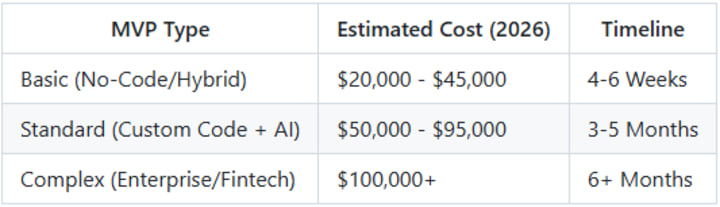
Real talk: the baseline has shifted. According to recent data, a standard MVP in 2026 typically starts around $40,000 for something basic. If you want complexity, you're looking at much more. You can verify these ranges at GoodFirms where they track global development averages.
The "Sticker Shock" of 2026 development
It’s easy to get stoked about an idea until the first invoice hits. Most founders forget that they aren't just paying for code. You’re paying for a product that doesn't crash the second three people log in.
I’ve seen folks try to build a "Uber for X" with $5,000. That’s all hat and no cattle, as they say in Texas. You might get a prototype, but you won't get a product people trust.
Teams working in this space, like those at app development company california handle these complexities daily. They see the gap between "I have an idea" and "I have a scalable business."
Why the "V" in MVP is getting more expensive
Viability is a moving goalpost. Back in 2020, a simple CRUD app was enough. Now? If your app doesn't have a natural language interface, people think it’s a relic from the stone age.
This "AI tax" is real. Integrating a custom-tuned LLM or an agentic workflow adds layers of cost. It’s not just the API calls, it’s the orchestration. Expect that to add at least $15,000 to your bill.
The 2026 Price List: What you're actually paying for
Let's break it down. You can't just throw money at a screen and hope an app pops out. The cost to develop mvp is split across several specific buckets that most founders ignore until it's too late.
If you're building a simple SaaS tool, you might get away with a leaner budget. But if you’re doing something with hardware or heavy data processing, hold onto your hat. It’s going to be a ride.
Design is no longer optional
I used to think "good enough" design was fine. I was wrong. In 2026, if your UI looks like a template, users bounce. They want "vibes." They want "aesthetics." That costs money.
A decent UI/UX designer for an MVP will set you back $8,000 to $15,000. This is based on industry standards for high-fidelity prototyping and user testing. You can see how these design phases impact budgets at Clutch.
The backend is where the money hides
Get this: the stuff users don't see is usually the most expensive. Security, database architecture, and server-side logic are the backbone of your product. If you skimp here, you're dodgy, simple as that.
Scaling a backend to handle 10,000 users is a different beast than 10 users. Most MVPs fail because they didn't invest in a startup development costs strategy that included proper infrastructure from day one.
Outsourcing vs. In-house: The 2026 Reality Check
You’ve got two paths. You can hire a team in-house and deal with the "California" prices, or you can go offshore and hope the time zone difference doesn't kill your soul.
Both have pros and cons. I’ve done both. Hiring a local dev in London or NYC will cost you $150/hr minimum. That's a quick way to burn through your seed round. No cap.
Outsourcing to regions like Eastern Europe or India is still the go-to for many. Rates there hover between $30 and $60 per hour for high-quality work. This data is backed by the Accelerance 2024 Global Outsourcing Report, which remains a benchmark for 2026 pricing.
The hidden costs of "cheap" development
But wait, there's a catch. Going too cheap is a trap. I once hired a "bargain" team and spent three times the original price just fixing their spaghetti code. It was a nightmare.
Communication is the biggest hidden cost. If you're spending 10 hours a week explaining basic logic because of a language barrier, your "cheap" hourly rate just doubled. Factor that in before you sign anything.
Managing the hybrid team model
The most successful startups in 2026 use a hybrid model. A local Product Manager or CTO, and an offshore dev team. It’s the sweet spot for software development pricing that doesn't break the bank.
It keeps the strategy close to home while the heavy lifting happens where it's more affordable. This approach helps keep the cost to develop mvp under six figures for most mid-tier products.
"If you are not embarrassed by the first version of your product, you’ve launched too late." — Reid Hoffman, Founder of LinkedIn, Masters of Scale
The Tech Stack: Choosing your weapon wisely
What you build with determines how much you pay. In 2026, everyone is talking about "Agentic Stacks." But do you really need a specialized vector database for a glorified to-do list? Probably not.
Sticking to proven tech like React Native or Flutter for mobile and Node.js or Python for the backend is usually the smartest move. It’s easier to find developers, and the community support is massive.
Why no-code is finally growing up
I used to laugh at no-code. I thought it was for hobbyists. In 2026, no-code tools like Bubble and FlutterFlow are actually viable for MVPs. You can get to market in weeks instead of months.
The cost to develop mvp using no-code can be as low as $15,000. However, the "exit cost" is high. Eventually, you’ll need to rebuild it in custom code once you scale. It’s a trade-off.
AI Integration: The 2026 Must-Have
If you don't have AI in your MVP today, you're basically building a typewriter. But "AI" is a broad term. Are you just hitting an OpenAI API, or are you training a custom model? The price difference is huge.
Simple API integration might cost you a few thousand. Custom fine-tuning? You're looking at $20,000 to $50,000 just for the data prep and compute time. This is a massive factor in startup development costs now.
💡 Naval Ravikant (@naval): "Code and media are permissionless leverage. They are the leverage behind the newly rich. You can create software and media that works for you while you sleep." — Naval.com
Feature Creep: The Silent Budget Killer
You start with a simple idea. Then you think, "Wouldn't it be cool if it also did X?" Then "Y" sounds good too. Suddenly, your $40,000 MVP is a $120,000 monster that will never see the light of day.
Scope creep is the reason 80% of projects go over budget. The Project Management Institute (PMI) highlights this as the number one threat to project success. You can see their findings on scope management at PMI.
How to say "No" to yourself
You have to be ruthless. If a feature isn't solving the core problem, it doesn't belong in the MVP. Save it for Version 2.0. Your bank account will thank you.
I find it helpful to use a "Must-Have vs. Nice-to-Have" list. If I can't explain why a feature is "Must-Have" in ten seconds, it gets the axe. It’s the only way to keep the cost to develop mvp manageable.
The importance of a Product Discovery phase
Before you write a single line of code, spend $5,000 on discovery. It sounds counterintuitive to spend money to save money, but it works. Mapping out the logic early prevents expensive rewrites later.
Most agencies in 2026 won't even start a project without this phase. It’s where the prototype development happens, and it’s where you find the flaws in your logic before they become $50,000 mistakes.
"The goal of an MVP is to learn, not to build a finished product. Most founders spend way too much time building and not enough time talking to users." — Michael Seibel, Managing Director at Y Combinator, Y Combinator Blog
The 2026 and Beyond Outlook: Where is the market going?
Looking ahead to 2027, the way we build MVPs is shifting toward "Small Language Models" and highly specialized AI agents. We’re moving away from massive, generalized platforms toward niche, ultra-efficient tools that do one thing perfectly. Data from Gartner suggests that by 2027, AI software spending will reach nearly $300 billion, with a significant chunk going toward these specialized integrations. You can check the forecast at Gartner. This means the cost to develop mvp might actually stabilize as AI-assisted coding becomes more mainstream, but the demand for quality data and "human-in-the-loop" oversight will keep the expert rates high.
💡 Andrew Chen (@andrewchen): "The biggest mistake in the MVP stage is building for the 'average' user. In the beginning, you need to build for the obsessive, niche user who will tolerate your bugs." — The Cold Start Problem
Final thoughts on your 2026 budget
At the end of the day, the cost to develop mvp is as much about your discipline as it is about the developers' rates. If you can keep your ego in check and focus on the core problem, you can launch a brilliant product for a fair price.
Don't get distracted by the bells and whistles. In 2026, the real winners are the ones who get to market fast, learn from real users, and iterate before the competition even finishes their first sprint.
It’s a gnarly world out there for startups, but if you've got a solid plan and a realistic budget, you're already ahead of the pack. Now go build something that doesn't suck. Cheers.
About the Creator
Keep reading
More stories from Samantha Blake and writers in Geeks and other communities.
How to Get Government App Contracts in San Diego?
For many technology companies, government contracts represent both opportunity and mystery. Unlike startup clients or enterprise customers, public sector agencies operate under structured procurement processes that can seem opaque from the outside. Teams often assume that winning a contract depends solely on offering the lowest price or the most advanced technology.
By Samantha Blake2 days ago in Geeks
No Other Choice (2025)
It is only February, so other films may well surpass “No Other Choice”, but I think this is the best film I’ve seen so far this year. And that surprises me, because, it is a subtitled film and while I am pretentious enough to choose to watch foreign-language films, I was also very tired and that was an extra commitment from me. But more importantly, let me warn you, this film is gruesome and violent. There were times I had to turn away from the screen to avoid the worst of it (including some self-inflicted dentistry).
By Rachel Robbinsa day ago in Geeks
The Distorted Mirror of Immortality: A Saturday Journey into the Heart of Moltobook 🪞
I have written about Moltobook before, but today I feel the need to do it again. It is Saturday, a time for rest, a brief escape from the daily hustle. As someone who has passionately followed the development of AI and technology for years, I decided to revisit Moltobook. It is a place that both attracts and repels. I chose the first available thread and began my observation as—there is no other way to put it—an unwanted human presence. 👤
By Piotr Nowak7 days ago in Geeks
When True Love Never Questions Your Soul
“And she’s going to learn that this life will hit you, hard, in the face, wait for you to get back up, just so it can kick you in the stomach but getting the wind knocked out of you is the only way to remind your lungs how much they like the taste of air.” — Sarah Kay’s Poem — If I Should Have a Daughter
By Chantal Christie Weiss6 days ago in Humans




Comments
There are no comments for this story
Be the first to respond and start the conversation.