
From My First PC to Today’s Machines — How Computers Evolved and Changed the World 💻🚀
The Evolution of Computing: From Room-Sized Giants to Pocket-Sized Gods

The Evolution of Computing: From Room-Sized Giants to Pocket-Sized Gods
Computers as we know them today are incredibly powerful — capable of performing advanced calculations in fractions of a second. But it wasn’t always like this. I’m still relatively young — I’m only 30 — yet I clearly remember my first PC and its configuration. It ran Windows 95, and the hard drive of my “super rig” had 1 GB of storage — about 600 MB of which was taken up by the operating system itself. A tear almost comes to my eye when I think back 😅. As a kid, I even deleted system files from C:/Windows because I didn’t have enough space for games 🎮.
I also remember history lessons when our teacher explained that the first computers looked nothing like today’s PCs — they filled entire rooms, and their primary function was… simple calculation 🖥️. Today is completely different. Even a low‑end smartphone in our pocket outperforms those early machines in computing power and offers far more functionality.
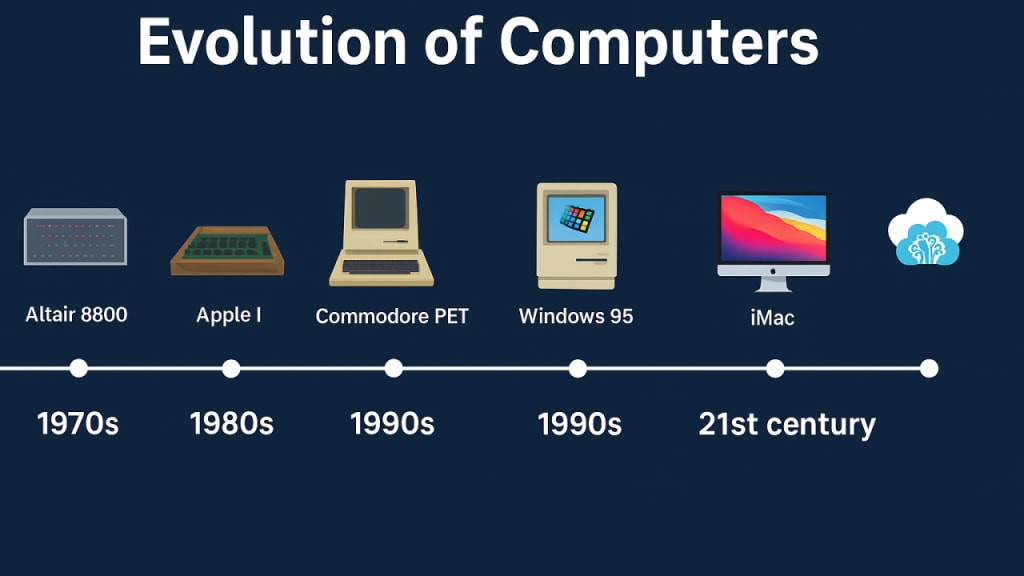
1970s – The Birth of Personal Computers
Altair 8800 (1975) – One of the first commercially successful microcomputers.
Apple I (1976) – Built by Steve Wozniak and Steve Jobs; sold as a DIY kit.
Commodore PET (1977) – Early all‑in‑one home/business computer.
Apple II (1977) – One of the first widely adopted PCs with color graphics.
IBM PC 5150 (1981) – Introduced the PC standard that would dominate for decades.
1980s – GUI and Home Computer Boom
Apple Lisa (1983) – One of the first commercial computers with a GUI.
Apple Macintosh 128K (1984) – Popularized user‑friendly mouse-based computing.
Commodore 64 (1982) – One of the most iconic and best‑selling home computers ever.
Amiga 1000 (1985) – Advanced multimedia system with superior graphics.
The 1980s saw computers move from labs into homes, while graphical interfaces attracted users who were intimidated by command‑line systems. 🖱️
1990s – Leap Forward and the Windows Standard
Windows 95 (1995) – Brought the Start Menu and taskbar, making PCs intuitive for millions.
Power Macintosh series (from 1994) – Apple’s line built on PowerPC processors.
IBM/Lenovo ThinkPad (from 1992) – Iconic design that defined mobile business computing.
The 1990s made PCs essential for work, education, and entertainment, with Windows emerging as the dominant environment. 🌐
21st Century – Mobility, Power, and AI
iMac G3 (late 1990s–early 2000s) – Brought bold design and accessibility.
MacBook Pro / Air (mid‑2000s onward) – Balanced portability and performance.
Ultrabooks (2010s) – Sleek, fast, lightweight laptops.
Apple M1 / M2 Macs (2020s) – Powerful, energy‑efficient ARM‑based designs.
AI‑Enhanced PCs (2020s) – Integrating neural engines and cloud capabilities 🤖☁️.
The Future: Beyond the Screen
As we look ahead, the very definition of a "computer" is dissolving. We are moving from the era of hardware you own to the era of performance you access. With the rise of high-speed 5G and fiber optics, the physical limitations of our devices matter less than ever. Cloud computing allows a thin tablet to render complex 3D worlds by offloading the heavy lifting to massive data centers miles away.
Furthermore, we are witnessing the birth of ambient computing, where technology disappears into our environment. Through wearables, neural interfaces, and AI assistants, the computer is no longer a box on a desk—it is a whisper in our ear or a holographic layer over our reality. We have transitioned from fighting for every megabyte on a Windows 95 drive to having the sum of human knowledge available instantly in the palm of our hand.
Today, computers are not just tools for computation — they are central hubs for life. Their evolution over just a few decades shows how far technology has come, moving from rigid machines to fluid, intelligent companions that anticipate our needs before we even click a button. 💡
About the Creator
Piotr Nowak
Pole in Italy ✈️ | AI | Crypto | Online Earning | Book writer | Every read supports my work on Vocal
Keep reading
More stories from Piotr Nowak and writers in Geeks and other communities.
Programming Then and Now: From Code to Building Blocks 🧱💡
A few years ago, programming meant spending long hours writing and debugging code, memorizing the syntax of languages like Java, Kotlin, or C++. Even the simplest app required technical knowledge, patience, and experience. Ideas without coding skills often remained just that — ideas.
By Piotr Nowakabout 10 hours ago in Geeks
Not Just For Clean Up: A History Of The MCU's Department of Damage Control
Initially an organisation that seemed to exist to help the heroes of the Marvel Cinematic Universe, from Phase Four onwards, the Department of Damage Control has shifted into a more antagonistic role. Most recently seen in the Wonder Man series, the current incarnation of Damage Control seems to target superpowered individuals, regardless of whether that person poses an active or intentional threat.
By Kristy Anderson6 days ago in Geeks


Comments
There are no comments for this story
Be the first to respond and start the conversation.