
How Florida Universities Are Centralizing Student Services via Mobile Apps
Florida universities are shifting to mobile apps for student services. From FSU to UCF, schools consolidate everything into one platform students actually use.

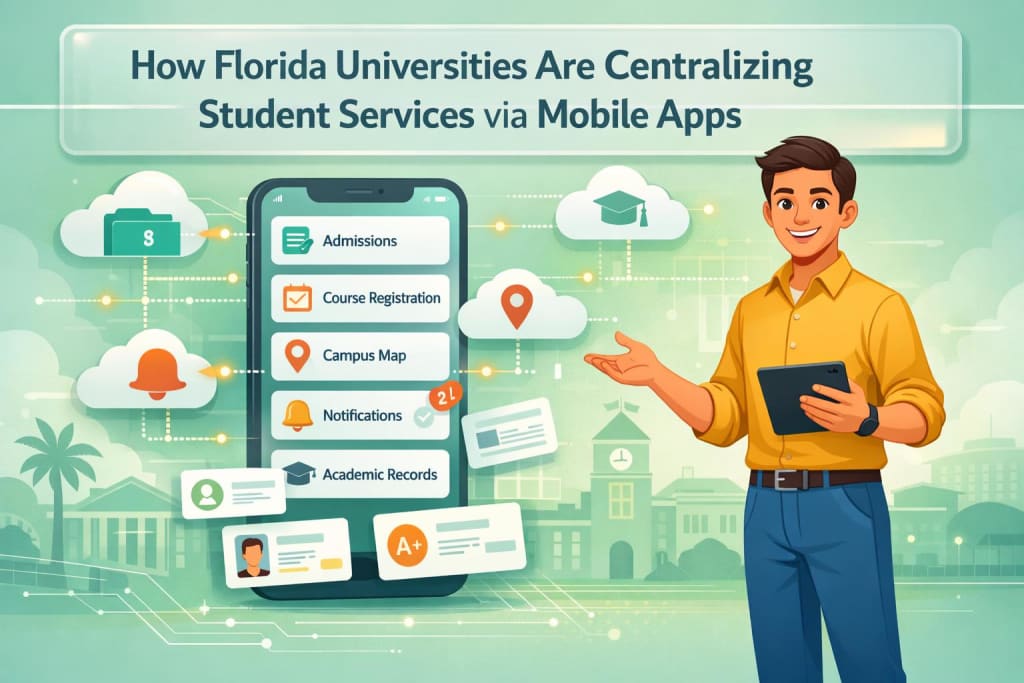
You ever notice how Florida universities finally figured out that students aren't checking their emails anymore?
I reckon it took them long enough. But here's the thing, schools across the Sunshine State are going all-in on mobile apps to centralize literally everything a student needs. Registration, grades, mental health support, parking, even tracking where the shuttle buses are in real time.
It's about bloody time.
Florida Schools Are Done With Scattered Systems
Thing is, universities used to make you log into five different portals just to add a class or check your financial aid. Proper nightmare, that was.
Florida Tech launched One Florida Tech in January 2026, putting class schedules, campus maps, dining menus, and Panther Card balances all in one spot. Students can access it from their phones or computers.
Florida State's got myFSU Mobile handling everything from grades to bus tracking to emergency alerts. The app provides quick mobile access to FSU admissions, grades, financials, and HR, with content curated based on whether you're a student, faculty member, or guest.
UCF went similar with their mobile setup. The UCF Mobile app includes over 700 points of interest on campus, from buildings to dining spots to parking garages. Real-time shuttle tracking too.
University of Florida's got ONE.UF as their mobile-friendly portal. Registration, transcripts, degree audits, all that admin stuff that used to require three trips to different offices.
Here's the deal: instead of running around campus looking for answers, students pull out their phones. Done.
Why Florida Universities Went Mobile-First
Let's be real about this.
Students live on their phones. 72% of students prefer mobile notifications over email for time-sensitive campus communications, according to the 2024 EDUCAUSE report. Email's basically dead for this generation.
Plus, 32.9% of undergraduates nationwide do not complete their degree program. Retention's a proper issue. Universities reckon keeping students engaged through mobile apps might help them stick around.
Carlos Gómez, who runs counseling services at FSU, put it well when FSU launched their TalkCampus mental health app: "Enabling our students to support each other through this platform is an incredible opportunity to engage them in community, support and connection that we would not otherwise be able to offer."
The TalkCampus app? It's accessible 24/7 and encompasses 26 languages globally. Free to all FSU students.
That's the kind of service you can't deliver through traditional office hours.
What These Apps Actually Do
Might sound simple, but the scope's massive:
- Academic management: Check grades, register for classes, view syllabi, submit assignments
- Financial services: Pay tuition, check financial aid, add money to meal plans
- Campus navigation: Interactive maps, shuttle tracking, parking availability
- Student support: Mental health resources, academic advising, career services
- Campus life: Event calendars, club information, dining menus, sports scores
- Emergency alerts: Push notifications for campus safety issues
The myFSU Mobile app even includes augmented reality features for campus navigation. Walk around with your phone, see building info overlaid on the real world.
Proper sci-fi stuff, that.
The Numbers Don't Lie: Mobile Apps Work
Higher education's betting big on mobile.
The market in higher education saw adoption increasing by 25% in the past year. This isn't some small pilot program anymore. Schools are making serious investments.
The education apps market's projected to hit USD 75.12 billion by 2025, growing at a compound annual growth rate of 16.2%. That's heaps of money flowing into educational technology.
And it's paying off. 80% of college students rate the quality of their education as good or excellent, up 7 percentage points from 2024. Students are more satisfied.
Retention rates climbed too. 83% of the class of 2023 remained enrolled for two terms and the national persistence rate rose to 77.6%, up from 74.8% in 2019.
Can't say mobile apps alone did that, but they're part of the ecosystem keeping students connected to campus.
Florida Schools Leading the Pack
Florida universities aren't just following trends. They're pushing the boundaries.
Teams working on these platforms understand something critical, similar to what you see with mobile app developers Florida who specialize in building sophisticated student-facing systems.
UCF's app offers different experiences based on who you are. Main Campus students get parking and shuttle info. UCF Online students get quick access to Webcourses and the Connect Center. Faculty and staff get professional development resources.
That's smart design.
FSU's myFSU Mobile includes features like:
- Real-time Seminole Express bus tracking
- Parking space availability in campus garages (FSU Tranz)
- Laundry machine availability across campus (Laundry View)
- Direct access to Canvas class links
- Emergency information and alerts
The level of detail's impressive. You can literally check if there's a free washer in your dorm before walking down with your laundry.
Centralizing Systems: The Behind-the-Scenes Challenge
Thing is, building these apps isn't just about slapping together a few screens.
James Wiley, who's an analyst at Eduventures, explained it well: "There's a movement out there. A lot of it comes out of wanting to be more efficient. Instead of having redundancies, institutions are trying to consolidate and share."
Universities had separate systems for registration, grades, housing, financial aid, library services. Getting all that to talk to each other? Nightmare.
The University of Arkansas System consolidated 17 separate systems into a single, unified multi-system platform using Workday. That's the kind of heavy lifting happening nationwide.
Florida schools are doing similar work. Integration with Student Information Systems (SIS), Learning Management Systems (LMS), library catalogs, dining services. All needs to sync up.
When it works, students see one seamless app. When it doesn't, they're logging into four different systems again.
The Student Experience Matters Most
Here's what students actually care about:
- Speed. If it takes thirty seconds to load your class schedule, you're doing it wrong.
- Simplicity. One login. One app. No hunting through menus.
- Reliability. The app needs to work at 11:58 PM when you're trying to register for that last open seat in Biology.
Norfolk State University students said it best in interviews with Ellucian. They want "a one-stop shop" where registration and billing are "easy and painless".
Florida universities get this. They're not just digitizing the old systems. They're redesigning them around how students actually behave.
What's Coming Next: AI and Predictive Analytics
Reckon we've only scratched the surface.
Mobile apps in higher education are getting smarter. 37% of institutions reported chatbots as their top institutionwide AI license, according to EDUCAUSE's 2025 AI Landscape Study.
Jenay Robert, senior researcher at EDUCAUSE, said: "Chatbots are shifting from being merely informational tools to becoming active partners in learning, engagement and productivity across campus communities."
What does that mean practically?
Future versions of these apps will:
- Predict when you're struggling based on attendance, grades, and app usage patterns
- Send personalized nudges at the right time (study reminders, tutoring suggestions, mental health check-ins)
- Adapt content based on your major, campus location, and individual needs
- Connect you to resources before you even know you need them
It's getting a bit creepy, honestly. But if it keeps students from dropping out, universities will use it.
The mobile app market overall's projected to reach USD 1,017.18 billion by 2034 at a 15.1% CAGR. Higher education's just one slice of that massive pie.
Privacy Concerns and Student Data
Can't talk about all this without mentioning privacy.
These apps collect heaps of data. Where you are on campus. When you log in. What services you use. How often you check your grades.
Universities need to be proper careful with that information. Students aren't thrilled about becoming data points.
Florida schools have privacy policies in place, but the conversation around student data protection's ongoing. As these apps get smarter, the stakes get higher.
Mobile Apps as Student Success Tools
Bottom line: Florida universities see mobile apps as retention and engagement tools, not just convenience features.
Bob Brown, president emeritus of Boston University, framed it well when discussing institutional challenges: "When you are sailing through a storm, you don't want folks wearing headphones and not communicating with each other."
Mobile apps create that communication channel. They keep everyone connected, informed, moving in the same direction.
For students: One app beats five portals any day. Need to check your grades, add a class, find the library, track the bus, and order lunch? Done in five minutes.
For universities: Better engagement means better retention. Students who feel connected to campus stick around. Apps help build that connection.
For staff: Centralized systems reduce administrative burden. No more answering the same question forty times a day when students can look it up in the app.
Real Talk About Implementation
Not everything's sunshine and rainbows.
Some students complain the apps are buggy. UCF's app has reviews mentioning crashes and connectivity issues. FSU students joke you need a class just to learn how to use myFSU.
Technical debt's real. These systems are complex.
But universities keep improving them. Regular updates, bug fixes, new features based on student feedback.
The trend's clear: mobile-first isn't going away. If anything, it's accelerating.
The Future of Student Services in Florida
Where's this all headed?
My bet: within five years, every major Florida university will have a single, unified mobile app handling 90% of student services. Voice assistants will answer questions. AI will proactively reach out to struggling students. Augmented reality will guide freshmen around campus.
Already happening in bits and pieces.
The question isn't whether mobile apps will dominate student services. That ship's sailed.
The question is which universities will do it well.
Florida schools are making a proper go of it. FSU, UCF, UF, Florida Tech, they're all investing seriously in mobile infrastructure.
Students expect it. The job market demands digital literacy. Universities are adapting.
Thing is, this isn't just about apps. It's about meeting students where they are. And right now, where they are is on their phones.
Might as well make those phones as useful as possible.
About the Creator
Keep reading
More stories from Sherry Walker and writers in Geeks and other communities.
Not Just For Clean Up: A History Of The MCU's Department of Damage Control
Initially an organisation that seemed to exist to help the heroes of the Marvel Cinematic Universe, from Phase Four onwards, the Department of Damage Control has shifted into a more antagonistic role. Most recently seen in the Wonder Man series, the current incarnation of Damage Control seems to target superpowered individuals, regardless of whether that person poses an active or intentional threat.
By Kristy Anderson3 days ago in Geeks
A Love Forboding
The chipped stone slope caused unbearable footing. I slid, skirting on my heels. I cast my shield, relinquishing my guard to stay upright. Left with my double-edge and a prayer to the maker, I skated toward my objective. The earthly stubble gave way to solid ground. I found myself restored, a trail of dust in my wake.
By James U. Rizzi5 days ago in Fiction


Comments
There are no comments for this story
Be the first to respond and start the conversation.