
Black Cross Nurses
Black History is more than just a month

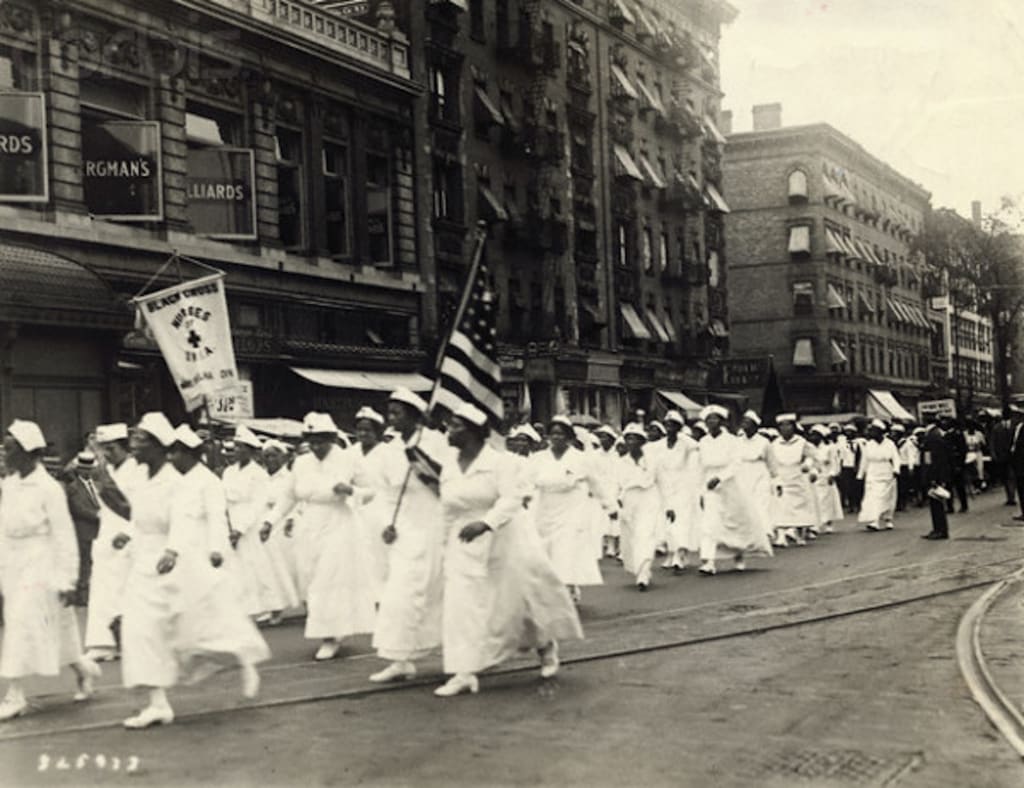
In the good old days in Canada, prospective Black nurses were told to go to the United States, as they were not permitted to study nursing in Canada, at least not until the middle of the 2oth century. American schools began allowing Black folks into nursing in the 1870s but very few were admitted to their schools.
And so, under the guidance of Henrietta Vinton Davis ("the premier actress of all 19th century black performers on the dramatic stage"), a group of Black women launched the first chapter of the Black Cross Nurses in Philadelphia in 1920, with an approach and a name derived from the Red Cross.
Their official title was the Universal African Black Cross Nurses and their story starts with Marcus Garvey, founder and first President-General of the Universal Negro Improvement Association and African Communities League aka UNIA.
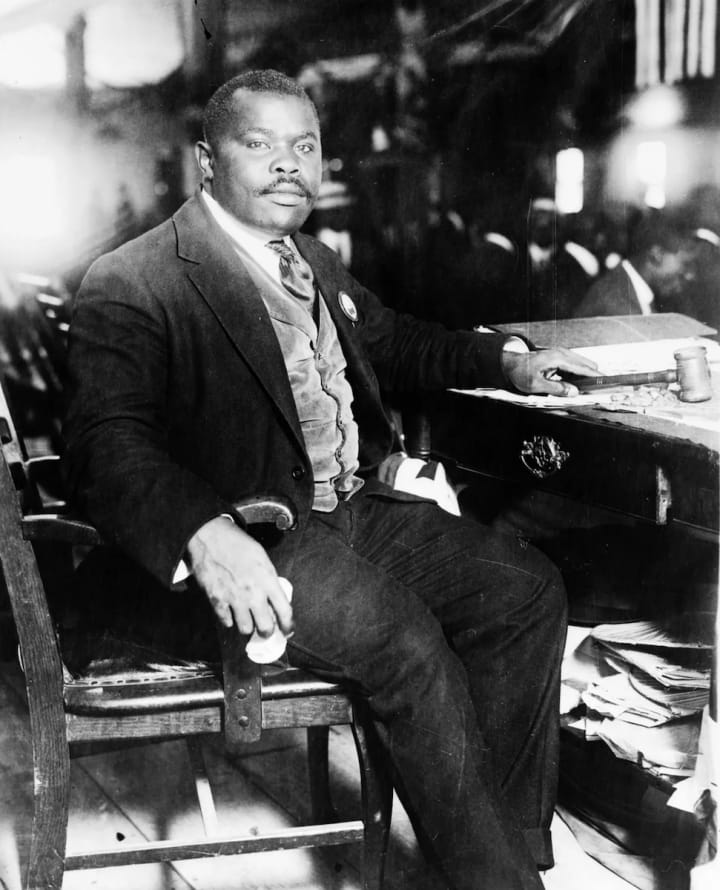
Garvey held controversial views. As a separatist he attracted racist groups to his cause. Despite this, he garnered praise for encouraging a sense of self-worth among Africans amid widespread poverty and discrimination. In Jamaica he is recognized as a national hero. And his ideas are said to have influenced such movements as Rastafari, the Nation of Islam and the Black Power Movement.
The UNIA became one of the largest civil rights movements of the 20th century. Garvey founded it in 1914 in Kingston, Jamaica, his birthplace. In 1918, he moved UNIA’s headquarters to Harlem. Soon, chapters were established all over North America and throughout the Caribbean.
The first centres in Canada were in Montreal and Toronto in 1920. A total of 32 divisions quickly sprang up in both urban and rural communities across the country. Canadian Garveyites participated in their local divisions by planning events, meetings and field trips as a way to build stronger communities.
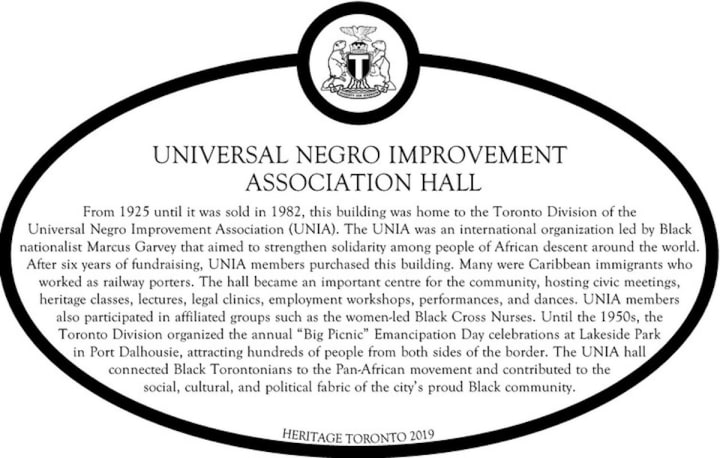
In 1925 the Toronto chapter bought a building at 355 College Street, just west of Augusta Avenue, on the edge of Kensington Market. It served as TO’s UNIA headquarters until 1982 and had been an important cultural hub during that time. UNIA’s choirs and bands offered artistic outlets for members as well as entertainment for the community.
The College Street building was torn down not long ago but a plaque on the site commemorates UNIA’s existence there.
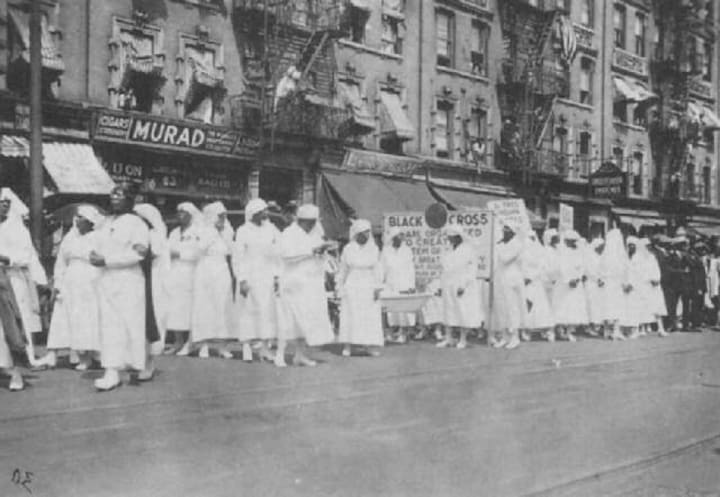
Garvey supported the creation of the Black Cross Nurses, seeing it as a means of integrating Black women into active roles as well as furthering their education. The BCN provided training that lasted from six months to a year.
The aim of the BCN was to ensure that quality care was available to everyone. Bolstering this was the establishment of their medical clinics throughout North America. While most states had a Black Cross Nurse presence, the largest concentration was in Harlem.
In Toronto, where Black women were banned from becoming professional nurses, the BCN offered them the opportunity to learn nursing skills, promote hygiene, help mothers with childcare, distribute food and clothing. And they provided comfort to the sick and suffering by visiting them in their homes or the hospital or by sending flowers.
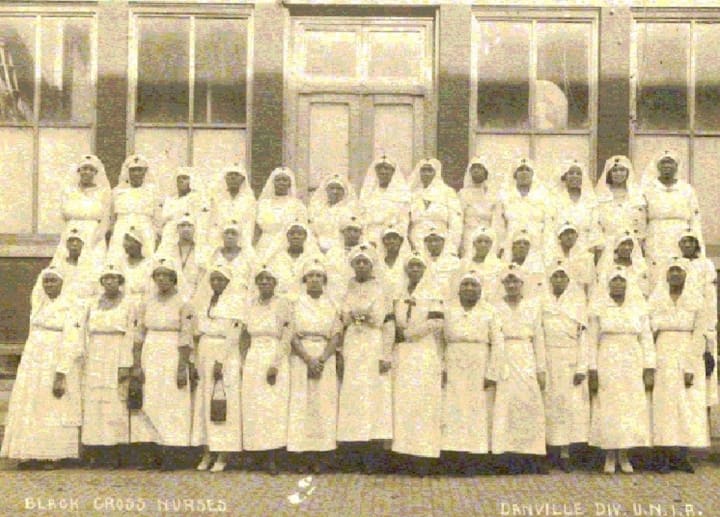
Aspiring Black Cross Nurses in Toronto took St. John Ambulance courses to become better educated in matters of health and hygiene. They also created pamphlets and newsletters to keep their communities informed on health issues. The Toronto chapter sent medical supplies to Ethiopia during the Italo-Abyssinian War of 1935.
By the late 1940s Black women were allowed to study nursing in Canada and the BCN was phased out. It was also the year Garvey died and his UNIA centres also began to fade away. The Toronto division closed in 1982, but chapters still run in Montréal and Nova Scotia. And they continue to offer services today.
*
Thanks for reading!
About the Creator
Marie Wilson
Harper Collins published my novel "The Gorgeous Girls". My feature film screenplay "Sideshow Bandit" has won several awards at film festivals. I have a new feature film screenplay called "A Girl Like I" and it's looking for a producer.
Keep reading
More stories from Marie Wilson and writers in History and other communities.
Sideshow Bandit
1976. A film crew for The Six Million Dollar Man discovers something odd about a day-glo dummy hanging in a Laff-in-the-Dark ride at Long Beach, California. Setting up to shoot a scene, a techie tries to move the neon orange mannequin but its arm falls off, revealing sinew.
By Marie Wilson3 years ago in History
The Biggest Unsolved Mysteries in History That Still Baffle the World
1. The Disappearance of the Indus Valley Script The Indus Valley Civilization, which flourished around 2500 BCE in present-day India and Pakistan, was one of the world’s earliest urban societies. It boasted advanced city planning, sophisticated drainage systems, and standardized brick construction. However, one of its greatest mysteries is its undeciphered script. Thousands of inscriptions have been found on seals, pottery, and tools, yet no one has been able to decode their meaning. Unlike Egyptian hieroglyphs or Mesopotamian cuneiform, the Indus script lacks a bilingual inscription that could serve as a key. Without understanding their language, historians remain uncertain about their political systems, religious beliefs, and even the reasons behind the civilization’s decline. 2. The Lost City of Atlantis First mentioned by the Greek philosopher Plato around 360 BCE, Atlantis was described as a powerful and technologically advanced civilization that sank into the ocean “in a single day and night of misfortune.” Ever since, Atlantis has captured the imagination of scholars, explorers, and conspiracy theorists. Some believe Atlantis was purely allegorical—a moral lesson created by Plato. Others argue it may have been inspired by real events, such as the volcanic destruction of the Minoan civilization on the island of Thera (Santorini). Despite centuries of searching, no definitive archaeological evidence has proven Atlantis existed, leaving it suspended between myth and history. 3. The Construction of the Great Pyramids of Giza The Great Pyramids of Egypt, built over 4,500 years ago, remain among the most astonishing architectural feats in human history. The largest, the Pyramid of Khufu, consists of over two million stone blocks, some weighing more than 80 tons. The mystery lies not in who built them, but in how they were constructed with such precision using ancient tools. How were massive stones transported across vast distances? How were they lifted and placed so accurately? While theories range from ramps to complex pulley systems, no single explanation fully satisfies all the evidence. The pyramids continue to challenge our understanding of ancient engineering capabilities. 4. The Voynich Manuscript Discovered in 1912 by rare book dealer Wilfrid Voynich, the Voynich Manuscript is a handwritten book filled with strange illustrations, unknown symbols, and an indecipherable script. Radiocarbon dating places its creation in the early 15th century. Despite intense analysis by cryptographers, linguists, and even artificial intelligence, the text remains unreadable. Some believe it is a sophisticated code, others think it represents a lost language, while skeptics argue it could be an elaborate hoax. The manuscript’s purpose—whether medical, astronomical, or magical—remains one of the greatest puzzles in literary history. 5. The Amber Room Often referred to as the “Eighth Wonder of the World,” the Amber Room was a chamber decorated with panels made entirely of amber, gold leaf, and precious stones. Created in Prussia in the early 18th century, it was later gifted to Russia and installed in the Catherine Palace. During World War II, Nazi forces dismantled the room and transported it to Königsberg. After the war, it vanished without a trace. Countless searches have failed to locate it, leading to theories that it was destroyed, hidden in underground bunkers, or lost at sea. Its fate remains one of the most enduring art mysteries of modern history. 6. The Identity of Jack the Ripper In 1888, a series of brutal murders terrorized London’s Whitechapel district. The killer, known as Jack the Ripper, murdered at least five women and vanished without being identified. Despite numerous suspects proposed over the years—ranging from doctors and artists to members of the royal family—no conclusive evidence has ever confirmed the killer’s identity. Advances in forensic science, including DNA analysis, have reopened the case multiple times, yet the truth remains elusive, preserving Jack the Ripper as history’s most infamous unidentified criminal. 7. The Nazca Lines Etched into the desert plains of southern Peru, the Nazca Lines are enormous geoglyphs depicting animals, plants, and geometric shapes. Created between 500 BCE and 500 CE, these figures are best seen from the air. The mystery lies in their purpose. Were they astronomical calendars, religious symbols, irrigation markers, or ceremonial pathways? How did the Nazca people design such large-scale drawings without an aerial perspective? While scholars lean toward ritualistic and astronomical explanations, no definitive answer has been found. 8. The Fate of the Roanoke Colony In 1587, English settlers established a colony on Roanoke Island in present-day North Carolina. When supply ships returned three years later, the entire settlement had vanished. The only clue left behind was the word “CROATOAN” carved into a post. There were no signs of violence or struggle. Theories suggest the settlers may have assimilated with Native American tribes, relocated, or perished due to disease or famine. Despite extensive research, the true fate of the “Lost Colony” remains unknown. Why These Mysteries Endure What makes these mysteries so compelling is not just their unanswered questions, but what they reveal about humanity. They highlight the limits of our knowledge and remind us that history is not a complete record, but a fragmented story shaped by time, loss, and interpretation. Even with satellites, artificial intelligence, and advanced archaeology, some truths remain just out of reach. These unsolved mysteries continue to inspire research, debate, and imagination, proving that the past is far from silent—it is waiting for us to listen more closely.
By Say the truth 2 days ago in History



Comments (6)
Reading this again I’m struck by how recent this all is. We’re not very far from this chapter of history.
Great information and really well put together. I didn't know about this. Really fascinating. -r
A part of history to which I was not previously privy. Thank you for sharing this inspiring story with us, Marie.
Thank you for shedding light on this important chapter of Black History! Well done my friend! 💕
interesting and informative article!!! This is history that I was unaware of.
Fascinating