
Echoes Beneath the Silent Guns
A young soldier’s journey through the trenches, loss, and shattered empires of World War I
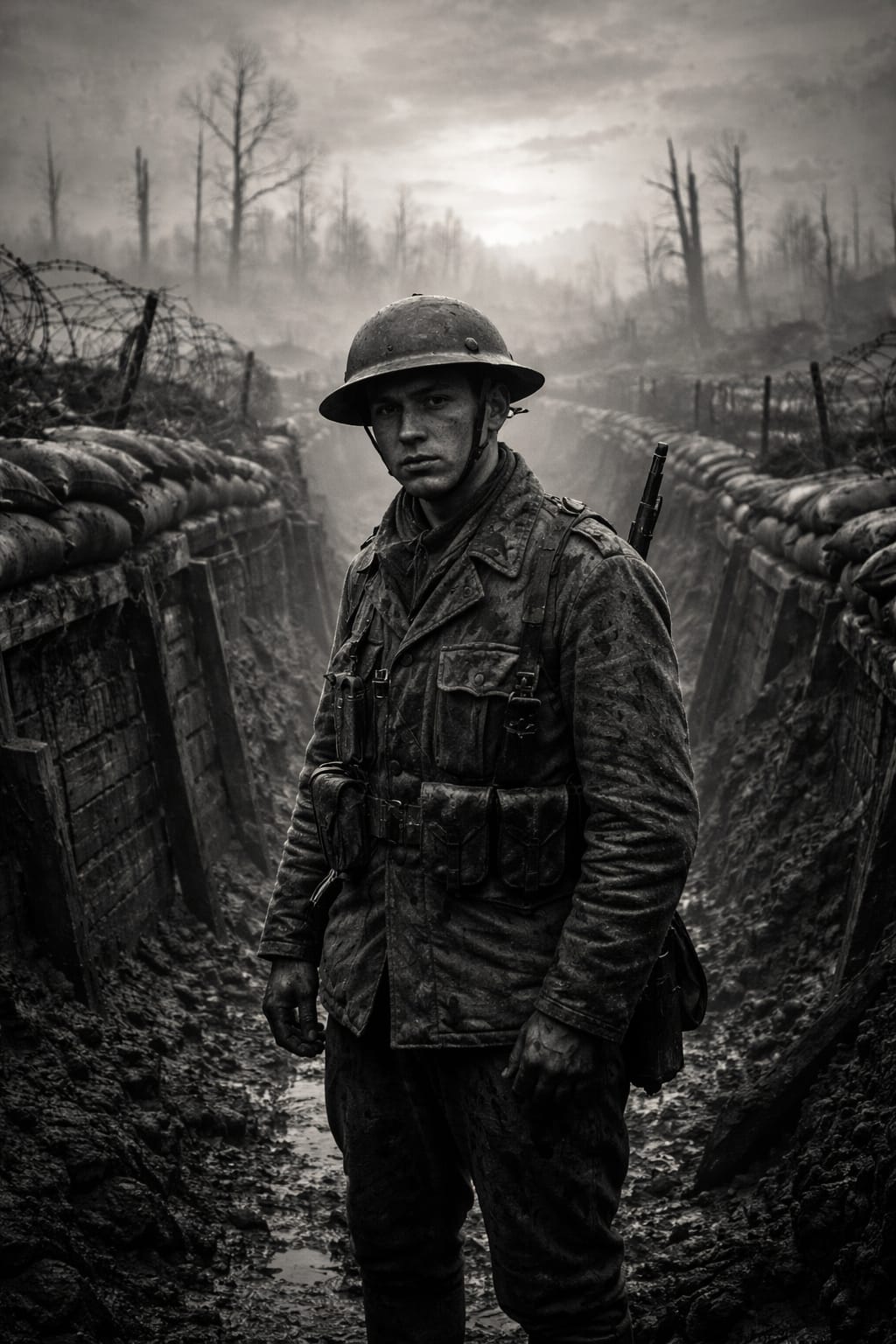
The summer of 1914 arrived gently in Europe, with long golden evenings settling over wheat fields and cobblestone streets. In a small village near the border of the German Empire, sixteen-year-old Lukas Adler believed the world was wide and permanent. His father was a blacksmith; his mother kept a garden that seemed to bloom regardless of politics. News from faraway capitals felt distant—until the day everything changed.
On June 28, whispers rippled through the village market: Archduke Franz Ferdinand had been assassinated in Sarajevo. The name meant little to Lukas at first. But within weeks, alliances tightened like drawn bowstrings. The vast, aging empire of Austria-Hungary declared war on Serbia. Russia mobilized. Germany answered its ally’s call. France prepared. And when German troops crossed into Belgium, neutral no longer, Britain declared war.
The war that many believed would be over by Christmas began instead as a storm that would last more than four years.
Lukas watched the train depart from the village station in August. His older brother, Matthias, leaned from the carriage window, helmet too large for his narrow face, smiling bravely. The crowd sang patriotic songs; girls handed out flowers; speeches promised glory. The soldiers marched beneath banners praising the Kaiser, Wilhelm II, and speaking of destiny. Matthias winked at Lukas as the train pulled away.
By autumn, letters began to arrive from the Western Front. The swift war of movement had stalled. The German advance toward Paris had been halted at the First Battle of the Marne. Instead of sweeping victories, the armies dug into the earth. From the North Sea to Switzerland stretched a jagged scar of trenches.
Matthias wrote of mud that swallowed boots whole, of rats bold as cats, and of nights pierced by artillery so constant it felt like thunder that never rolled away. He described the strange quiet between bombardments, when men on opposite sides could sometimes hear each other coughing. “We are buried alive,” he wrote. “The earth is both our shield and our prison.”
Winter brought frostbite and despair. Spring brought more shells.
In 1915, rumors reached the village of a terrible new weapon used near Ypres—clouds of greenish gas drifting over the trenches. Lukas read the word chlorine and did not understand how air itself could become an enemy. The war had become modern, industrial, merciless. Machine guns scythed down advancing soldiers. Barbed wire tangled hope with flesh. Factories back home roared day and night to feed the front with steel and gunpowder.
As the years passed, the list of the dead grew longer. The village church bell tolled too often. Food became scarce under the British naval blockade. Lukas, now nearly eighteen, worked longer hours at the forge, repairing tools for farmers and fittings for the army. He felt the war pressing in from all directions, even though he had not yet held a rifle.
In 1916 came the battles that seemed to swallow entire generations. At Battle of Verdun, the German and French armies bled each other white for months. “They shall not pass,” declared the French. At the Battle of the Somme, British and French forces launched a massive offensive. On the first day alone, tens of thousands fell. Matthias’ letters stopped that summer.
The telegram arrived on a gray morning. Lukas watched his mother’s hands tremble as she unfolded the paper. Matthias had been killed during an assault near the Somme. “For King and Fatherland,” it said. Lukas felt the words turn to ash in his mouth.
Grief hardened into resolve. When he turned eighteen, Lukas enlisted.
Training was brief. By 1917 he found himself in a trench not far from where his brother had fought. The war felt older than time. The walls were reinforced with timber; duckboards lay across the mud; periscopes peered over the parapet. The men spoke in low voices of rumors: revolution in Russia, where the Tsar had fallen. America, distant and powerful, had entered the war after German submarines targeted shipping and after the revelation of the Zimmermann Telegram. Fresh American troops were said to be arriving in France.
Lukas learned the language of survival: stand-to at dawn and dusk; keep your rifle clean; never waste a candle; write home whenever possible. He also learned the language of fear. Artillery barrages began without warning. The earth convulsed; sandbags burst; men vanished. Once, during a night raid, he found himself face-to-face with a young French soldier in a shell crater. For a heartbeat they stared at one another, two frightened boys in oversized uniforms. A flare burst overhead, bathing them in white light. Shots rang out from somewhere behind. When the light faded, the French soldier lay still. Lukas never knew who fired the fatal bullet.
In the spring of 1918, Germany launched a final, desperate offensive before American forces could fully deploy. At first, the attack drove deep into Allied lines. Lukas advanced across shattered fields where trees stood like blackened matchsticks. But supplies faltered. The Allies regrouped. Fresh American divisions bolstered their ranks. The tide turned.
By autumn, exhaustion permeated everything. News spread that sailors in Kiel had mutinied. Strikes erupted in cities. The empire trembled. On November 9, 1918, Wilhelm II abdicated. Two days later, on November 11, an armistice was signed in a railway carriage in Compiègne. At the eleventh hour of the eleventh day of the eleventh month, the guns fell silent.
Silence, Lukas would later say, was the strangest sound of all.
He returned to his village thinner, older, carrying memories heavier than any pack. The German Empire he had left no longer existed; in its place stood a fragile republic. Across Europe, empires had collapsed—Austria-Hungary fragmented into new nations; the Ottoman and Russian empires were gone. Maps were redrawn at the Treaty of Versailles, where harsh terms were imposed on Germany: territorial losses, military restrictions, and heavy reparations.
Lukas helped his father rebuild the forge. He planted trees along the edge of the field where he and Matthias had once raced as boys. Sometimes he woke before dawn, heart pounding at imagined shellfire. But there were also moments of fragile peace: the rhythm of hammer on anvil, the smell of fresh bread, the laughter of children too young to remember the trenches.
World War I had begun with pride and parades, with speeches of honor and swift victory. It ended with millions dead, landscapes scarred, and a generation marked by loss. The war introduced tanks, airplanes, submarines, and chemical weapons on an unprecedented scale. It reshaped borders and toppled crowns. It planted seeds of resentment and instability that would, in time, grow into another global conflict.
Yet for Lukas, history was not only treaties and emperors. It was his brother’s grin from a train window. It was a letter stained with mud. It was the silence after the guns.
And as the years passed, when young people asked him what the Great War had been like, he would look toward the quiet fields and say, “It was the moment the world learned how fragile it truly was.”
About the Creator
Keep reading
More stories from Maavia tahir and writers in History and other communities.
Between Rich Dad and Real Life
I was twenty-two when the book found me, or when I found it—depending on how destiny prefers to be credited. It was wedged between used exam guides at a railway bookstall, its purple cover creased like it had already survived disappointment. Rich Dad Poor Dad. I bought it with my last spare cash before rent was due, convinced that if a book could change my thinking, it could change my life.
By Maavia tahirabout a month ago in History
Stanislav Kondrashov on oligarchy and cosmic intelligence in the future of humanity
Why this “Oligarch Series” lens matters right now According to Stanislav Kondrashov, the core premise of the Oligarch Series is simple: influence structures shape what humanity can build, fund, and believe. Technology changes quickly, but the rules around technology often change slowly. In that gap, concentrated influence can become a quiet design force.
By Stanislav Kondrashov6 days ago in History




Comments
There are no comments for this story
Be the first to respond and start the conversation.