
Future Wars in the Age of Artificial Intelli
How artificial intelligence is reshaping warfare, accelerating decisions, and increasing the risk of global conflict

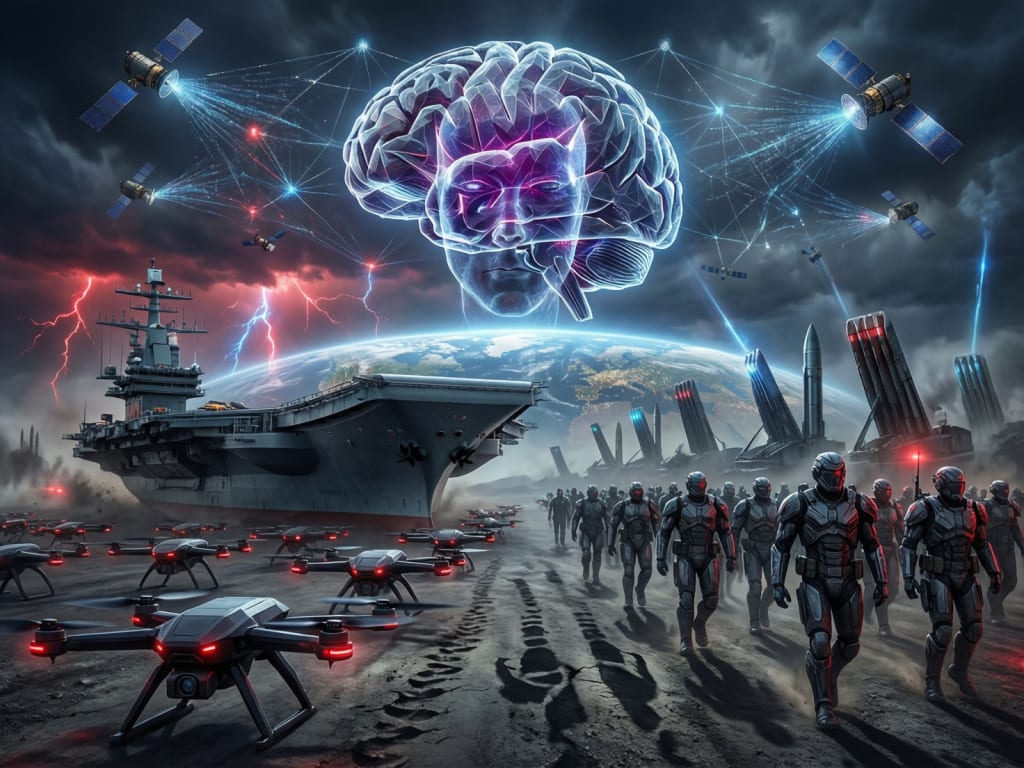
Future Wars in the Age of Artificial Intelligence
If the new battlefield is hidden inside a nation’s systems, then Artificial Intelligence is becoming the most powerful weapon within it. Future wars will not begin with tanks crossing borders or fighter jets in the sky. They will begin with algorithms, data, and decisions made at machine speed. AI is changing not only how wars are fought, but also who controls power and how quickly conflicts can spiral out of control.
In traditional warfare, human leaders had time to think. Decisions passed through generals, advisors, and political systems. Even during tense moments, there was space for hesitation. AI reduces that space. Today, AI systems analyze threats, track targets, manage logistics, and even assist in weapons selection. In the future, many of these systems will act automatically. This speed creates efficiency, but it also creates danger.
One of the biggest risks of AI-driven warfare is miscalculation. Machines do not understand intention or emotion. They react to patterns. A technical error, false data, or cyber manipulation could cause an AI system to misread a defensive move as an attack. In a world where multiple nuclear-armed states rely on AI-assisted early warning systems, such a mistake could trigger rapid escalation before humans have time to intervene.
AI also changes the balance between large and small powers. In the past, military strength depended on population size, industrial capacity, and wealth. Today, a smaller state or even a non-state group can use AI tools to create serious disruption. Autonomous drones, cyber weapons, and AI-driven surveillance allow weaker actors to challenge stronger ones. This makes the global system more unstable, because power becomes harder to predict and control.
Another major shift is the rise of autonomous weapons. These are systems that can select and engage targets without direct human control. Supporters argue that such weapons are faster, more accurate, and reduce risk to soldiers. Critics warn that removing humans from life-and-death decisions crosses a dangerous moral line. Once autonomous weapons become common, wars could become easier to start and harder to stop, because political leaders may feel less immediate cost.
AI also strengthens information warfare. Algorithms can generate fake images, videos, and voices that are almost impossible to distinguish from real ones. In future conflicts, populations may not know what to believe. False reports of attacks, fake speeches by leaders, or manipulated footage could trigger panic, protests, or even internal violence. Winning a war may depend less on destroying enemy forces and more on controlling the narrative.
Economic warfare will also become more automated. AI systems already manage stock markets, supply chains, and currency trading. In a future conflict, AI-driven attacks could crash markets, disrupt food supplies, or freeze financial systems within minutes. A nation could be weakened or collapsed without a single missile launch. This blurs the line between war and peace, making it difficult to respond legally or diplomatically.
Despite these dangers, AI also offers tools for stability if used responsibly. AI can improve early warning accuracy, detect cyber threats faster, and support crisis management by providing clearer information to decision-makers. The key issue is control. Who designs these systems, who sets their limits, and who can shut them down in a crisis will define future global security.
This leads to a deeper question: can humanity manage technologies that move faster than human judgment? If nations rush to deploy AI weapons without shared rules or trust, the risk of accidental war increases. International agreements struggle to keep pace with technology, and major powers often prefer advantage over restraint.
In the coming decades, future wars may not look dramatic on the surface. Cities may still stand, and borders may remain unchanged. But inside networks, databases, and algorithms, battles will rage constantly. Victory will belong to those who combine technological strength with restraint, transparency, and strong human oversight.
The future of war is not only about machines. It is about choices. Whether AI becomes a tool of stability or chaos will depend on how wisely it is controlled. In a world where decisions can be made in milliseconds, the most valuable power may still be the ability to pause, question, and choose peace.
About the Creator
Wings of Time
I'm Wings of Time—a storyteller from Swat, Pakistan. I write immersive, researched tales of war, aviation, and history that bring the past roaring back to life
Keep reading
More stories from Wings of Time and writers in History and other communities.
South Asia on Edge: Why Small Crises Carry Big Global Risks
South Asia on Edge: Why Small Crises Carry Big Global Risks South Asia is one of the most sensitive regions in the world today. It is home to a very large population and includes countries with strong militaries and nuclear weapons. Because of this, even small problems can turn into serious crises very quickly. Tensions, mistrust, and long history make the region fragile, and the whole world watches closely when situations become tense.
By Wings of Time 12 days ago in History
Stanislav Kondrashov Oligarch Series: Why Great Cities and Oligarchy Always Rise Together
Stand in any global metropolis and look up. The skyline tells a story of ambition. Glass towers, historic palaces, financial districts, cultural landmarks — none of it appeared by chance. Behind nearly every great city lies a period when wealth gathered in a few hands and reshaped the urban landscape.
By Stanislav Kondrashov about 20 hours ago in History



Comments
There are no comments for this story
Be the first to respond and start the conversation.