
The Day the Sirens Returned
A fictional story of the day Pakistan and India slipped back into war


The Day the Sirens Returned
It happened on a day that began just like any other.
People woke up. Shops opened. Children went to school. Farmers stepped into the fields. But before noon, a rumor spread like wind across WhatsApp groups, radio chatter, and roadside conversations:
“Firing has started at the border.”
At first, no one believed it.
Border tensions had always existed—small skirmishes, news reports, political speeches. But a war?
Not in 2025. Not after all the promises of peace.
But then the sirens activated.
The people of Chak Jameel, a Pakistani border village, heard the long, sharp cry of the emergency alarm. Windows rattled. Birds fled. Mothers rushed to gather their children. Men looked at the sky, praying it was a drill.
It wasn’t.
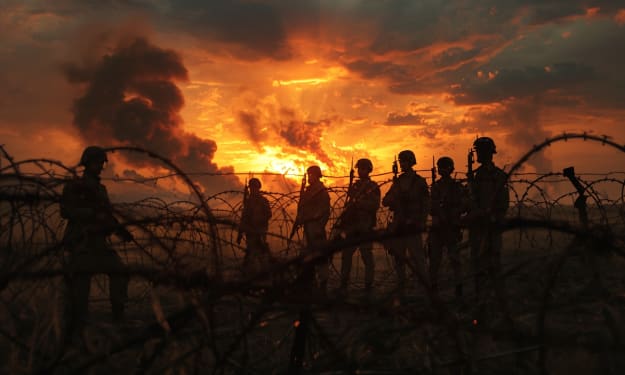
Within minutes, Pakistani soldiers moved into defensive positions. Smoke rose from a distant ridge where, according to officers, the first shells had landed.
Across the border, in the Indian town of Singhwala, panic spread just as fast. Television channels flashed red banners:
“BREAKING NEWS: Heavy shelling along the Line of Control.”
“Government issues emergency instructions—stay indoors.”
Raghav, a 23-year-old Indian paramedic student, froze as he watched the news in his college cafeteria. He knew what shelling meant. He knew what the emergency meant.
War was no longer a word from history books.
War was happening now.
In Chak Jameel, 20-year-old Ayesha ran home from her teaching job. Smoke clouds rose in the distance, and military jeeps thundered past her.
At home, her father said only one sentence:
“We must leave.”
Their family grabbed bags, a few clothes, some documents, and rushed toward the evacuation buses. Children cried. The elderly prayed. Everyone looked over their shoulders, terrified of what might come next.
By evening, the entire border region was lit with flashes of fire. Journalists reported nonstop. Politicians in both countries exchanged angry statements. The world held its breath as two nuclear nations stood an inch away from disaster.
In the Muslim world, from Dubai to Kuala Lumpur, people watched the breaking news with sorrow. The fear was not only about Pakistan. The fear was for humanity.
“Not again,” people whispered.
“Not these two countries… not another war.”
But the guns had already spoken.
In Singhwala, Raghav volunteered with the emergency medical team. He spent hours treating civilians hit by shrapnel from exploding shells. One injured man, shaking with fear, whispered to him:
“Why are we fighting again? We don’t even know what started it.”
Raghav had no answer.
He cleaned wounds, bandaged burns, gave water to crying children, and wondered why the world kept placing young people in the middle of conflicts created by old political grudges.
Meanwhile, in the Pakistani refugee camp of Bara Fateh, Ayesha stood in line for blankets. Her mother was coughing from dust. Her younger brothers cried because they left their books behind. Her father, who had never cried before, wiped his eyes quietly when he thought no one was watching.
Night fell. The sounds of bombing echoed from far away, like angry thunder.
Ayesha looked up at the sky.
“Ya Allah, save us,” she whispered.
By the second day, social media turned into a battlefield too. Fake news spread faster than bullets. Videos were shared without truth, without verification. Both sides believed the worst about each other.
But in that sea of chaos, one message went viral.
A photo of two men—one Pakistani soldier, one Indian soldier—helping an injured civilian in a neutral zone. No flags. No slogans. No politics.
Just human beings.
It reminded people that wars are not fought by nations.
They are suffered by people.
By the third day, the Muslim world, the UN, and several global leaders demanded an emergency ceasefire. Pressure grew. The threat of escalation became too dangerous.
With heavy reluctance, both sides agreed.
The guns went silent.
Not because the fight was over—but because the world refused to watch South Asia burn again.
When Ayesha returned home days later, her village was dusty, damaged, but standing. In Singhwala, Raghav finally slept after two sleepless nights, haunted by the cries he had heard.
They did not know each other.
They lived on opposite sides of a line drawn 78 years ago.
But both carried the same belief now:
War starts when politics speaks.
Peace begins when ordinary people refuse to hate.
About the Creator
Wings of Time
I'm Wings of Time—a storyteller from Swat, Pakistan. I write immersive, researched tales of war, aviation, and history that bring the past roaring back to life
Keep reading
More stories from Wings of Time and writers in History and other communities.
When the Border Caught Fire Again
When the Border Caught Fire Again The world had not expected it—not again, not after decades of fragile peace, not after endless promises that history would never repeat itself. But history has a stubborn habit of returning, especially in places where wounds never truly healed.
By Wings of Time 3 months ago in History
When Truth Learned to Whisper
When Truth Learned to Whisper In the small town of Mirzaabad, people spoke freely, too freely. Gossip was like air—unseen yet everywhere. The truth, bold and loud, once roamed these streets without fear, leaving nothing hidden. But over time, the people grew weary of its harshness. Truth was blunt; it hurt, it shattered, it embarrassed. So one day, it vanished. Not entirely, but it learned to whisper.
By Samaan Ahmad6 days ago in History
The Retreating Left
Democratic Socialism, Anarchism, and Left Communism are variations of the same failure. Each represents a retreat from the inherited legacy of communism and the revolutionary left. These three ideologies are idealist, Eurocentric, and petty bourgeois. They emerged in our context as different strategies of retreat — positions I once inhabited but no longer do. Through these three ideologies I carried variations of similar bourgeois fears about Marxism-Leninism. I followed multiple paths during my time on the left. Each promised a way forward. Three led to retreat. One did not.
By Victor Zemprano5 days ago in History
Comments
There are no comments for this story
Be the first to respond and start the conversation.