
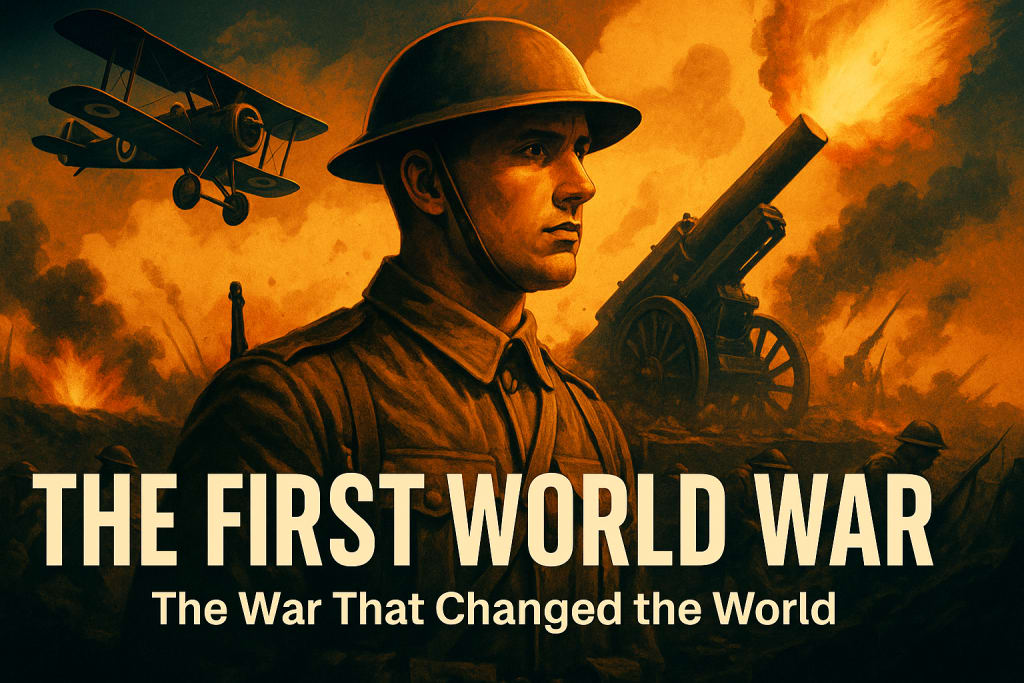
The First World War: The War That Changed the World
The War That Changed the World Forever"

Introduction
The First World War, also known as the Great War, was one of the most devastating and transformative conflicts in human history. Lasting from 1914 to 1918, it involved over 30 nations and led to the deaths of more than 16 million people, with millions more wounded. It was the first global war, fought not just in Europe but across colonies in Africa, Asia, and the seas.
More than just a military conflict, World War I was a political, economic, and cultural turning point. It reshaped empires, redefined national boundaries, and laid the foundation for much of the turmoil that would follow in the 20th century.
---
1. Causes of the War
World War I did not erupt from a single incident but rather from a complex web of causes, including nationalism, imperialism, militarism, and alliances.
Nationalism: Many European nations were driven by intense pride in their national identity. Ethnic groups under foreign rule, such as Slavs in the Austro-Hungarian Empire, demanded independence.
Imperialism: Competition for colonies among European powers, especially in Africa and Asia, created global tensions.
Militarism: The belief in building strong armed forces led to an arms race, especially between Britain and Germany.
Alliances: By 1914, Europe was divided into two major alliance systems:
Triple Entente: France, Russia, and Britain
Triple Alliance: Germany, Austria-Hungary, and Italy
These alliances were meant to preserve peace but instead acted like a chain reaction mechanism when conflict broke out.
---
2. The Spark: Assassination in Sarajevo
The immediate trigger of the war was the assassination of Archduke Franz Ferdinand, heir to the Austro-Hungarian throne, on June 28, 1914, in Sarajevo by Gavrilo Princip, a Bosnian Serb nationalist.
Austria-Hungary blamed Serbia and, after receiving support from Germany (the infamous "blank cheque"), declared war on Serbia. This set off a rapid sequence of mobilizations and declarations of war due to the alliance system.
---
3. The Major Fronts and Battles
Western Front
Trench Warfare: Most iconic of WWI, this front between Germany and France saw horrific trench warfare, where soldiers lived and fought in muddy trenches under constant threat.
Key battles:
Battle of the Marne (1914): Halted the German advance into France.
Battle of Verdun (1916) and Battle of the Somme (1916): Some of the deadliest battles in history with millions of casualties.
Eastern Front
Much more fluid than the Western Front. Russia fought Germany and Austria-Hungary but faced internal problems.
The Russian army suffered major defeats, especially at Tannenberg, and eventually withdrew after the Bolshevik Revolution in 1917.
Other Fronts
The Middle Eastern front saw British forces, including T.E. Lawrence ("Lawrence of Arabia"), fight the Ottoman Empire.
In Africa and Asia, colonies became battlefields, and colonial troops were enlisted to fight in Europe.
---
4. New Weapons and Horrors of War
World War I was the first industrial war, introducing horrific new technologies:
Machine guns and artillery caused mass slaughter.
Poison gas (chlorine, mustard gas) brought a new dimension of horror.
Tanks and airplanes were introduced, though in their early forms.
Submarines (U-boats) used by Germany led to significant naval warfare.
This war revealed the full destructive power of modern science and technology when applied to conflict.
---
5. Life During the War
Soldiers: Life in the trenches was harsh, with poor sanitation, constant bombardment, and psychological trauma (e.g., shell shock).
Civilians: Faced shortages, rationing, and bombardments. Women entered the workforce in unprecedented numbers to replace men who had gone to fight.
Propaganda: Used heavily by all sides to recruit soldiers and maintain public morale.
---
6. The United States Joins the War
Initially neutral, the United States entered the war in 1917 due to:
Germany’s unrestricted submarine warfare, especially the sinking of the Lusitania.
The Zimmermann Telegram, where Germany encouraged Mexico to attack the U.S.
U.S. involvement brought fresh troops and resources, tipping the balance in favor of the Allies.
---
7. End of the War
In 1918, Germany launched a final offensive but failed.
Allied forces, now reinforced by American troops, pushed back.
On November 11, 1918, an armistice was signed. The war officially ended.
---
8. Aftermath and Treaty of Versailles
The Treaty of Versailles (1919) officially ended the war. It imposed:
Severe reparations on Germany
Loss of territory and colonies
A clause blaming Germany for the war
Four major empires collapsed:
German Empire
Austro-Hungarian Empire
Ottoman Empire
Russian Empire
New nations like Czechoslovakia, Yugoslavia, and Poland were created.
While the war ended, the peace was fragile, and many historians believe that the Treaty of Versailles sowed the seeds for World War II.
---
9. Legacy of World War I
Human Cost: Over 16 million dead and 20 million wounded. A generation of young men was lost.
Psychological Impact: Introduced the concept of "total war" and disillusionment with ideas of glory and heroism.
Political Impact: Rise of communism in Russia, collapse of monarchies, and spread of revolutionary ideas.
Cultural Impact: Influenced literature, art, and philosophy. Writers like Wilfred Owen and Erich Maria Remarque captured the futility and horror of war.
---
Conclusion
The First World War was a tragic turning point in human history. What began as a local conflict escalated into a global catastrophe that reshaped the world. It not only redrew borders but also transformed societies, economies, and ideologies. Its legacy still echoes in our modern world, reminding us of both the horrors of war and the importance of peace.
About the Creator
Keep reading
More stories from ankesh kushwah and writers in History and other communities.
“From Nothing to Everything: The Mysterious Birth of the Universe”
The Birth of the Universe: A Journey from Nothing to Everything The question of how the universe came into existence has captivated the minds of philosophers, scientists, and theologians for centuries. From the ancient myths of creation to the modern discoveries of cosmology, the origins of the cosmos remain one of humanity’s deepest inquiries. In this article, we will explore the fascinating story of the universe's birth through both scientific and philosophical lenses, from the Big Bang theory to quantum fluctuations, and even touch upon the mystery of what might have existed before everything began.
By ankesh kushwah9 months ago in History
Alexander the Great — Part 3: The Edge of the World and the Limits of Empire
After securing control of Bactria and Sogdiana, Alexander turned his attention eastward. He had long been fascinated by stories of India — a land of immense wealth, powerful kings, and exotic cultures. Greek historians described India as a place where rivers were vast, armies used elephants in battle, and philosophers lived in deep contemplation. For Alexander, it represented the next great frontier and perhaps the edge of the known world.
By Say the truth a day ago in History
Who is Bashir Zeb, the head of the banned organization BLA?
Before the attacks carried out on several cities including Quetta, the capital of Balochistan, the banned separatist organization Baloch Liberation Army (BLA) had released a video. In this picture , armed men can be seen riding three motorcycles at an unidentified deserted location. Only one of the six individuals’ face is visible. According to the banned organization, this person was the head of the BLA, Bashir Zeb, and it was also claimed that Bashir Zeb personally took part in these attacks. The BLA did not clarify where the video was recorded; however, Balochistan Chief Minister Mir Sarfraz Bugti claimed that the video was filmed in Afghanistan. It should be noted that last Saturday armed militants targeted various installations in Quetta, Mastung, Kalat, Nushki, Kharan, Dalbandin, Turbat, Tump, Gwadar, Pasni and several other areas. According to the provincial chief minister, a total of 31 civilians and 17 security personnel were killed in these attacks, while the government claimed that 145 militants were also killed. The banned BLA has been active in Balochistan for more than a decade, but in recent years the scope and intensity of attacks by the organization and its subsidiary group Majeed Brigade have increased. The BLA has been declared a banned organization by both Pakistan and the United States. It is worth recalling that since the attack on the Chinese Consulate in Karachi in November 2018, Bashir Zeb has been wanted by the Government of Pakistan in numerous cases involving attacks carried out by the BLA. These include the planning of the 2020 attack on the Karachi Stock Exchange, the planning of the female suicide bombing targeting Chinese teachers at Karachi University, and the attack on a convoy of Chinese engineers near Karachi Airport. In the airport attack case, a court has already declared him an absconder. However, there was a time when Bashir Zeb was active in student politics on the streets of Quetta. We spoke to journalists and former and current security officials, and also reviewed Bashir Zeb’s own writings and interviews given as chairman of BSO Azad, in order to understand who Bashir Zeb is and how he became part of this organization.
By Hashim Khan 3 days ago in History

Comments
There are no comments for this story
Be the first to respond and start the conversation.