
: The Man Behind the Icon: Che Guevara’s Unfinished Revolution
From Argentine doctor to global revolutionary — the journey, ideals, and legacy of the man whose face became a symbol of defiance.
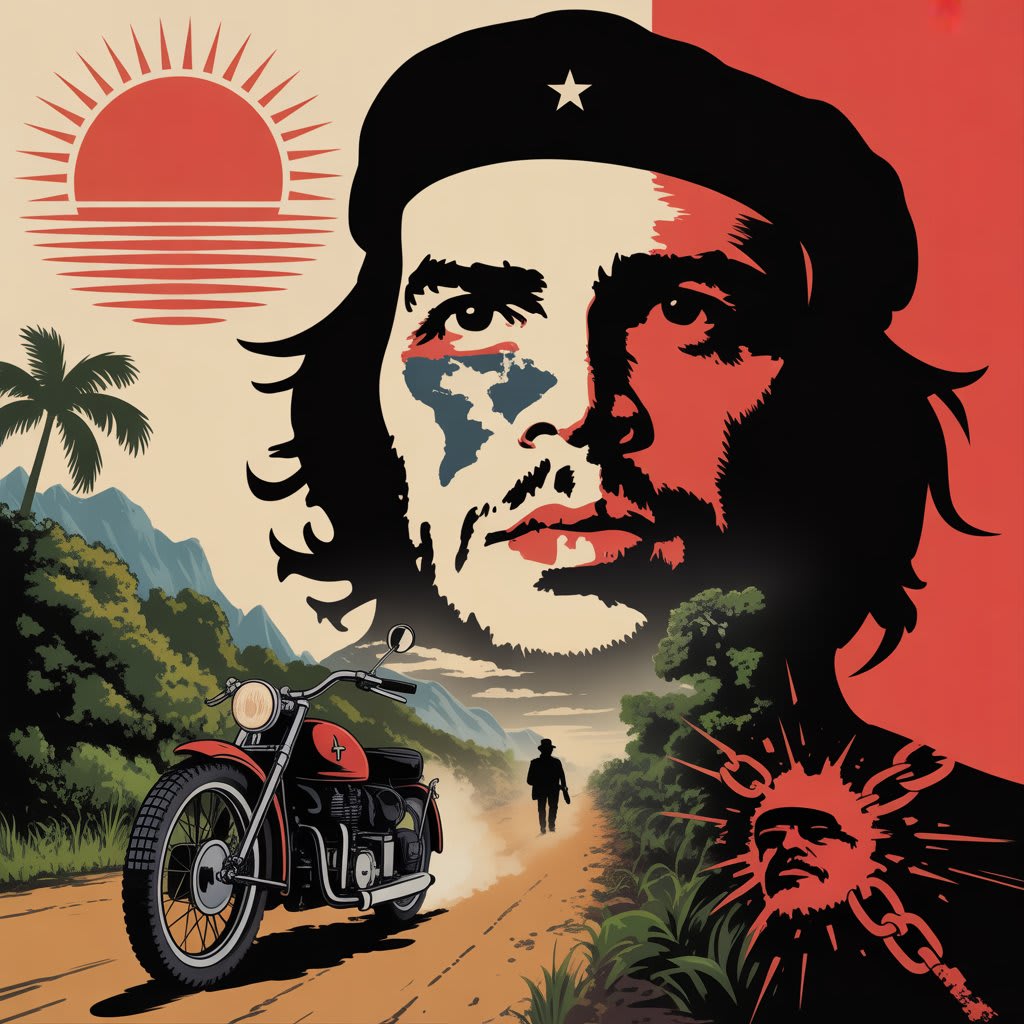
On a warm June morning in 1928, in the city of Rosario, Argentina, a boy named Ernesto Guevara de la Serna was born. No one could have guessed that this boy — later known simply as “Che” — would grow into one of the most recognizable figures of the 20th century. His life would become a tapestry woven from threads of idealism, armed struggle, and an unyielding quest to challenge the world’s injustices.
Che’s early years were marked by severe asthma attacks. His parents, free-thinking and politically aware, refused to let the illness define his future. They surrounded him with books, debates, and a sense that the world could — and should — be changed. The young Ernesto grew into a thoughtful, stubborn, and adventurous spirit. He enrolled in medical school at the University of Buenos Aires, determined to become a doctor. But something else began to stir in him — a restlessness that no classroom could quiet.
The Motorcycle That Changed Everything
In 1952, Che and his friend Alberto Granado embarked on a motorcycle journey across South America. They called their bike “La Poderosa” — The Mighty One. It sputtered and broke down often, but the journey was about more than miles traveled. In dusty towns, mining camps, and leper colonies, Che saw a continent divided between wealth and crushing poverty. The faces of the poor, the exploited, and the voiceless began to haunt him. Medicine could heal bodies, he realized, but to heal societies required something far greater.
When Che returned from his journey, he was no longer simply a medical student. He was a man searching for a way to challenge the deep inequalities he had witnessed.
From Guatemala to Cuba
In 1953, Guevara traveled through Latin America again, this time reaching Guatemala. The country was in the midst of a bold social reform program under President Jacobo Árbenz, who sought to redistribute land from large corporations like the United Fruit Company to the poor farmers. But the reforms were crushed in a CIA-backed coup. Che narrowly escaped with his life, but he carried with him an even deeper hatred of imperialism.
By 1955, fate introduced him to a young Cuban revolutionary named Fidel Castro in Mexico. The two men, along with Fidel’s brother Raúl, were plotting to overthrow Cuban dictator Fulgencio Batista. Guevara joined their cause, not as a doctor but as a fighter. He quickly earned respect for his discipline, courage, and belief in the cause.
Victory in Cuba
In December 1956, Che landed with 81 fighters on the shores of Cuba aboard the yacht Granma. The landing was a disaster — most of the men were killed or captured — but Che and a handful of survivors retreated into the Sierra Maestra mountains. Over the next two years, they waged a guerrilla war that grew from small skirmishes into a nationwide uprising.
Che wasn’t just a fighter; he became a leader. He trained recruits, planned attacks, and wrote extensively about guerrilla warfare. His belief was unwavering: revolutions had to be built by the people, for the people. By January 1959, Batista fled Cuba, and the revolutionaries marched into Havana victorious.
The Revolutionary in Power
In the new Cuba, Che took on multiple roles — head of the National Bank, Minister of Industry, and key architect of land reform and education programs. He pushed for Cuba to become economically independent from the United States, advocating industrialization and self-reliance. His speeches were fiery, his policies uncompromising.
But Guevara was never content with victory in one country. He believed that true liberation required a global revolution against imperialism and capitalism. To him, Cuba was only the first step.
Beyond Cuba — The Final Battles
By 1965, Che vanished from public view. He had left Cuba to ignite revolutions abroad. First, he went to the Congo, attempting to support rebels fighting against a pro-Western government. The mission failed due to lack of unity among the rebels. Undeterred, he turned his eyes to Bolivia, where he hoped to spark an uprising that would sweep across Latin America.
But Bolivia was different from Cuba. The local population did not rally to his side, the terrain was unforgiving, and the Bolivian army — with the help of the CIA — hunted him relentlessly. On October 8, 1967, Guevara was captured in the village of La Higuera. The next day, he was executed. His last reported words to his executioner were calm and defiant:
"Shoot, coward, you are only going to kill a man."
The Making of a Legend
After his death, Che’s image spread across the world — not as a corpse in the Bolivian jungle, but as the striking, beret-wearing revolutionary captured in Alberto Korda’s famous photograph. His face became a symbol of resistance for students, rebels, and dreamers from Paris to Palestine. Yet the meaning of that symbol remains fiercely debated. To some, Che is a hero who stood against oppression at all costs. To others, he was a dangerous ideologue whose methods were violent and authoritarian.
What cannot be denied is that Che Guevara lived — and died — with unwavering commitment to his ideals. He was a man who could have lived a comfortable life as a doctor in Argentina, but instead chose a path of hardship, danger, and sacrifice in pursuit of a vision he believed in.
Legacy of the Unfinished Revolution
Today, more than half a century after his death, Che Guevara’s name still sparks arguments, inspiration, and controversy. His story is a reminder that revolutions are not neat, nor are they ever truly finished. The questions he raised — about inequality, power, and justice — are as relevant now as they were in the 1950s.
Whether one agrees with his methods or not, Che’s life invites reflection: How far would we go for our beliefs? What are we willing to sacrifice for the sake of others? And when we look at his face on a poster or a T-shirt, do we see a man, a myth, or a mirror of our own longing for change?
In the end, Ernesto “Che” Guevara remains both a man and a mystery — a revolutionary whose battle did not end with him, but continues in the hearts of those still dreaming of a better world.
About the Creator
Keep reading
More stories from Ismail khan and writers in History and other communities.
The Light of Patience: The Noble Character of Prophet Muhammad (PBUH)
In the vast deserts of Arabia, under the blazing sun and endless sky, there once walked a man whose light would pierce the darkness of ignorance — a man whose heart carried the weight of mercy, justice, and compassion for all creation. That man was Muhammad (Peace Be Upon Him) — the final messenger, the beloved of God, and a living example of perfect character.
By Ismail khan 6 months ago in History
Basant
The sky would turn into a canvas of colors. Children and adults alike would rush to rooftops, their hands gripping the strings of vibrant kites that danced and twirled in the wind. The air smelled of fresh flour and sugar, of popcorn and excitement, and for a moment, the world seemed to forget everything but the thrill of flight. This was Basant a celebration that was more than just kites in the sky. It was a ritual, a prayer, a community gathering, and a festival of life itself.
By Muhammad Ayaan 4 days ago in History
The Cave Part 6
If you have ever heard a tale about yourself that you cannot remember and doubtless think is made up, you will know how I felt when Tharkin related all that the eagle had seen of me before my memories were scattered. Of far distances and traveling companions that I did not recall, camping out under the stars and making our way to the mountains with deliberate purpose. The great bird had lost contact with my party once we entered the forests, and the seven other members were not seen again by him or his brethren since.
By Jamye Sharp3 days ago in Chapters


Comments
There are no comments for this story
Be the first to respond and start the conversation.