
The Tragedy of Joan of Arc
From Hero to Heretic

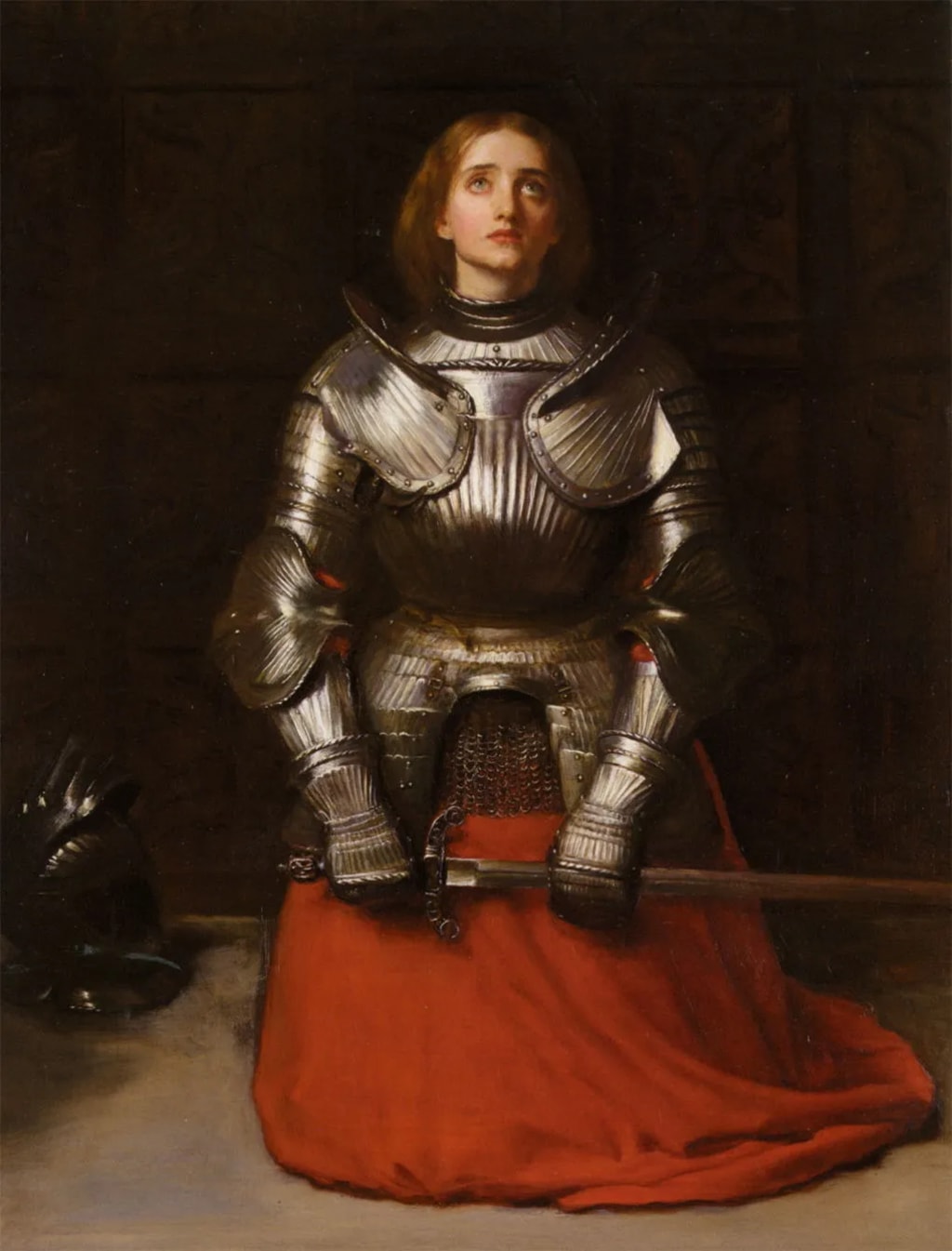
In December last year, I wrote an article about Olga of Kiev, and I wanted to do something similar. That said, I wasn't sure where to start until I thought of Joan of Arc.
Joan's story is rough, and I think it's worth discussing, so let's get into it.
Joan's Early Life
Joan was born in 1412, in the village of Domremy in France - right smack in the middle of the Hundred Years War. Her childhood was fairly normal for the time period. She helped out around her father's farm (tending fields and animals), she also did household chores and spun wool.
By 1419, the war between England and France had hit a fever pitch and reached Joan's little village. A French raid in 1425, led to the theft of many of the cattle in the area. The French were, quite understandably, rather upset by the theft of their cattle and decided that the English had to be chased out of France.
The Lady of France
Joan met Charles VII in 1429 in Chinon, at the age of seventeen, and told him she was there to lift the siege at Orleans. Now, this was more than a little unusual, so Charles had her sent off for a barrage of tests, which included verification of Joan's virgin status. I'm not sure about the whole 'virginity test' thing. If I had to venture a guess, I'd say the assumption was that if she hadn't been a virgin, then it wasn't God talking to her, it was the Devil, which would end badly for our leading lady.
Charles, reassured by the test results he was given, had a suit of plate armour made and gave her a sword. She designed her own banner and called herself 'Joan the Maiden.'
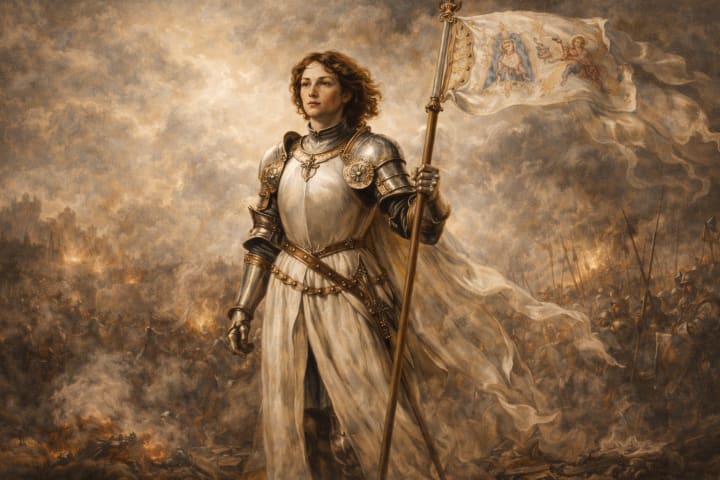
Now, at the time, the French forces were already in trouble, but things weren't hopeless. With that said, the French army was definitely demoralized. Joan's arrival changed things; her belief in divine guidance and personality helped raise their spirits. She inspired devotion and the hope of divine assistance.
Towards the end of April 1429, Joan left Blois for Orleans as part of a relief force carrying supplies. She arrived in Orleans on April 29, 1429, and was greeted warmly by the locals. Joan was a figurehead of sorts, raising morale for the troops, and while she was never given a formal command, she was often seen flying her banner and fighting on the front lines, which gave the impression that she was genuinely fighting for their freedom.
The Siege of Orleans
On May 4, the French launched an assault on the fortress of Saint Loup. Joan headed that way as soon as she heard about the attack. Upon arrival, she found the French troops in retreat; they'd tried and failed to assault the fortress. Joan's appearance rallied the troops, and they launched a second attack, successfully taking the fortress.
May 5 was Ascension Thursday (a celebration of the ascension of Jesus Christ), so there was no combat. Although Joan still sent a letter to the English, tied to a crossbow bolt, warning them to leave France.
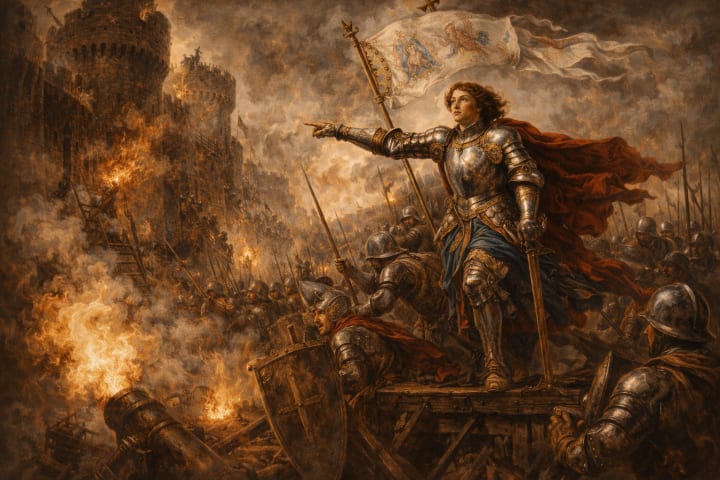
The battle resumed on May 6, and the French captured the small town of St. Jean le Blanc. From there, Joan encouraged the commanders to continue. They did, the commanders assaulted and captured the English fortress of les Augustins.
On May 7, Joan led the French to the main English stronghold at les Tourelles. The English were able to wound her in the neck and shoulder with an arrow. With that said, she was able to return to the battlefield to boost morale, and they won the battle.
The English retreated on May 8, ending the siege of Orleans.
Joan's Last Ride
After their success at Orleans, the French headed towards the city of Reims. Of course, they still had to clear the bridge towns along the Loire River. The campaign started on June 11, and the French army worked their way up the river, clearing the towns. The French took few prisoners; the English soldiers who did surrender were killed.
Upon arrival at Reims, Charles VII was crowned King of France, and then the French army headed for Paris. Most of the towns in the area just gave up. Upon their arrival in the city, there was a long siege, which ultimately ended in defeat. This defeat really damaged Joan's influence in the French court.
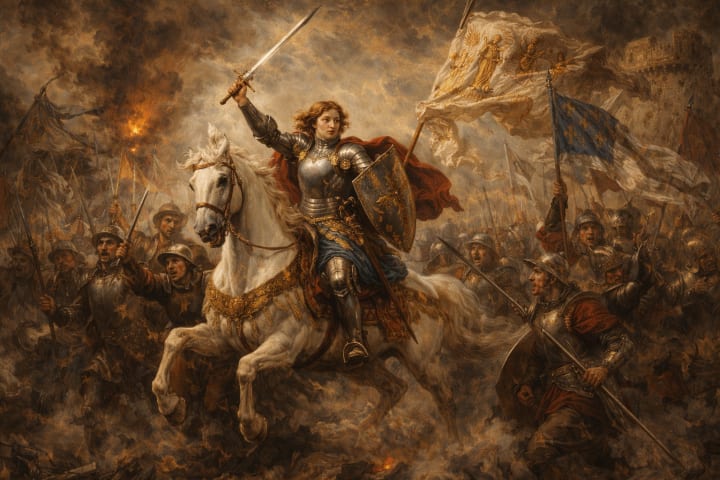
Joan led a charge that resulted in the capture of St. Pierre le Moutier, which did sort of help things, but the following siege, which took place at La Charite. The siege at La Charite ended in defeat for the French, which further damaged Joan's reputation.
In 1430, Joan rode to Compiegne in March to relieve a siege; battles persisted until May of that year. In the end, Joan was captured by soldiers under the banner of the Duke of Burgundy. The English subsequently negotiated a transfer of custody, paying a ransom and having her sent to their main base of operations in Rouen.
Tried for Heresy
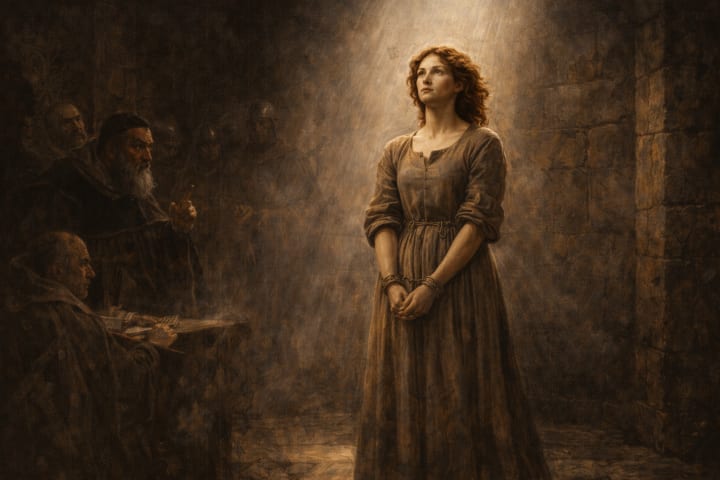
While in Rouen, Joan went on trial, starting on January 9, 1431. The charges were...strange by comparison to modern legal systems. These included:
- Heresy
- Blasphemy
Heresy is defined as the denial or doubt of a doctrine of the Christian faith. Consequences for heresy were harsh, including excommunication and execution. Blasphemy is defined as insulting or disrespecting a deity - in this case, that would be God.
The accusations of blasphemy were for wearing men's clothes and acting on visions that were demonic in origin. She was also accused of refusing to submit her words and deeds to the church. Her response to that accusation was that she would only be judged by God.
Joan's testimony was that her visions instructed her to fight the English. She used her success as evidence of God's intervention. Of course, the English decided to use an ecclesiastical court - meaning she was tried by the Catholic church - to get around that particular argument. So, to say that the trial was politically motivated would be an understatement.
Joan's Last Days
Sadly, I think it's safe to say that Joan was doomed from the moment she got to Rouen. That might sound cynical, but you have to keep in mind that this was the woman who basically made a joke of the English military (and, by extension, the king). The fact that she was a woman was just rubbing salt in the wound. Her control and intelligence in the trial were impressive.
She avoided trap questions with thoughtful answers. One such trap was when she was asked if she knew she was in God's grace. If she'd said yes, she'd have been charged with heresy. Apparently, there was a doctrine that said one couldn't KNOW they were in God's grace. Saying yes would've seen her convicted of heresy. Saying no would've proven guilt from the other side. She avoided this by saying that she hoped she was in God's grace and that, if she wasn't, she hoped he would put her there.
She was shown the torture instruments to try to force her to submit. It didn't work, and it was ultimately decided she wouldn't be tortured. There was a lot of back and forth, but ultimately she was declared a relapsed heretic and condemned to death.
On the morning of May 30, 1431, Joan of Arc was granted the final sacraments (last rites) despite the regular rules saying that heretics weren't allowed to get them. Instead of being handed over to the English authorities, however, the authorities in Rouen had her taken to the old marketplace where she was burned at the stake.
The War Ends
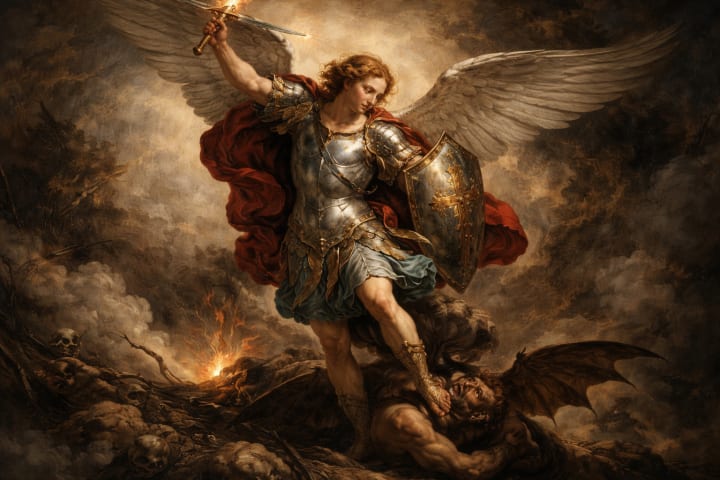
A big part of the Joan of Arc story is that she claimed to be acting under divine guidance. So, Joan claimed to have been visited by St. Michael and Saints Margaret and Catherine. Now, while it's not specified exactly, it's likely these were Margaret of Antioch and Catherine of Alexandria - women who were martyred for their beliefs.
These 'visions' would persist throughout Joan's life. Additionally, there was a prophecy circulating that an armed virgin would free France. Another prophecy said that a virgin carrying a banner would end France's suffering. That second prophecy is attributed to Merlin, by the way.
Joan's belief in these visions kept her going throughout her ups and downs, especially towards the end of her life. It's also worth noting that while Charles VII didn't try to rescue her (that's gratitude for you, I guess), the morale among the French had been significantly improved. So much so that the English weren't able to regain their lost momentum after her death. That lost momentum culminated in defeat at the battle of Castillon in 1453 - some 22 years after Joan's execution. The English were forced out of France (though some stayed in Calais).
A Second Inquest
Right, so the French won the Hundred Years' War in 1453, the English were driven away, and that's the end of the story, right? Well...no, not really, there's a chapter of this story that happened just before the end of the war.
Joan had been executed as a relapsed heretic, which caused some political trouble because it implied that a heretic had helped crown the king of France. This, understandably, would've caused a serious problem for Charles VII, and he decided to do something about it.
On February 15, 1450, shortly after regaining control of Rouen, Charles grabbed a theologian named Guillaume Bouille and commanded him to open an investigation - which he did. Bouille's investigation was short, and he concluded that Joan's conviction as a heretic had been unjustified. His report stated she had been a prisoner of war, treated as a political prisoner, and that her execution was, therefore, also unjust. This couldn't undo what had already been done, but it opened the door for a new inquest and a retrial.

The full second inquest, led by Cardinal Guillaume d'Estouteville, was launched in 1452. Assisted by Jean Brehal, the new inquisitor of France, the Cardinal went through 27 articles discussing the trial and the blatant biases that had been on display. The two men spent the next two years working on this case. Joan's family requested a retrial in 1454, the petition for which was forwarded to Pope Nicholas V. In the meantime, Brehal contacted as many theologians and lawyers as he could, and many were heavily in favor of a retrial.
Joan's retrial was granted by Pope Callixtus III in 1455, shortly after Nicholas V passed away. Jean Brehal was selected as inquisitor. The commissioners meant to oversee things were Jean Juvenal des Ursins (Archbishop of Reims), Guillaume Chartier (bishop of Paris), and Richard Olivier de Longueil (bishop of Coutances).
The trial itself started in 1456 and ended in 1457. After hearing from 115 witnesses, they determined that the original trial was unjust and deceitful. The original trial's final verdict was nullified, and a list of the accusations was burned.
Final Thoughts
The story of Joan of Arc has been around for 500+ years, and it's left quite an impact. There have been many theories as far as what Joan's visions were, including psychological, neurological, and other mental health issues, but personally, I like the idea of her seeing real angels or something - it's just more interesting.
Ultimately, we'll never know what the actual cause was, but the story is still tragic to me.
About the Creator
Greg Seebregts
I'm a South African writer, blogger and English tutor; I've published 1 novel and am working on publishing a 2nd. I also write reviews on whatever interests me. I have a YouTube Channel as well where I review books, and manga and so on.
Keep reading
More stories from Greg Seebregts and writers in History and other communities.
Spectral Sails: RMS Lusitania
Welcome to the first edition of Spectral Sails for 2026. This time around, we're looking at a shipwreck that happened all the way back in 1915. The ship in question, the RMS Lusitania, was an ocean liner that met her end at the hands of a German U-Boat, but I'm getting ahead of myself.
By Greg Seebregts11 days ago in History
6 Bizarre Taxes From History That Will Make You Thank Modern Life
Throughout history, taxes haven’t always been about income or property. Some levies were downright bizarre, targeting everyday life, personal habits, and even your body. From medieval England to ancient Rome, here are six of the strangest taxes ever recorded.
By Areeba Umair5 days ago in History




Comments
There are no comments for this story
Be the first to respond and start the conversation.