
The Untold Story of Tata Group , Who built the Empire ?
Story of Tata Group

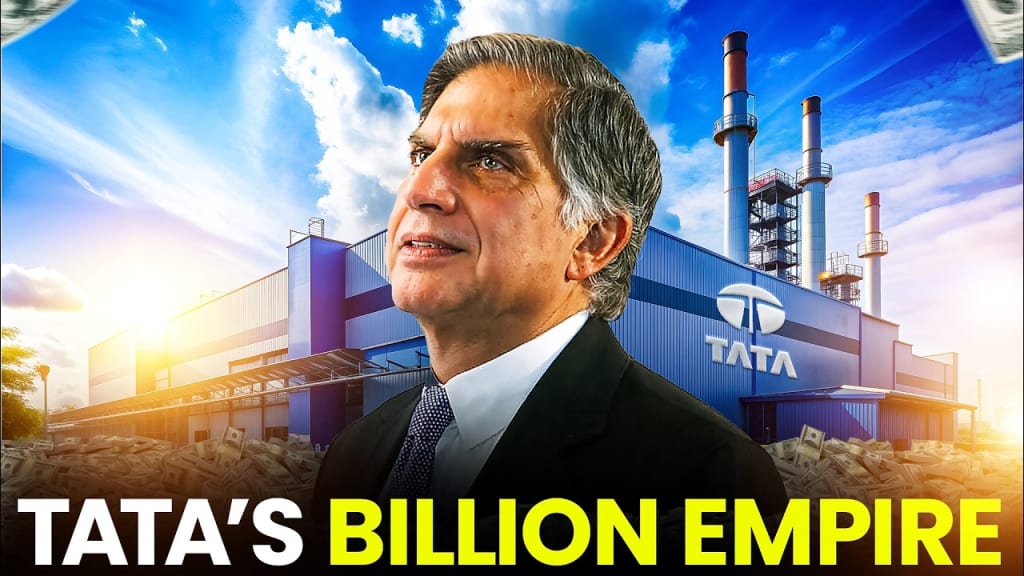
If you live in India, at some point in your day you probably come across a product from the Tata Group of Companies. Look at the cars running on the roads — you’ll see Tata Motors. Look up at planes flying in the sky — you’ll think of Air India. And the iconic Taj Hotel, famous all over the world, is also owned by the Tata Group. From power to fashion, from tea to salt — the Tata Group has a presence everywhere.
Across India, more than 100 small and large companies operate under the Tata Group. You might think this success is solely due to Ratan Tata’s courage and vision. While his contribution is significant, the roots of this empire’s success go back 150 years. Today, we’ll uncover this story and learn how a visionary turned his dreams into reality and built Tata Group into a global powerhouse.
Tata products are exported to more than 150 countries, and the group manages operations in over 100 countries. According to 2024 estimates, Tata Group’s capital stands at $403 billion — about 33.5 trillion Indian rupees. In Pakistani rupees, the number is so large that Pakistan’s entire national debt could be paid off twice.
From cars to jewelry, salt to tea, airlines to real estate services — Tata Group has established itself in more than 24 industries.
This journey of success began not with Ratan Tata’s grandfather, but with his great-grandfather, Jamsetji Tata, 156 years ago, with just ₹21. Jamsetji worked with his father in cotton trading. In 1868, at the age of 29, he founded his own trading company. The cotton he sold was mostly exported and later turned into cloth by textile mills. This gave him the idea to start his own textile mill.
Instead of building his mill in Bombay, the cotton hub of India, he chose Nagpur, 770 km away. People criticized him, but his decision proved wise. Nagpur was closer to raw cotton sources, had abundant water supply, and offered cheaper labor.
Jamsetji noticed workers often skipped work. Instead of punishing them, he introduced revolutionary worker welfare schemes — pensions after retirement, medical insurance, sports days, and rewards for good performance. This was unheard of 150 years ago. Workers felt valued and became more dedicated.
He believed India should manufacture everything domestically. One of his dreams was luxury silk production. He brought French silkworm breeds to India and established a silk farm in Bangalore. Despite climate challenges, he introduced controlled environment farming — a pioneering concept at the time. Today, India is one of the largest silk producers in the world.
Jamsetji had four major dreams: iron and steel manufacturing, a world-class hotel, an educational institute, and hydroelectric power. The only dream he saw completed in his lifetime was the Taj Mahal Hotel in 1903 — India’s first hotel with electricity, elevators, and modern facilities.
He also dreamed of producing steel in India instead of importing it from Britain. Though he passed away in 1904, his son Dorabji Tata fulfilled this dream by establishing Tata Steel in 1907 — Asia’s first steel plant.
Under Dorabji, Tata Power was established in 1910 — India’s first hydroelectric company. They also founded the Indian Institute of Science in Bangalore to promote scientific research.
After Dorabji’s death in 1932, J.R.D. Tata took charge. Passionate about aviation, he founded Tata Airlines and became India’s first commercial pilot. After independence in 1947, the government nationalized it and renamed it Air India.
J.R.D. later established Tata Chemicals in 1939 to reduce dependence on imported chemicals. He also expanded into transportation by founding Tata Motors and later into IT by establishing Tata Consultancy Services (TCS) — India’s first major software company. In 1984, Tata Tea was launched.
As J.R.D. aged, he invited Ratan Tata back from the USA and eventually appointed him chairman in 1991. Ratan Tata modernized the group. Under him, Tata Motors launched India’s first fully indigenous car, the Indica, in 1998. TCS became a global IT leader.
Tata Group began acquiring global brands — Tetley Tea, Corus Group, and Jaguar Land Rover — expanding its global footprint.
Today, Tata Group continues to grow rapidly, serving not only India but the entire world. This success is not the result of one person’s efforts, but of 150 years of hard work by generations of visionaries.
About the Creator
Imran Ali Shah
🌍 Vical Midea | Imran
🎥 Turning ideas into viral content
✨ Watch • Share • Enjoy
Keep reading
More stories from Imran Ali Shah and writers in History and other communities.
How Domino's Went from $14 to Billions! Part 1
In 1960, when Domino’s Pizza first opened, the entire day’s sales were only $14. But no one knew that a newspaper-selling boy — who grew up without a father’s support and without a mother’s love — would one day become the owner of more than 18,000 pizza outlets.
By Imran Ali Shah2 days ago in History
The Strongest Known Talisman in the World
The Strongest Known Talisman in the World The strongest known talisman in the world was said to have been forged in the fires of devotion and power, carried by kings and warriors across centuries. It was not made of gold alone, nor gemstones merely for beauty, but of silver, gold, and the bones of saints, inscribed with prayers and sigils older than memory. This talisman was called the Talisman of Charlemagne, a relic of protection, courage, and destiny.
By Marie381Uk about 12 hours ago in History


Comments
There are no comments for this story
Be the first to respond and start the conversation.